
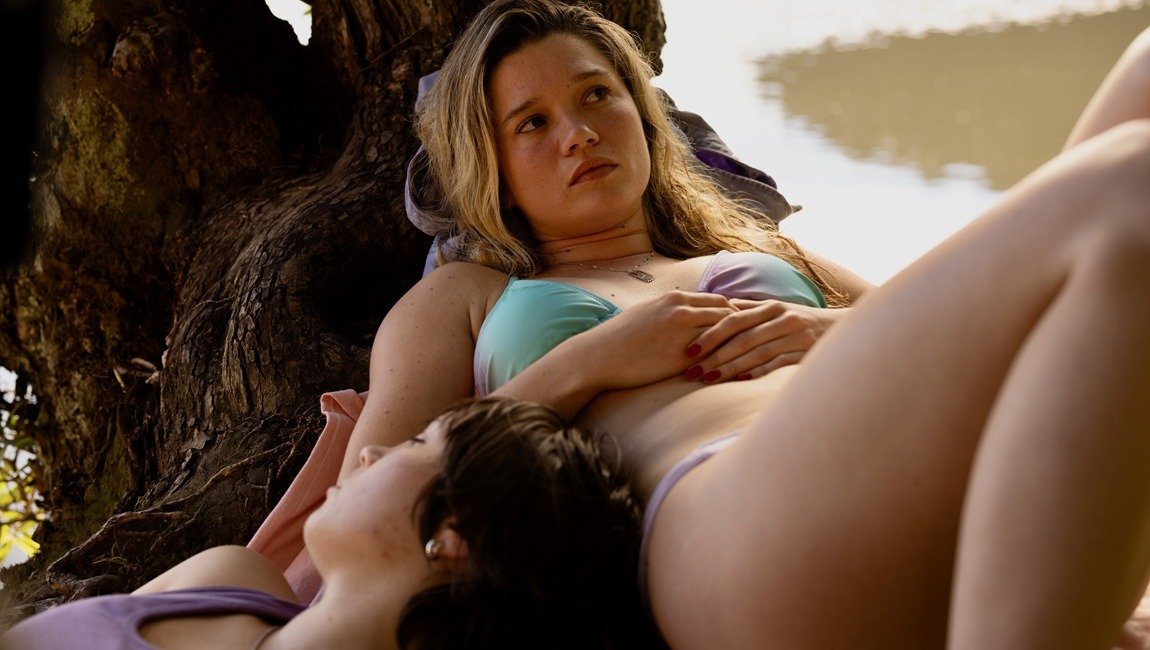
God, girlhood is tough. Of course, there’s no one-size-fits-all experience of being a young girl; we all likely know this, but the diversity of youth doesn’t stop girlhood from being defined by external, one-size-fits-all expectations. Nowadays, the contradictions of patriarchal standards might be understood enough to be laid out in Barbie, but so rarely do we navigate how that confusion operates in practice, particularly at an impressionable age where kids are exploring their autonomy.
It’s in this stage of life that Paloma Schneideman’s debut film Big Girls Don’t Cry introduces us to Sid Bookman (Ani Palmer), a 14-year-old girl growing up with a single, working-class dad (an affecting Noah Taylor) in rural New Zealand. The year is 2006, the internet is fairly nascent (and in this rural community, still dependent on dial-up), and six weeks of December summer is too much time to fill. It’s especially too much time to be alone with feelings — urges — that are too daunting to confront. The moments Sid allows herself to explore her burgeoning sexuality are private and shrouded in shame. Religion doesn’t factor into her life, but whether she’s on a chat site fibbing about her age with her webcam taped over as a man masturbates, or cocooned in her comforter, fantasizing about the bikini-clad model on a music poster in her room, she is wary of being caught by an omnipotent eye. In fact, Sid spends the run of the film lying — falsehoods that do real harm to herself and others — anticipating who everyone else wants her to be before she even has a chance to figure out who she is.
As we follow Sid, it is evident that nearly all the young women around her have fabricated their identities. Lana (Beatrix Rain Wolfe), the cool girl who reluctantly befriends Sid in hopes of scoring booze, fits the description of a high school mean girl to a tee. She pierced her belly button and eyebrows (the coolest piercings you could have in the mid-aughts), wears heavy make-up, and dresses to show off her body. She knows how to attract boys and never seems uncomfortable being an object of desire. On the other end of the “cool girl” spectrum is Freya (Rain Spencer), a college-aged American girl, who is friends with Sid’s older sister, who comes to stay with their family over the break. Freya is kind, breezy, and open. She just as quickly attracts attention, but it is practically unbeknownst to her as she effortlessly moves to her own beat. Lana and Freya both represent a kind of success that Sid aspires to. Lana wants boys and boys want her, and even as Sid tries to earn the older boys’ interest, she doesn’t really want them. Freya is soft, physical, and willing to hold Sid’s hand through her first experiences with makeup, weed, and heavy drinking. But Freya also eventually crosses a boundary. Her judgment may not be as sure as Sid has been led to think, and there are things Freya is running away from that Sid only catches glimpses of. It’s confusing enough for Sid to see visions of who she could and should be before she even knows herself, but there is the added question of whether she wants to be like Lana and Freya, or whether she wants to be with them. Of course, any inkling of attraction is just another article of shame to pave over with dishonesty.
Plot-wise, there are echoes of recent coming-of-age slices of girlhood like Ladybird and Eighth Grade, but it’s in the details that Big Girls Don’t Cry managers to stand on its own — little things like dust on the floors and tresses knotted around an abandoned hair tie, and even funny things, like how all of the MSN handles include either “69” or “420.” Tonally, a sense of danger cuts through the idle warmth of this singular summer, carried by performances from Palmer, Spencer, Wolfe, and Ngātai Hita as Sid’s friend and neighbor Tia. No matter the face they put forward, there’s sadness, confusion, and hurt inside these girls, and the pressure placed on Sid leads her somewhere unsafe. As she is put in more and more uncomfortable situations — parties she shouldn’t be at, men she shouldn’t be talking to, friendships that don’t have her best interest in mind — she will twist and conform to pretend these are things she wants. It’s easier to believe something is inherently wrong with her than to accept she’s being taken advantage of.
Schneideman’s film settles into the fine line space between lies told out of self-preservation and those of self-defense. In this way, Big Girls Don’t Cry is an evergreen depiction of the vulnerability of girlhood and queer youth; and also, unfortunately, very much a movie of the present, where discourse around women’s autonomy is backsliding from the few gains made nine years ago with #MeToo. The film is not a balm for these times. It ends in a state of ambiguity that feels too bleak for a film that otherwise moves in the space between the affirming and the devastating. If there is anything to glean from the complexity of the characters, it’s that Sid is not alone in her feelings of wrongness. Schneideman keeps her isolated and misunderstood, with no path to the other side of this unease.
DIRECTOR: Paloma Schneideman; CAST: Ani Palmer, Rain Spencer, Noah Taylor, Tara Canton, Beatrix Wolfe; DISTRIBUTOR: Blue Fox Entertainment; IN THEATERS: October 9; RUNTIME: 1 hr. 40 min.
Comments are closed.