
The “small cast in one location” drama has been an advantageous route to follow for budget-confined filmmakers for as long as there have been independent films. From Almanac of Fall to Eephus — to cite but two standout examples — it’s a pseudo-genre of sorts based on economy, one that in eschewing scale and the kind of forced fun that throwing money at the situation can entail, filmmakers are reliant upon the free crafts: writing, performance, formal experimentation, all touched by the value of a good idea taking precedence above all else. It’s within this camp that Littermates, the debut feature collaboration of Michael Wilson and Scott Tinkham, lands. A largely single-location three-hander that foregrounds atmosphere and performance in reaching for something pleasingly off-center and implacable, it’s a film that delivers far more than it promises.
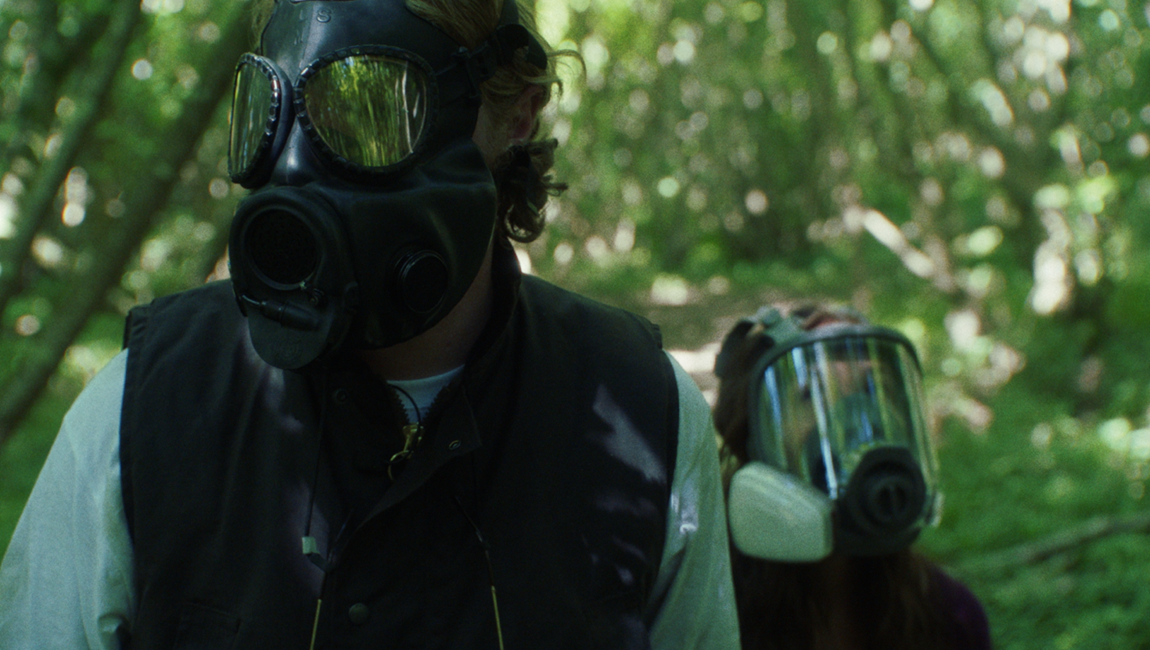
After a a flicker of an awkward yet idyllic(-seeming) family photo, we are thrown into the woods with a panic-stricken man (Joey Bader) pelting and tumbling away from gunfire — but whose it is and why it’s pursuing him, we are unsure. After stumbling into a clearing, he meets and is calmed by Chester (Oliver Woolf), who takes him to his grand, modern country house. It becomes apparent that the rescued man, dubbed Liam, cannot speak, and so Chester teaches him to re-find his voice, their relationship becoming tender, if oddly parental, with forehead kisses and a Supernanny-style reward system in place. But just as they are settling into their isolated existence, insulated from the sounds of war heard beyond the house and the unknown strikes that prompt alarms and sends the men scurrying into their shelter, a woman (Kaylee McGregor) staggers into the house, panicked and afflicted with the same silence that gripped Liam. As the teaching process repeats itself, Liam and Mel (as Chester has named her) settle into teenager-like roles, with tensions beginning to arise: he becomes more cautious, while she proves inquisitive and eager to discover what is happening beyond the comfort of their idyll.
Littermates‘ narrative inspirations aren’t hard to spot. Dogtooth is a clear cousin, if a crueler and more nihilist one, and in its flirtation with genre and paranoia, the film also calls to mind something like 10 Cloverfield Lane, an association it makes little effort to dispel in its trailer. What’s pleasing, then, is how much Wilson and TInkham’s film allows itself to slip into a strange rhythm all its own. It’s refreshingly reticent with its information, to the extent that for much of the film the central mystery of what is going on beyond the house becomes a background hum, and what you’re left with is a kind of day-to-day placidity that is nonetheless perceptibly colored by its own uncanny oddness. Part of this can be attributed to the Littermates‘ cinematography: lush and photographic, some of it even feeling straight out of the pages of Country Life, it gives the increasingly murky goings on in the house both a languorous drift and perverse idiosyncracy. The effect is the development of a wonky atmosphere, one twisted further by the fact that the film feels more like a comedy for much of its runtime — and a funny one at that — one buoyed by strong central performances, with Bader’s face in particular reaching near heroic levels of gormlessness.
This all functions to establish the film’s offbeat atmosphere superbly well, but where many a high-concept low-budgeter can fall down is in how it moves beyond its initial scene-setting and settles into a second act, with more than not failing to satisfactorily transition a core conceit into a fully rounded piece of work. What most thrilling about Littermates, then, is how admirably it sidesteps this typical pitfall. Having set its rhythms up at such an amble, it impressive — especially for a film of such relative brevity — that Wilson and TInkham manage a real feat in not allowing their film to suddenly feel hurried as events begin to take shape, instead giving clear room for its central ideas to breathe. On the one hand, those ideas include a study of family dynamics, and on the other the filmmakers allow their narrative to unfurl more macrocosmically as if a parable or a creation myth. But rather than fostering any self-seriousness with this shift, everything remains cloaked in an off-handed silliness, refusing the invitation to slip into portentousness despite the darkness of the film’s central questions: When the world changes unrecognizably, how are we going to meet it? Will we greet the new world as oafish children or with determination and curiosity?
It’s disappointing, then, that the conclusion proves to be a relative disappointment, with its final 15 minutes stumbling into a landing it fails to stick. The tonal line between comedy and unease that had been so successfully toed to this point tips rather too heavily in the former’s favor, descending into a farce that is committed but not entirely equipped to fully bring the viewer along. But by this point, Littermates has already established itself as an admirably wonky piece of work, one that subverts expectations and makes for something at once atmospherically sallow and genuinely funny. One need not be perfect to be memorable.
DIRECTOR: Michael Wilson & Scott Tinkham; CAST: Joey Bader, Kaylee McGregor, Oliver Woolf, Jack Redmayne, Kenichiro Thomson; DISTRIBUTOR: Alamo Exclusives; IN THEATERS: November 6; RUNTIME: 1 hr. 28 min.
Comments are closed.