
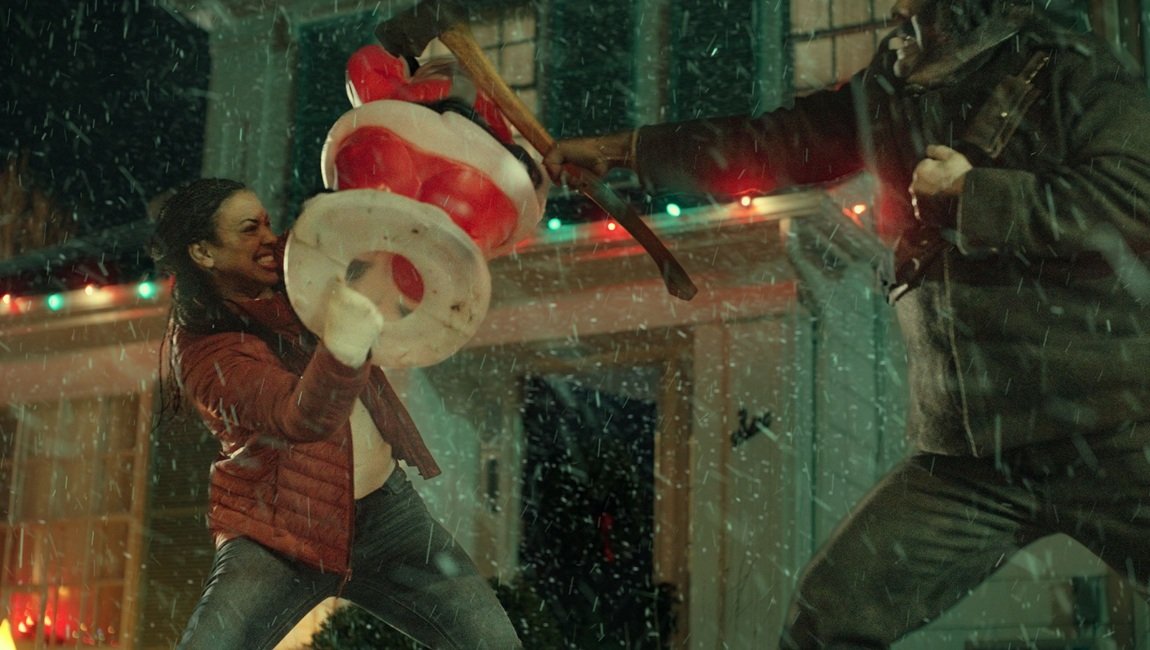
For introverts and the unaccomplished, the greatest threat looming over every family gathering isn’t the unlikely prospect of mass violence, but an all too conscious reckoning of one’s character and credentials as the treacle of seasonal goodwill conveniently comes to bear on one’s sense of self-worth. As Michael Gabriele’s riotous holiday horror would have you believe, this phenomenon is not unique to Asian households, where shame and propriety commingle under a greater generational hierarchy, but rampant across traditions. Commencing in media res amid the fanfare of an Italian Christmas sited in the wintry suburbs of Canada, Unholy Night splatters its festive proceedings with an introductory rampage that’s as brutal as it is brief, with Lucia, a young girl, as its sole survivor. Decades later and now a mother of three, Lucia (Toni Ellwand) once again gathers her adult kin around for their annual reunion; this time, an uninvited guest shuffles into her home, skulking around in the basement, before emerging to unleash bloody mayhem on the household.
That uninvited guest is grandma, or Nonna (Jacqueline Robbins), as Lucia’s children affectionately know her. The chief issue with this unexpected reunion is that Nonna has been dead and buried for years; her skin has turned a ghastly white, and her eyes are susceptible to glowing like red-hot embers when provoked. While the rest of her offspring fend themselves against her and hole up amidst rumors of a wider outbreak of the living dead, single and underachieving Gino (Marc Bendavid) heads out for some answers, and also to check in on his ex-girlfriend, Renee (Shailene Garnett), whose sudden appearance on his doorstep earlier raises more questions than it provides any semblance of closure. Cutting to and from the house and Gino as the latter tussles with more of the underworld’s ritornati (as they’re ominously termed), Unholy Night takes no small delight in unfurling its bloody homages to the likes of Evil Dead and Black Christmas while valiantly fighting to flesh out its thematic subtext. Yet the coherence it achieves with the bloody consistency of its kills is sorely lacking in both the method and madness of its virulent familial setup.
A largely diffident man, Gino — who lives with his parents and receives little credit for his profession as a paint specialist — pales in comparison with his forceful siblings, who naturally provide the foil for him to outsmart and outlast the group’s flaying showdown against their undead nemeses. But while Gabriele courts no little familiarity and nostalgia from viewers who no doubt would appreciate the finer tones of the quintessential dinner squabbles and dynamic jests particular to the immigrant Italian diaspora, his characters don’t quite possess the requisite depth to sustain and justify their prolonged presence throughout the film. (In most of the Evil Dead entries, psychological insight is rightfully jettisoned alongside physical integrity.) Throughout the prolonged nocturnal battering of bodies and emotions, little is really articulated by way of Nonna’s return, alongside that of her long-deceased amici, except that the zombified corpses here serve some kind of loose metaphor for ancestral vengeance best interpreted as arising from a broad disrespect for tradition and authority. Notably, the ritornati aren’t all brain-dead but mostly capable of rational thought, excluding the fits of rage that turn them into maniacal shredders of flesh. On that count, Unholy Night’s choice of the Christmas dramedy vehicle to augur the return of the repressed registers as a lamentable waste of its monstrous arsenal and a wholly undercooked swipe at sacrilege.
Published as part of Fantasia Fest 2026 — Dispatch 3.
Comments are closed.