
Sometimes, the riskiest thing to do can be to play it safe. With her 2016 breakthrough and solo directorial debut, Wolf and Sheep, Shahrbanoo Sadat announced herself as one of cinema’s most intriguing young talents, and arguably the only female Afghan director working in arthouse film. If that film, with its slow pace and full frontal nudity, represented a risk for Sadat, then her new film, the rom-com-cum-war-drama No Good Men, may be even riskier. With its narrative focus and simple approach to style, tone, and aesthetic, it’s a swerve to the middle ground for a filmmaker previously working in the margins, a move that could conceivably threaten to lose Sadat her audience. Not that the film is without its challenges — its feminist slant, and one scene involving a vibrator, may pose problems for the Afghan censors — but its resolutely mainstream quality may pose problems for those expecting more ambitious stuff from Sadat.
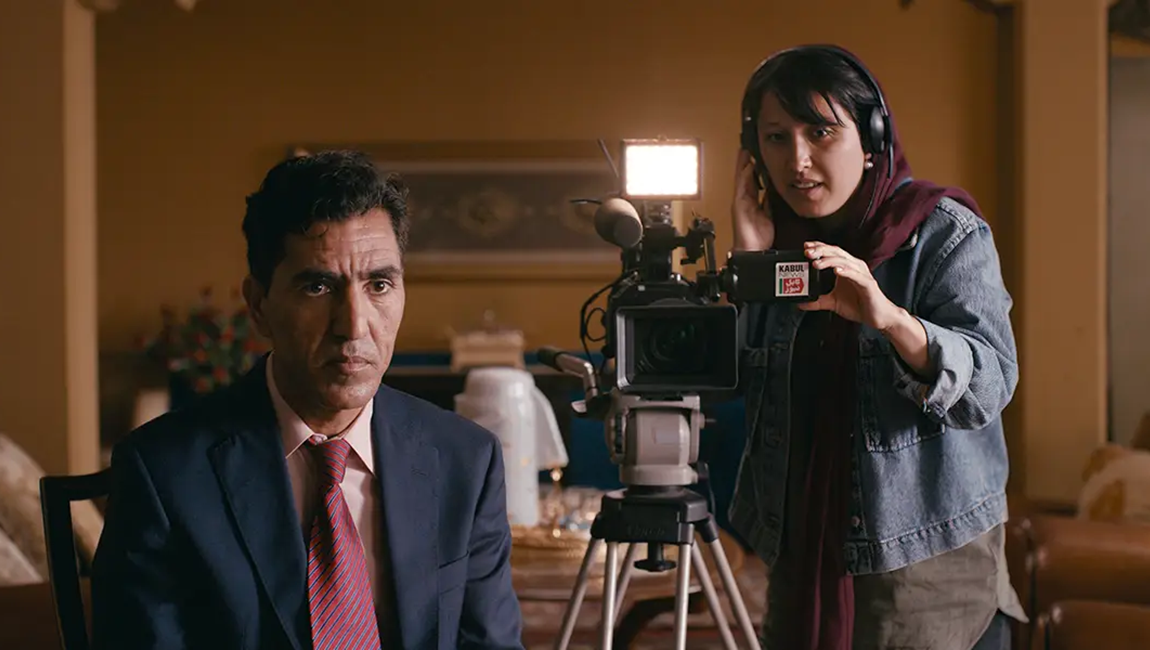
No Good Men wastes no time in getting down to business early on, and no time thereafter either. Set in Kabul in early 2021, immediately before and after the Taliban’s return to power, the drama concerns Naru (Sadat), a camera operator for Kabul News, disillusioned with men after growing up with an abusive father and now going through a testy divorce. After begging her male superiors for more substantial work, she’s promoted from chat shows to news packages, working alongside reporter Qodrat (Anwar Hashimi), a married man some 20-odd years her senior. Their first assignment — an interview with a Taliban representative — falls apart after Naru refuses to cover her head, and tensions are swiftly established between the new colleagues. But circumstances demand that they work together again, and those tensions begin to dissipate as Naru sees a more compassionate side to Qodrat. He challenges her assertion that there are no good men in Afghanistan.
The film’s plotting isn’t necessarily bad — Sadat develops each stage in both the central romance and the surrounding political environment adequately, ensuring that events run smoothly and straightforwardly. But it’s hackneyed, and there’s little interest in observing a narrative we’ve seen countless times before. What underpins this romance in turbulent times, or is exposed through it? There’s no identifiable commentary on what any of what transpires might represent, save a perfunctory protest against press censorship that’s stated too explicitly to be subtextual. What happens in No Good Men just happens — it’s a film largely stripped of complexity, banal in its simplicity.
If Sadat is passionate about her material, her style (or lack thereof) might suggest otherwise. There seems to be a marked decrease in care from both Wolf and Sheep and her last feature, 2019’s The Orphanage. Lazy cutting undermines the humor in early scenes, making Sadat’s subtle performance look blank. One edit, after a caller to Naru’s chat show states her daughter has fallen in love with a married man, feels particularly abrupt given the thematic relevance of the subject. And a number of scenes, particularly those involving multiple actors, are awkward and stagey. The film is an easier watch on the few occasions where it dispenses with narrative urgency — a few conversation sequences, while a touch didactic in their expression, have a better, more believable flow, and bring a pleasant sense of verisimilitude to a film that’s otherwise more beholden to rigid narrative schematics than it is to reality.
Sadat uses these conversations to make certain feminist statements, and surrounding scenes to support them: it may not be their fault — they’re only following each other’s example — but there really are no good men in Afghanistan. Alas, it’s a statement that comes unstuck with Qodrat. He’s an interesting character: a celebrated journalist whose fame and connections to senior police and political figures make for interesting interactions, such as one startlingly casual encounter during a gunfight. Hashimi’s understatement makes him all the more compelling, but Sadat’s core statement is more compelling still, and it’s undercut by the lengths she takes to lionize him.
Diluting the feminism at the heart of your film’s message feels especially strange when No Good Men appears to have been made not for an Afghan audience but for a European one. At numerous points, Sadat inserts explanations of the customs and laws of Afghanistan, and the war-torn setting provides a recognizable backdrop for Western viewers, a comfortable stage for those who like their stories familiar and digestible. But who are these viewers? Those who became aware of Sadat through her riskier previous work may be disappointed by how familiar and digestible No Good Men is. Sadat plays it much too safe here, and takes her first misstep as a filmmaker in so doing.
Comments are closed.