
Contrary to the quick-take meta-narrative, the quality of Yeon Sang-ho’s filmography cannot and should not be limited to his four zombie films (Seoul Station, Train to Busan, Peninsula, and Colony). Psychokinesis is a smart superhero film from the tail end of the genre’s heyday in 2018 and, though marginal when compared the IP of Marvel and DC, climbs close to the genre’s summit. Elsewhere, in JUNG_E, Hellbound, and Parasyte: The Grey, Yeon wrestles with non-zombie sci-fi concepts to varying degrees of merit and success. Furthermore, the first half of Hellbound — which is about supernatural beings that (randomly) condemn humans to hell — offers the most conceptually enticing material in the director’s entire filmography, along with his earlier animated short on the same subject, The Hell (Two Kinds of Life). More recently, in 2025’s The Ugly, he relates ugliness to human monstrosity and murder. We are, to Yeon, how we treat the Other. Regardless of the genre, there are always monsters in his films. In his latest, Paradise Lost, the Other turns out to be a mother’s own offspring.
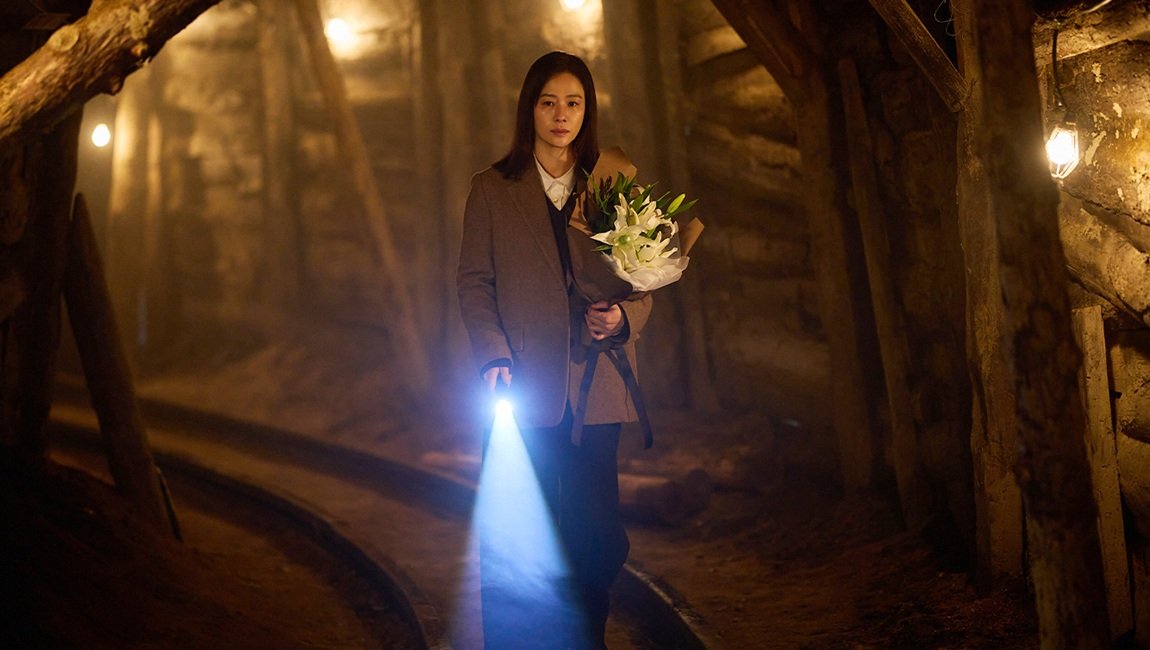
A bus full of children vanishes in Musan on the way to a camp and only the teacher’s body is found. The bus driver is the primary suspect and several of the children’s bodies appear later before he kills himself. The remaining parents are left to presume their children are dead. Veteran Yeon collaborator Kim Hyun-joo plays Ryu So-young, the mom of one of the still missing children, Ryu Sun-woo. Enter: AI. A tech company uses existing imagery and videos to create verisimilar simulations of the children, only accessible to the parents through glasses that look distinctly like Meta’s real-life product. The omnipresent subject of the moment has clearly worried Yeon recently; the zombies of Colony, also a 2026 film, operate with a hive mind and are the result of a corporate-driven “second cognitive revolution.” Not for nothing, he also managed the subject better in the zombie film.
Nine years pass and So-young has gone full ChatGPT-mom — addicted to spending time with the unaging AI-generated replica of her child — when Sun-woo, played with steely resolve by Bae Hyeon-seong, shows up as a full-grown adult with skeletons of his own to hide. Whatever happened to him during these past nine years, one thing is clear: though her biological child is alive, the little kid who got on that bus nine years ago is dead. For various plot tricks and bits, she must choose between the digital pseudo-Sun-woo forever locked into an ideal innocence and the mysteriously manipulative and dangerous real Sun-woo. Her little boy now returned is nothing like the innocent child (played by Yu Ji-wan) who exsists in her AI world: he is broody and quiet, can’t explain his nine-year absence, and appears more dangerous himself than psychologically tortured. A local child inexplicably goes missing at the same time he reappears, introducing another possible thread to pull, but the editing defuses any element of mystery to this circumstance. In lockstep adherence to the larger tradition of Yeon’s filmography, Sun-woo becomes something of a monster.
Beyond the unnuanced anti-AI position, what exactly Yeon wants to say is muffled by nonsense — which is regrettable, because the heady concept certainly makes it seem like he wants to say something. In Colony, the criticism against AI was much more targeted and contemporaneously relevant through the groupthink of the zombies and the resolve of creativity: it takes original thinking to survive this apocalypse. The concept here is older than generative AI technologies themselves, with genre touchstones like Steven Spielberg’s A.I. Artificial Intelligence informing discursive avenues. The insanity of AI’s aid in the grief process continues to make no intelligent (or even emotional) sense, and the Manichean binary between the two versions of Sun-woo forces two uneven narratives into one uncomely one. Sun-woo’s Odysseus-like return is certainly the more interesting of the two threads — and very little about the AI world fascinates at all, perhaps due to Yeon’s own skepticism of the technology — but together they leave a bad taste.
The film’s imagery is also flagrantly uninspired. The glasses gimmick is rendered as cheaply as it sounds, and the only major stylistic flourish is a symbolic gamification of the missing children: a group of children stands still and upright in a dark, empty room with spotlights highlighting their bodies (and turning off to symbolize their deaths). This stylized representation predates the reemergence of any suspects and, as such, doesn’t visualize the killer’s twisted memory. In truth, the frozen bodies of the children wouldn’t look out of place in something like Squid Game, and this realization provides clarity as to how unsavory this nihilistic gamification of child-death is without its being framed through any interpretative subjectification from an antagonist’s perspective. Like in The Ugly, Yeon here also makes use of still photographs; in the former film, the photos — and the dissonance between the photos and what the characters speak into existence — carry both thematic import and meta-epistemic onus. This time, they are empty vestiges of the past — empty memories of the real and nothing more.
DIRECTOR: Yeon Sang-ho; CAST: Kim Hyun-joo, Bae Hyeon-seong, Kim Jong-tae, Lee Hyun-kyun, Lee Yoo-joo; DISTRIBUTOR: Well Go USA; IN THEATERS: November 6; RUNTIME: 1 hr. 41 min.
Comments are closed.