
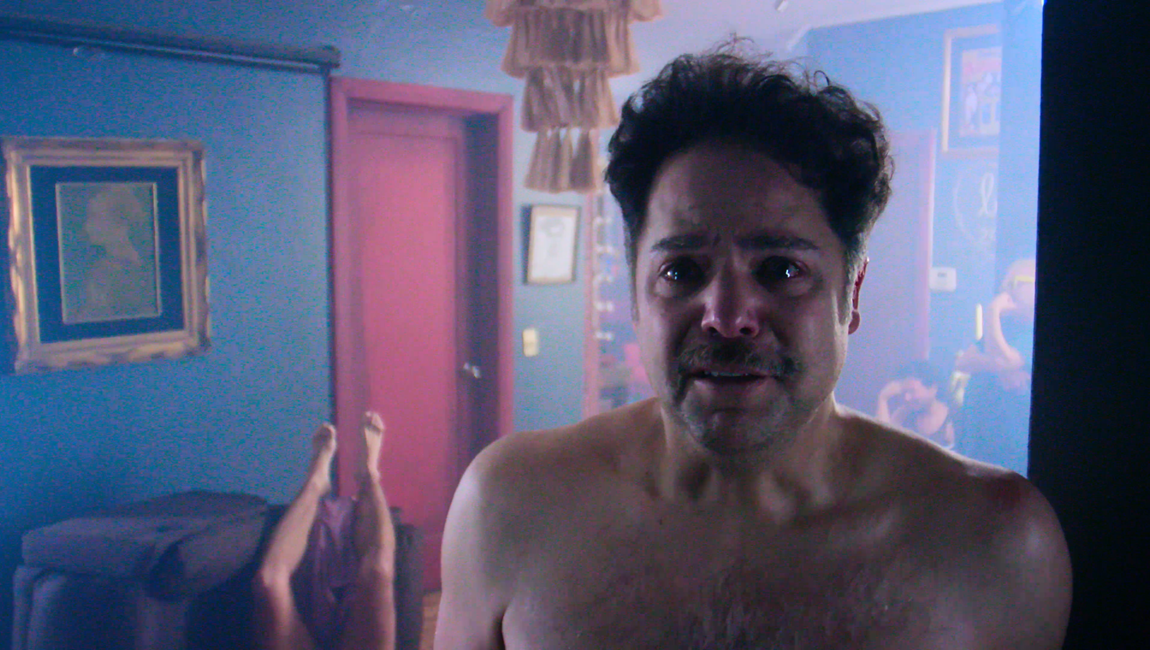
After a series of screenings at LGBTQ+ focused film festivals, director Sergio Tovar Velarde’s flamboyant new film The Divine Tragedy has received an on-demand release in the U.S. Low-profile as it is, Velarde’s film has resonated with the largely queer audiences who have had the chance to see it — the film won the Audience Award at the amusingly named Wicked Queer Film Festival in Boston — and while the film evinces many signs of limited resources, Velarde’s film is distinguished by a bold, even excessive, style and a cheeky sense of humor. Occasionally creaky but often delightful, The Divine Tragedy proves winning in its earnest, Almodóvar-inflected comedy of filial reconciliation.
The Divine Tragedy follows half-brothers Cristián (Artús Chávez) and Roy (Pablo Gómez). Both are gay men who live in Mexico City, but their similarities end there. Cristián is a fussy househusband acclimated to creature comforts, and Roy is an informally employed hedonist who shares a messy apartment with two roommates. When Cristián’s wealthy husband Carlos (Rosendo Gázpel) abruptly files for divorce, Cristián finds himself at Roy’s doorstep. The temporary arrangement between the two men, whose temperaments and lifestyles are diametrically opposed, lasts longer than either initially expects, and they begin to push each other out of their respective comfort zones. Roy encourages Cristían to loosen up and dabble in sex and drugs; in turn, Cristían pushes Roy to take a break from drug-fueled group sex and explore a deeper relationship with their handsome neighbor Esteban (Christian Ramos).
The basic setup of the film, then, is The Odd Couple with much, much more gay sex, and Velarde fully commits to depicting Roy’s robust sex life. Leather harnesses and jockstraps abound, and the film’s audacious opening shot is of Roy taking a deep sniff of poppers. The film’s overall visual style, in fact, mimics the dizzy rush of a popper hit: practically every other scene is shot at a Dutch angle, and frames frequently rotate, spin, and blur — typically when characters have sex or take drugs, but sometimes in more anodyne moments as well. As shot by director of photography Alex Z. Reynaud, the maximalist compositions sometimes seem to compensate for the digital photography’s decidedly lo-fi look. The lighting tends to be either harshly uniform or overly backlit, and in conjunction with the often tinny sound quality, the overall impression is that of technical limitations rather than poor aesthetic judgment.
There is a similar push-pull between ambition and restriction in the film’s narrative elements. Velarde, who co-wrote the screenplay with Orlando Manrique, establishes a tone that shifts constantly between various registers: broad comedy, earnest sentiment, sexual debauchery, and unfiltered trauma seem to be fighting to push their way to the film’s forefront. Velarde, and the cast of quick-witted and open-hearted performers, commit ably to the tonal tug-of-war for much of the film, but collectively falter when the film takes its darkest turn in the third act. Velarde’s narrative — which, in its overarching structure, largely hews to the conventions of odd-couple comedies — requires the brothers to reach their lowest points in the third act so they can emerge with greater self-knowledge on the other side. Velarde miscalculates the narrative balance in this stretch of the film: Roy is subjected to an excruciatingly painful and sexually traumatic self-reckoning, while Cristían’s low point is comparatively milder. There is a moralistic tinge to Roy’s dark night of the soul. Whereas the brothers are depicted as equally messy at the film’s outset, the dramatic consequences of Roy’s indulgence in sex and drugs suggest that he is ultimately the more dysfunctional of the two. This tilts the relationship out of equilibrium in the third act, and Velarde’s rushed handling of the conclusion does not help to realign the film.
But while inconsistent in aesthetic and narrative execution, the pleasures of The Divine Tragedy ultimately outweigh its more problematic elements. Velarde takes clear joy in imbuing the film with overflowing queerness and camp value — side plots involve self-produced drag shows and recurring dreams about leather-clad porn stars, and the apartment is adorned with exuberantly clashing colors (not to mention plenty of sex toys). The Divine Tragedy is ultimately at its best when Velarde indulges in the idiosyncratic joys of queer life, whether these joys involve sex, sequins, or simply a tender heart-to-heart between members of a chosen family.
DIRECTOR: Sergio Tovar Velarde; CAST: Artús Chávez, Pablo Gómez, Eduardo España, Helena Puig, Christian Ramos; DISTRIBUTOR: Cinephobia Releasing; STREAMING: November 3; RUNTIME: 1 hr. 41 min.
Comments are closed.