
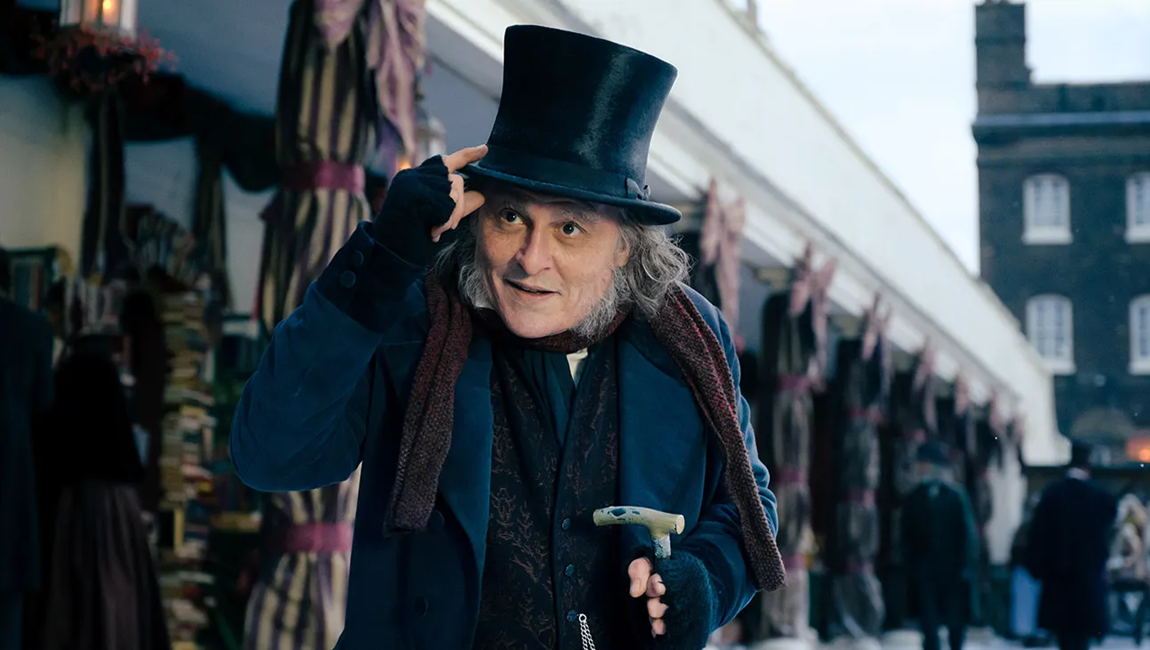
In any other context, an adaptation of A Christmas Carol should be a safe bet. You know the beats of the Dickens novella like you know your own limbs: an old miser’s greed threatens to ruin Christmas for all of London until a bevy of yuletide ghosts scare him straight. It’s a story that’s been performed and appropriated enough times that you likely have not only your favorite version, but your favorite associated franchise. But Ti West’s Ebenezer — an otherwise ornate but stubbornly conventional retelling — introduces an elephant into the offices of Scrooge & Marley. The movie marks a Hollywood comeback for Johnny Depp, whose ultra-public fallout with ex-wife Amber Heard divined his own litany of ghosts: abuse, addiction, and enough animosity to drag an international audience of hot-throated gawkers through its mire.
To his credit, Depp proves that his fall from grace didn’t render his sensibilities as outlandish as Ebenezer’s press cycle had suggested. His take on Scrooge is surprisingly measured and absent of the hyperbolic clowning of more recent disasters like Mortdecai. Instead, Depp casts quirks and pratfalls gingerly across West’s soft gothic palette; he’s game to go big, but never risks stealing the show. The result is a tethered and conspicuously calculated distillation of the broad-stroke theatrics of Depp’s salad days. Anything more sensational might risk the uncanny Grand Guignol that marks so many contemporary comeback attempts; better to keep your head down than to risk reminding audiences a UK court found your “wife-beating” allegations “substantially true.”
The movie Ti West builds around his troubled lead is similarly risk-averse. Little of Ebenezer’s structure deviates from its source — Tiny Tim, Marley, Ghosts, et al., show up with the resigned diligence of so many shift workers, dutifully awaiting the required entrances and exits of their respective staves. Save for Depp’s presence, the only distinction Ebenezer can claim from its hundreds of peers is its design. West has deliberately tempered the exploitative instincts of horror-forward works like Pearl in favor of a grim Victorian London that could believably be sold as a sober offering from Tim Burton. Within those eerie alleys, the ghosts that trail Scrooge stand as Ebenezer’s scant proof of life — bound as their terror is to a PG-13 rating.
As the Ghost of Christmas Past, Andrea Riseborough emerges white-eyed from a frozen Hell to yank Scrooge onto the right side of Ebenezer’s drolly linear morality. Greed is bad, Christmas is good, and Depp dances his uncoiffed eyebrows through three circles of lessons before he gets the picture. If Riseborough’s Ghost had pupils, they’d undoubtedly roll into her skull as Scrooge limply defends his adolescent descent into capitalist iconoclasticism. Ebenezer’s mall-lurking darkness is an unapologetic application to nudge its way into the Hot Topic Christmas Canon, but a handful of lightly leashed jump scares aren’t enough to generate a spark in Scrooge’s redemption arc. Even after the introduction of Tramell Tillman’s stunningly creepy Ghost of Christmas Present, Ebenezer can’t seem to spin its wheels out of a well-trodden Dickensian rut.
Competent as they are, then, Ebenezer’s scares and scenery are ultimately foliage for Depp to chew on his own journey toward forgiveness. The film has made no secret of its intentions as a comeback vehicle: “It’s good to be back,” Depp winks at the camera in its trailer, excusing its audience from the mental math of parsing art from artist. Like Digger before him, Johnny Depp is Ebenezer, and the movie’s banal apologia bears too thin a Victorian paint job to emerge as anything more than — generously and at best — a massive distraction. The meta mea culpas lobbed here are also the closest thing to an apology that the otherwise defiant Depp has offered after his fallout from Heard. “The world can be such a miserable place, and I’ve made it more so,” whimpers Scrooge. It’s a far cry from lashing out at the “fake motherfuckers” Depp has accused of fashioning him as a “crash test dummy for MeToo.”
Scrooge’s historic humbling has always held A Christmas Carol as an inherently political work. Ebenezer is perhaps the first time it’s felt partisan. For all his victimhood, Depp emerged from his legal troubles with legions of supporters; criticisms of his comeback swing are sure to be met with gnashing teeth about cancel culture and left-wing puritanism. But whether the world deserves an apology from Depp is immaterial. Great art from bad men enjoys ample refuge in traditionally progressive spaces, from Roman Polanski’s six-time certification in the Criterion Collection to David Bowie’s place in Obama’s summer playlists. The failure of Ebenezer’s metatextual handwringing is less an issue of morality than of taste; its apology tour does little more than to Streisand-affect a fallout many audiences likely would have volunteered to forget on their own. Ebenezer’s blatant existence as a test run for a Pirates reboot is cynical, but the movie’s biggest crime might be that it’s simply and thoroughly boring.
DIRECTOR: Ti West; CAST: Johnny Depp, Rupert Grint, Daisy Ridley, Tramell Tillman, Ian McKellen, Sam Claflin; DISTRIBUTOR: ddd; IN THEATERS: November 13; RUNTIME: 1 hr. 55 min.
Comments are closed.