
At the 75th edition of Cannes, Austrian director Marie Kreutzer’s Corsage (2022) sparked considerable attention, premiering in Un Certain Regard. This playfully reimagined portrait of Empress Sisi brought Vicky Krieps the Best Performance prize and gave Kreutzer a solid career boost, with the film eventually landing on the 2023 Oscar shortlist and a promising box office in international release. But suddenly, everything collapsed when more than 58,000 images of child pornography were discovered in the possession of cast member Florian Teichtmeister, throwing the entire team into shock and dragging the film’s prospects into the crossfire. Kreutzer’s follow-up Gentle Monster, competing for the Palme d’Or at Cannes’ 2026 edition, therefore arrives with particular intrigue, especially since Kreutzer previously voiced serious doubts about whether she might direct again. But with her return, she delivers a narrative dealing precisely with the kind of trauma that surrounded Corsage. By a grim twist of fate, it was also a story Kreutzer had been carrying long before making that earlier feature.
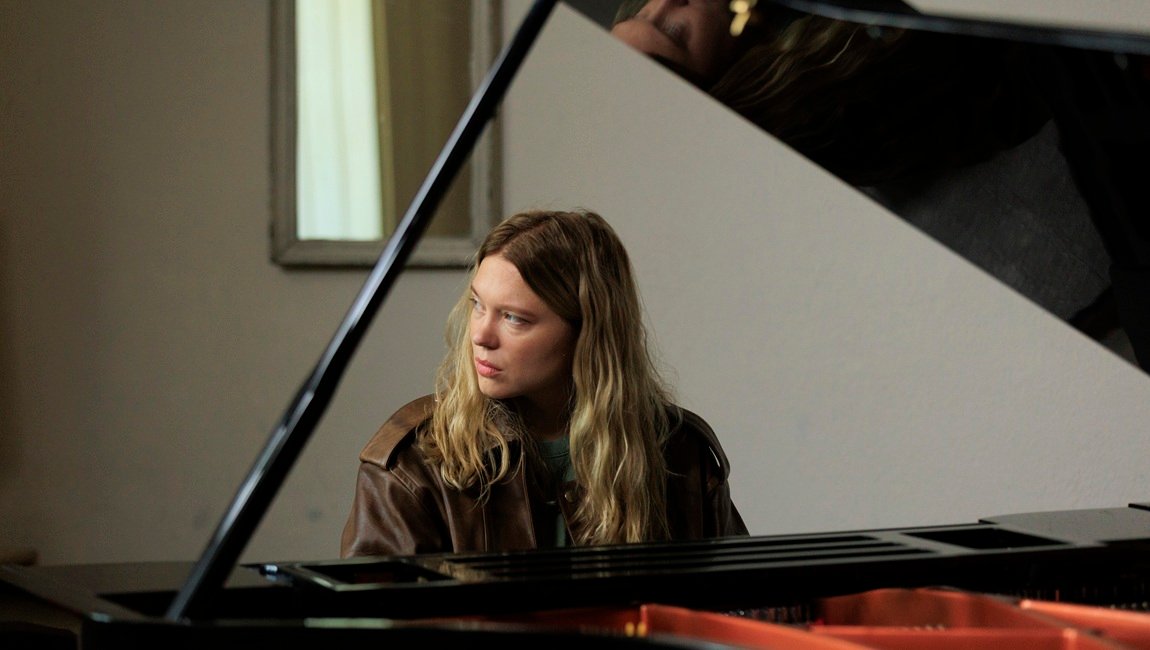
Gentle Monster opens on Léa Seydoux’s visage. She plays main protagonist Lucy, a musical performer rehearsing the piano notes of “Would I Lie to You, Baby?” and she is the kind of artist who deconstructs male-written songs through grotesque solo concerts involving multiple instruments. Not long ago she moved to the countryside with her young family in pursuit of a utopian idea, which, as her conceited mother (Catherine Deneuve) remarks, is the second worst thing that can happen to a woman engaged in creative work after having a child. A French woman married to an Austrian man, fluent in three languages and shuttling between her European concert tours, Lucy is equally devoted to her little son and to husband Philip (Laurence Rupp), who is suffocating under panic attacks and creative stagnation in his TV career. But she clings tightly to this fragile domestic happiness with genuine love and a stubborn faith in familial value above all else. Until one morning, several police cars descend on their pristine village street with a search warrant, ruthlessly confiscating laptops, flash drives, and phones from her husband before he has even had time to put on a shirt. Shaken and disoriented, Lucy dissolves into tears from sheer fear of the unknown, until her absolute worst suspicion soon crystallizes at the station, where she is instructed to press the elevator button to “Child Molestation Investigations.”
The film begins in the finest traditions of the gut-churning thriller, with a shrewd character’s exposition and a horror of suspicion. It truly unfolds at such a smooth and gripping pace that one almost begins to fear the film may eventually fumble its premise — which, unfortunately, it does. Kreutzer clearly has no interest in settling for a graphically moralistic story about a monstrous predator, and her ambitions reach for something intricate with the script and something more inventive with the form. After the first act, the method of narration begins adapting itself to the chaos of Lucy’s clouded consciousness, though it ultimately collapses into a blunt literalism of chaos rather than sustaining the elegant ambiguity it appears to pursue. From the moment of the police interrogation onward, Lucy enters a suspended psychological state governed by legal opacity, since the investigation cannot disclose its details. Her wounded heart desperately searches for solace through self-convincing, clinging first to the reassuring narratives offered by a lawyer friend advocating a more cautious framework of defense, then to her husband’s increasingly dubious explanations, and finally to the sight of her son, whose depth of trauma has yet to be revealed. But the central teasing question — where exactly Philip’s crimes fall within the horrifying spectrum of pedophilic criminality — is one Kreutzer does everything to delay, and in exchange offers too little to sustain the promised suspense.
Seydoux delivers the kind of suffering performance she has long perfected across her grand filmography, but the emotional swings on which the film so contagiously depends rarely achieve enough amplitude to land at a productive path. Kreutzer aspires to enter complex rhetorical territory, to peer into the emotional profile of a pedophile against the backdrop of state law, to unmask the picture-perfect families whose home computers harbor thousands of illicit files, and to explore how love can coexist with revulsion. And yet, Gentle Monster falls short of those reaches, even if its suggestive title pays off in the end. Instead, it sidesteps these questions, veering toward portraits of parallel characters. The case’s lead officer, for instance, comes to the foreground, revealed as a woman for whom this work is the sole source of meaning in her life, while she simultaneously struggles at home with an ailing father. Where Gentle Monster attempts to construct a dynamic of psychological mirroring or unspoken female solidarity between officer and Lucy, the connection it produces is hardly revelatory.
Yet it would also be unfair to deny Kreutzer’s talent for dense mise-en-scène, the minimalism of which, often paired with associative editing, works at times. When she depicts sex scenes between Lucy and Philip alongside the latter’s ordinary, warm interactions with their son, and then revisits those moments through the prism of the unfolded plot and flashbacks, retrospectively, the almost visceral revulsion makes one want to vomit. To be fair, Lucy herself undergoes a similar act of purging, following her mother’s advice and clearing the path to the predictable conclusion of a smooth enough divorce, an emptied family home, and a newfound faith in a brighter future. The Austrian filmmaker undoubtedly conducted extensive research and poured the anguish of her personal pain into the project, though these factors perhaps only served to complicate her task further. Gentle Monster could have been bolder and messier, or at least more creatively rigorous in its concept of formally adopting the concealed and the unseen, with the result occasionally raising the question of what the film is genuinely after. Beyond its too-slow-burning, creepy warning about a non-idealized vision of love and the extreme depravity of male secrets, there is not much more.
Comments are closed.