
A great way to insult the Circassian men in Butterfly Jam is to say they’re weak. Even worse is to call them a “pussy.” Somewhat fittingly, and ultimately regrettably, an overall sense of weakness is what also permeates Kantemir Balagov’s third feature film itself, a sour opener of the 2026 Quinzaine des cinéastes sidebar. The insistent lacklusterness of Butterfly Jam is particularly painful, given the fact that Balagov’s initial strides into the limelight of world cinema shaped up to be a promising success story. As a youngster he messed around with video cameras and YouTube shorts, only to graduate from Alexander Sokurov’s Example of Intonation film workshop at the Kabardino-Balkarian State University in Nalchik. Tutelage under the Russian master imbued his innate knack for visceral storytelling with a more spiritual dimension, which shaped his surprisingly mature debut feature Closeness (2017). From the get-go, it flexed Balagov’s unique cinematic sensibility, launched his career in Cannes’ Un Certain Regard section, and established the key themes of his modest, yet critically lauded, oeuvre.
Familial closeness always leads to emotional suffocation in the stark cinematic works of this Russian auteur with Circassian roots. The way Balagov’s debut tiptoed between loving tenderness and unspeakable violence was forcefully amplified for sophomore feature Beanpole (2019), a claustrophobic historic drama about two traumatized female veterans in post-war Saint Petersburg that became another critical darling in the Un Certain Regard sidebar. Things were off to a great start, were it not for a seven-year hiatus — marked by an exodus to the U.S. after Russia’s full-scale invasion of Ukraine, and subsequent behind-the-scenes turmoil on the set of HBO’s The Last of Us, prompting Balagov to announce his complete withdrawal from filmmaking altogether. Throwing the towel in turned out to be a temporary crisis of faith, as Butterfly Jam now marks his cinematic comeback. And while doubling down on the thematic throughline of his work, this English-language debut mostly bears witness to the fact he hasn’t regained grip — yet — on the very material that made him such a distinct auteur to begin with.
The problems run myriad in Balagov’s third feature, set within the diasporic community of Newark-based Circassians. Toiling in the Big Apple’s shadow, the New Jersey denizens of Butterfly Jam try to carve out their own piece of the American dream, mostly under the fluorescent lights of the Circassian diner Azik runs with his pregnant sister Valya. A cash cow this diner is not. At best, it offers the ethnic minority hailing from the Kabardian mountain region of Nalchik a slice of home. It’s from here that Azik and his closest friend Marat work out their idiotic business schemes, while pushing Azik’s teenage boy Temir (Talha Akdogan) to assert more dominance in what could become a promising wrestling career.
Temir might be winning his matches, but otherwise Butterfly Jam is populated entirely by losers. These are humiliated men, cut off from their native land, struggling to make ends meet and desperate to show the world their Circassian roots stand for something. It’s here that Balagov’s first crucial mishandling of the material he once intended to shoot in Nalchik becomes apparent, as he tries to both respect the cultural mores of his ethnic roots and simultaneously depict these men as emasculated cucks. His depiction of the vaguely aggressive, touchy-feely, and ultimately abusive Jersey lads all too closely resembles the racist stereotypes dismissive Muscovites have formulated about ethnic minorities from the Caucasus, who in their eyes have rolled from the hills and crash-landed in the gutter of the Russian empire. Whether Butterfly Jam is Balagov’s love letter to the native land he is separated from, or a reckoning with the toxic traditions its culture has produced, never becomes clear. And regrettably, this ambiguity of intent never translates to scenes that are ambiguous themselves, as Balagov’s directing remains excruciatingly superficial.
The worst offender of this comes in the film’s most violent scene: a moment where the typical suffocating closeness of Balagov’s films becomes perverted beyond belief. On paper, the sexual violence he depicts between two men who clearly love each other — but have no way to safely vent their reciprocal discontent — sounds like a natural progression of his oeuvre’s thematic concerns. However, the banality of literally every scene surrounding this grave moment completely gets in the way of any pathos or catharsis. It’s impossible to take seriously the lethal sexual crime, when the stilted narration awkwardly loops back from Temir mourning his murdered dad at the beginning of the film, only to gradually build toward the events leading up to the fateful attack.
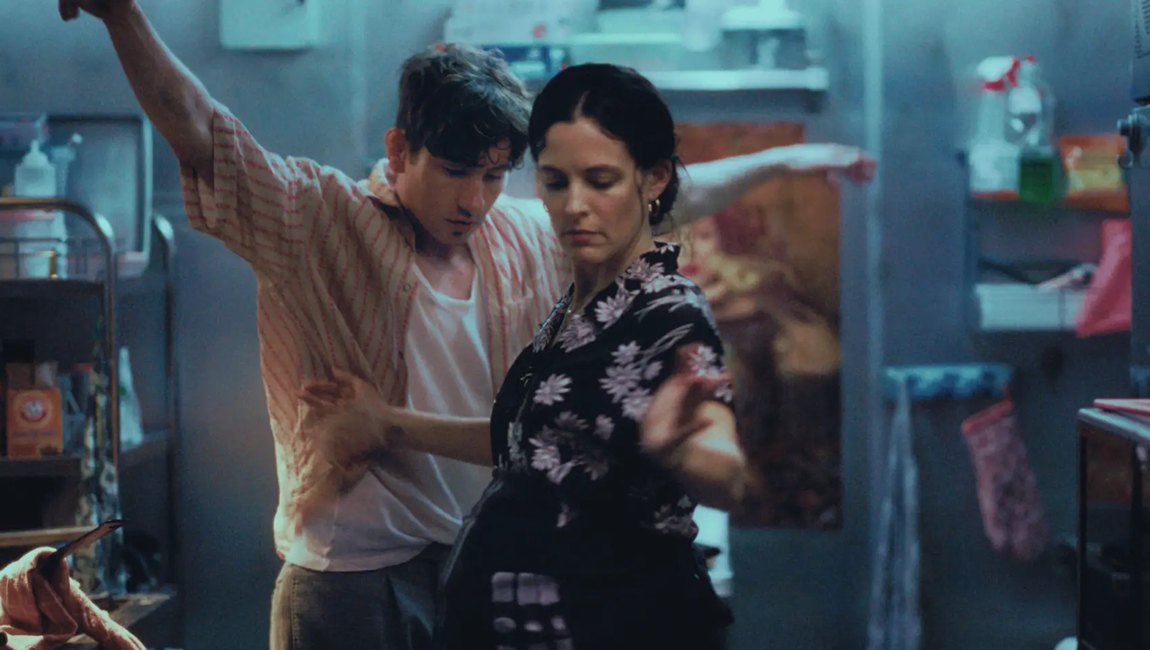
There’s something to be said for the structure of the film being messy, as Balagov is trying to play with the messiness of life for this substratum in Newark. Characters roll and tumble in and out of frame, wrestle their way from the margins of the image into the center of attention, only to scurry away, often seemingly at random. Cinematographer Jomo Fray does his best to stay in control of this chaos, but the smudged mise-en-scène never translates to the type of images Balagov used to command attention with in earlier work. Much of that has to do with the questionable casting of Irish arthouse darling Barry Keoghan as Azik, alongside American Riley Keough as his sister Valya and the Brit Harry Melling as his problematic fave Marat. Only the Turkish-American actor Akdogan has a vague ethnic resemblance as Azik’s boy Temir, which doesn’t compensate for the fact that this ensemble cast only delivers a vague facsimile of the authenticity Balagov is usually known for.
This accumulation of questionable creative choices wrestles for space in a stuffy screenplay Balagov once penned with Marina Stepnova. Completely reworked to respond to Balagov’s own diasporic condition, Butterfly Jam‘s narrative constantly struggles to find its bearings. Temir’s budding relationship with a fellow wrestler (played by non-professional Jaliyah Richards), Azik’s birdnapping of a pink pelican, a gimmicky cameo by a beautiful star actress — none of it has any business in a film that keeps distracting itself from telling its poignant story in the right way. It makes for an unfortunate comeback that undoubtedly forces Balagov to recalibrate once more, and actually translate his new life conditions into the emotionally charged cinema he is known for.
Comments are closed.