
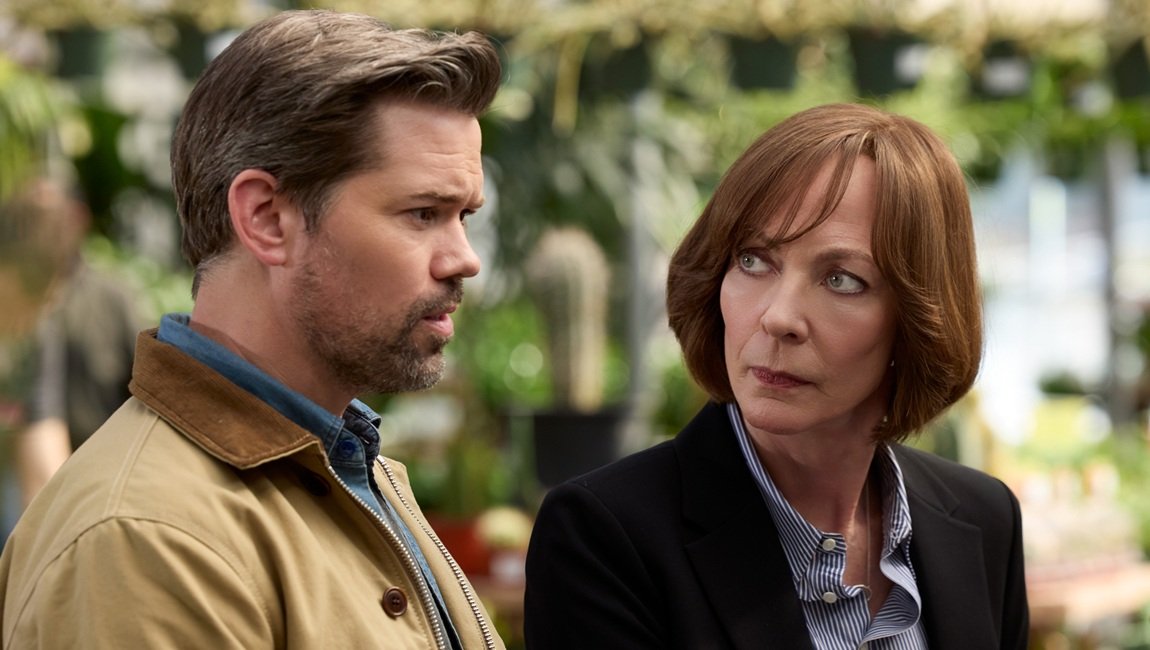
Acquired by HBO and released just in time for Emmy consideration, writer-director Jim Rash’s new film Miss You, Love You is a dialogue-driven two-hander that primarily functions as a performance showcase. In the film, a high-profile journalist sends his personal assistant, Jamie Simms (Andrew Rannells), to help his grieving mother, Diane Patterson (Allison Janney), plan funeral arrangements for her recently deceased husband. Over a week, the awkward and tense dynamic between the bereaved woman and her estranged son’s employee gives way to an unconventional bond. The narrative contrivances are manifold, and the dialogue is often clunky, yet committed performances from Janney and Rannells ground Rash’s film in genuine emotion. It’s a shame, then, that Rash’s direction proves insufficient; the film lacks an aesthetic point of view, and the performances — accomplished as they are — betray the signs of a too-light director’s touch.
After an opening credits sequence that, with its plucky string score and close-up images of a succulent, is incidentally reminiscent of the opening credits of countless HBO series, Rash quickly and efficiently sets up the film’s key characters, setting, and conflict. Arriving at Diane’s New Mexico ranch house, Jamie is awkwardly solicitous, and Diane, angry at her son Tyler’s absence, is pointedly resistant to Jamie’s presence. It is not an auspicious opening: the seriocomic dialogue contains no shortage of flat punchlines, and Rannells and Janney both seem to be pushing too hard to establish their characters’ heightened emotional states. As soon as the exposition is dispensed with, though, the film settles into a more relaxed and inviting rhythm. Jamie and Diane, once accustomed to each other’s presence, commiserate over their complicated relationships with Tyler, and confide in personal experiences that encompass grief, coming out, and loneliness.
Rash bestows on Rannells and Janney reams of text to deliver, including a number of tightly structured monologues that build to personal revelations, and, at their best, both performers execute their roles with feeling and assurance. Janney, playing a role that is of a piece with any number of formidable women she has played before, is a forceful and flinty presence who still embodies deep emotional vulnerability, while Rannells cannily deploys his natural charm as a gradually slipping emotional mask for his wounded character.
Rash’s screenplay, though, has tendencies toward cliché and emotional overkill, particularly acute when Jamie and Diane devolve into heated arguments, which are exhaustingly verbose and hammer home obvious aspects of character and theme. As a director, Rash’s visual strategy and deference to his actors render these textual flaws all the more apparent and dull the effectiveness of the two central performances. Nearly every scene is structured around medium shots of Janney and Rannells, followed by shallow focus close-ups when conversations reach an emotional or narrative turning point. While a restrained and performance-focused directorial style is logical for this inherently theatrical film, the endless shot-reverse-shots and obvious close-ups are flat and predictable (the one notable exception to this strategy occurs when the camera incessantly roves between Janney and Rannells during a tense dinner conversation, which is as distracting as the film’s typical shot choices are dull).
This is an aesthetic mode that places nearly the entire burden of the film on the actors’ shoulders, and while Janney and Rannells typically prove more than capable of living up to the task, scenes that require them to quickly escalate to emotional peaks reveal weaknesses: Both slip into emotional over-emphasis and stagey acting choices, with Janney in particular giving into presentational shouting more than once. These occasional lapses in performance are not fatal to their overall effectiveness, but it rankles that these weaknesses are visible at all — both actors have proven capable of emotional and tonal modulation, leaving one wishing that Rash had taken greater efforts to shape and refine his leading actors’ performances.
Rash has undoubtedly considered, with sensitivity, how grief, estrangement, and regret have shaped his central characters, and he has placed understandable trust in his accomplished actors to anchor the film. Yet despite frequent glimmers of emotional resonance and Janney and Rannell’s engaging rapport, Rash’s overwriting and underdirection ultimately lead to a viewing experience that is more frustrating than moving.
DIRECTOR: Jim Rash; CAST: Allison Janney, Andrew Rannells, Bonnie Hunt, Suzy Nakamura; DISTRIBUTOR: HBO Films; STREAMING: May 29; RUNTIME: 1 hr. 38 min.
Comments are closed.