
In This Dispatch
Colony
Third verse, same as the first. Yeon Sang-ho’s 2016 rage-zombie opus Train to Busan was a breakout it, largely because of its relentless pace and technical virtuosity in staging a monster assault on a moving passenger train. Eat your heart out, Jaume Collett-Serra. That was followed in 2020 with a direct sequel, Peninsula, which was more of a post-apocalyptic work, one that frankly felt a bit microwaved in light of the endless Walking Dead spinoffs that were — and still are — proliferating the culture. Now we have Colony, which, while not technically related to the previous movies, shares enough of their raw DNA to be considered a virtual third iteration, for good and for ill.
Unemployed academic Kwon Se-jeong (Jun Ji-hyun) is at a bioengineering trade conference hosted by a big firm, whose CEO (Kim Jong-tae) gives an impressive presentation about slime molds and how they interact. Before she can cajole him into offering her a job, he gets injected with a mysterious compound by disgruntled employee Seo (Koo Kyo-hwan), which instantly turns him into a foam-puking, bug-eyed rage monster who turns anyone he bites. It’s not long before Kwon is trapped along with your standard crop of survivor archetypes in the building, which is now teeming with zombies.
Returning to a more grounded scenario and relatively confined space after Peninsula has done Yeon some good visually, but Colony’s broad characters and basic premise are pretty boilerplate this time around — you’ve seen almost everything here before. But where the film does generate some real fun is in its single new twist on the zombie formula: the living dead here have a hive mind, and they can be controlled by Seo. The only way to stop them (potentially) is to take him out before he can manage to find a way to unleash his creations on the world outside the building, which has been locked down by the authorities, and plenty of gnarly fun and mayhem follow the characters’ attempts to solve this problem.
Colony’s set pieces expand outward from this initial reveal, bringing both genuinely unsettling moments (like a group of zombies mirroring the physical movements of the survivors they’re stalking) and elated, exciting shocks as the characters figure out new ways to use the creatures’ hive mind against them and their controller. Importantly, Yeon also gets a lot of mileage out of his set, which his camera hurtles through with appealing fluidity, and which gradually becomes entirely covered in monster puke, as do the actors — it’s all amusingly gross. So while the character beats and narrative trajectory in Colony never move in directions you aren’t ready for and little about the film’s guiding framework proves all that compelling, the execution of the central gimmick helps the film transcend its baseline familiarity and manage to still seem relatively fresh. That’s no small feat in our present zombie-rich entertainment landscape. — MATT LYNCH
Someone’s Daughter
At best, Wiebke von Carolsfeld’s Someone’s Daughter can be described as well-intentioned. Critically, however, it is existentially foolhardy and morally naive. Carrying a juvenile sort of feminism, running laps chasing the optimistic high of girlboss feminism, the film feels as though it was conceived in a writing workshop in the ‘90s.
The story, written by Carolsfeld and Doug Taylor, is essentially a thought experiment. What would happen if a lawyer were stranded in the wilderness with the man she successfully defended against rape charges 15 years ago? Pascale Bussières plays Sam, the defense lawyer, and François Arnaud is Paul, her erstwhile client. Both are kidnapped by Mr. Borden (Peter Outerbridge), the father of Lydia, the woman who brought rape charges against Paul. We learn in the first few moments of the film that Lydia’s life fell apart after the trial, and she died two years prior of a fentanyl overdose. The angry and grieving Mr. Borden, resenting himself for letting his daughter be further victimized by the legal system, wants to teach Sam a lesson, so he kidnaps her and leaves her stranded in the remote wilderness with Paul. He wants Sam to learn the “truth.” The rest of the film follows Sam and Paul’s attempts to survive and return to civilization.
A defense lawyer’s job, for the most part, is not to proffer objective truth, but to build an argument that acquits her client. Will seeing the once-accused Paul outside of the confines of the justice system, when it is no longer her job to save his life, prod Sam toward some kind of existential reckoning? That’s what this film asks, not realizing that this question is beside the point. As Sam learns that Paul carries in him the strength to inflict violence on women, she also realizes that she might have facilitated the freedom of a bad man.
Someone’s Daughter doesn’t seem to realize that defending guilty people is part and parcel of a defense lawyer’s job. Instead of taking the entirety of our justice system to task, instead of interrogating the system that allows and even encourages the dehumanization of victims of sexual assault and violence, it places the burden of responsibility on a single woman, turning her realization of her culpability into the point of catharsis. Sam becomes the single blameworthy locus for the injustice depicted in this film, as though she were the judge in Paul’s case. It all feels like an exercise in strawmanning at best, and misogyny at worst.
Further, it feels a cruelty that Sam is a woman who needs to be “taught” this lesson by Mr. Borden. Most women understand viscerally the power men wield, the potential that lies in someone like Paul to hurt women, and would not need such a vulgar form of teaching to be convinced that that Paul could have raped a woman. It’s strange that this film doesn’t entertain the complex reality of many defense lawyers. Sam would have defended Paul even if she felt him to be guilty — this is how the legal system works, people defend people even if they know they are bad. This feels a cruelty because the film believes Sam to be that stupid, to be that naive. One gets the sense that Sam was written as genderless, and just perfunctorily embodied by a woman actor, because women can be lawyers, too.
One might hold great apprehension about this film from its title alone, and nothing in its execution is accomplished in the way of assuaging that caution. It is a dated thing to do, to convince the public to care for victims of rape because “they could have been your sister or daughter”; one shouldn’t care about a person because of their relation to oneself, but rather because a person is a person. This kind of thinking, saying Lydia was “someone’s daughter,” decenters Lydia in the dialogue about the violence done to her and centers others, centers men. This kind of thinking doesn’t believe women so much as it first and foremost considers the feelings of those nearmost to the victim. Lydia’s is just a name in this film. She remains a perennial victim, first of Paul’s, then of mental illness, and then of death. Her story isn’t related or valued at all, and it’s Sam’s feelings that are instead pedastaled, while Paul is endlessly humanized. Lydia is flat, not a person in herself deserving of respect, but just “someone’s daughter.”
Von Carolsfeld’s film is a bold step in the wrong direction. It feels as though it were made for men who don’t believe women to begin with, a lofty thought experiment for them to consider from a place of safety. Someone’s Daughter doesn’t add anything to the conversation about victims of sexual assault navigating the judicial system, but rather distracts from them. Only superficially feminist, this film takes great and disappointing pains to get us to thinking about ourselves, not others. — ALISHA MUGHAL
Godhead
In Mark H. Rapaport’s Godhead, the world would seem to start and end between the walls of the church. In fact, this specific church commands such a presence within its small community that its priest (Al Warren) is known to his congregation simply as Father. Father keeps modest quarters for himself on the church grounds; he speaks in a meek, gentle drawl that inspires enough trust for parishioners young and old to flock to his pulpit for advice and safety. So, when two strange twins arrive at his steeple with a loaded gun, the boundaries between light and dark, sin and purity, seem as clear as the film’s cutting black-and-white photography. That is, unless, Father harbors sins of his own.
Godhead is a slim and severe chamber drama that leaves little room in its dank halls for God himself. Belief, in Rapaport’s world and in our own, casts a shadow under which power and paranoia congeal and fester. It makes for a powerful swill for Father. Before the twins arrive, we learn that Father has kept his son, Matthew (Luke Speakman), locked within the church house since birth. Father writes and performs Matthew’s universe, preaching doctored sermons and looping tape-recorded sounds of apocalypse outside his doors and windows to better sell a fear of the secular world. “What’s a strawberry?” Matthew asks when Father treats him to a bit of fruit. Matthew’s world is impossibly claustrophobic; cinematographer William Babcock’s crisp black-and-white, set to Academy ratio, renders it even tighter.
Father’s sins enjoy roots in delusion, but the mysterious twins who greet him in his parish prove a worthy match. Dressed in matching jumpsuits and styled like a Gen Z Die Antwoord, the twins approach Father with a request. They believe that one of them is the holy spirit made manifest, and Father must use his divine judgement to decide which one it is, kill them, and let their spirit ascend.
.jpg)
Godhead’s four-handed cast is evenly remarkable, but it’s Rapaport’s script that elevates the film from low-budget festival fodder to a considered, dogmatically rich text. It quickly becomes clear that the twins, who call themselves Firstborn (Sarah Coffey) and Secondborn (Kimball Farley, find a firm leader in the former. Firstborn seems at first a radical eccentric but reveals herself to be a calculated menace, countering Father’s liturgical arguments (the Holy Spirit can’t be a person, after all) with her own poisoned doctrine. And, like Father’s, that doctrine proves itself an able vehicle for control and abuse.
Rapaport’s premise is a compact foundation fertile for an examination of the ecstasy of faith and the binds of religion. Godhead isn’t unique in its plot — Bugonia leads a pack of films that similarly explore righteously deluded kidnappings — but its questions are meaty and sink deep into religious texts. When Secondborn is revealed to have been developmentally disabled in the womb, Father and Firstborn’s tête-à-tête shifts gears into a war between vessels of abuse, each equipped with their own vicious creed and sick history. Father betrays his own path to purity by tempting Secondborn with the fruits of Leviticus; Firstborn lobs evidence of Father’s lurid predilictions and admits to her own incestual control of her brother. To watch them spar is to watch an arm-linked spiral toward hell, with Secondborn and Matthew teetering perilously on the edge of the abyss.
For all its heavenly bluster, Godhead remains as sober as a priest until its third act. When it does pivot toward the divine, evoking miracles, roiling in beatific revulsion, and opening its gates toward religious horror, the assuredness of Rapaport’s otherwise muscled script loses a bit of its footing. The transition from lockjawed Kammerspielfilm to charismatic horror isn’t jarring enough for the movie to fall from grace, but it’s tempting to wonder whether Rapaport should have kept his players in the realm of the mortal. Godhead retains moments of brilliance through its weaknesses, though, and its precise craft makes even the movie’s most garish flirtations with the absurd enigmatic. In our efforts to praise God, we often ignore His awesome terrors. Godhead remembers them all and holds them close to its chest. — CHRISTIAN CRAIG
Also Playing
No Rest for the Wicked
Kasper Kalle’s No Rest for the Wicked is, on the face of it, dark and grim; apt, for a vampire horror with Gothic sensibilities. The film, written by Kalle, Rasmus Birch, and Heinreich Ulrichs, takes place on the Faroe Islands in the mid-1800s. A small community of primarily fishermen and their wives live in a village perched as if on the edge of a cliff: an overcast, jagged stretch of land often besieged by the thick fog rolling in off the angry Atlantic Ocean. It’s a damp, dangerous, and relentless place, moody as a daub of ink. There are no trees, but all hope isn’t lost. There are sometimes sunny days when the waters are calm, and it is in this bright light that it becomes apparent that, despite the loss and heartbrokenness, this film is a love story.
Egor Venned plays Baldur, a young man living in a small house with his mother Ásla (Sofia Nolsøe). The patriarch passed away some time ago, lost, it is suggested, to the hazards of being a fisherman on such treacherous waters. Ásla and Baldur are incredibly close; they are, after all, each other’s only family. They live a peaceable life, with Baldur working as a fisherman and Ásla keeping the home in order. But a rift begins forming between the two with the appearance of Helge (Pilou Asbæk), a whaler temporarily staying in the town while awaiting work.
Baldur and Helge are drawn to each other from the start. A passionate romance blooms between the shy Baldur and the worldly Helge, but it is short-lived, for a tragedy rips Helge away from Baldur and the living realm. Heartbroken, Baldur searches for Helge amongst the fog-covered crags of the shore; when he does finally find him, he doesn’t let go, for better or for worse.
No Rest for the Wicked‘s first half is pure period drama. It’s as pensive and patient as Portrait of a Lady on Fire, a meticulous study of how passion and desire build in the pregnant spaces between common conversation and surreptitious looks. The second half, meanwhile, turns dark and bloody, drenched with the fast-moving, grasping waters of a blind sort of love, and a community’s fears for one of its members.
But the film never feels disjointed or bifurcated when the tonal shift, from drama to horror, does arrive, as Kalle and co. do an excellent job of fomenting a halting suspense from the start; when the horrors begin, it feels inevitable. From the outset, Kalle imbues the film, through the thick fog and severity of the landscape — the community, somberly Christian and inured to the often cruel whims of the rough terrain and climate, is of necessity on edge, even if calmly, from the moment we meet them, poised for action — with a nagging sense of doom, which is only ratcheted up by the growing din of the roar of waves that wash Helge onto the shores of the story. This place is an easy home to the terrifying; something bad is going to happen, a voice keeps whispering in the back of your mind.
The film’s genius lies is placing Venned’s Baldur at the center of its doom. His sweet face — warm, shy eyes and curious yet forlorn mouth — anchors the story within a distinct perspective. Baldur is a young man who has not known much warmth other than his mother’s, and though his community is kind, it is not intimate, not warm enough. When Helge appears and holds Baldur in warmth and passion, the story’s sense of doom stokes a heartbreaking apprehension, an impossible to ignore care for Baldur, in us, kin to the apprehension Baldur’s community has been feeling, leaving one viscerally entangled within the tale, deeply and irrevocably involved as sweet drama turns to tinny horror.
Venned turns in an unforgettable performance as Baldur, carrying the film’s story within a sure sense of the infinitude of pure and true love. Though No Rest for the Wicked’s terrain is rough and dark, and though it conveys a bloodthirsty horror, it still remains, through Venned’s presence and a masterfully written and painted story, a hopeful film, ultimately a love story that refuses to disbelieve in the arrival of goodness, light, and — indeed — rest. — ALISHA MUGHAL
Corpus
Corpus opens tantalizingly, with a modeling session in which apparently inexperienced Wren (Nuha Jes Izman) is being photographed by veteran Billie (Lily Cowles). This being a horror movie, obviously something unsettling is likely to happen, and indeed it does as Billie gently coerces her subject into doing something she’s clearly reluctant to engage in, something involving a weird wicker mask with a long beak. We’ll get back to that later.
It’s 1998, and now we follow Sayo (Jeff Wahlberg), a hustler, sometime drug dealer, and aspiring photographer. He snaps picture after picture of nightlife while slinging coke at the clubs. One night he reunites with Vince (Brodie Townsend), an ex- (or maybe just on-and-off) lover who’s since become a famous model and actor. Vince invites Sayo and another mutual friend Ross (Michael Vlamis) to a retreat at a creepy castle out in the middle of nowhere for a weekend of partying. Sounds like a good idea, what could go wrong? By the time everyone’s “enjoying” a delicious meal of raw meat served by a Billie and a clearly more assertive Wren, it’s already too late.
Corpus is the kind of ambitious but obvious little indie that tends to get called “body horror” in that it explicitly deals with physical transformations and vaguely outre sex. Sayo and Vince engage in constant back and forth with regard to their unbalanced and mildly abusive relationship, with one or the other exclaiming that they can’t live without each other or that they feel like they’re trapped inside one another — seems like we might be going somewhere with all that. When the purpose of the aforementioned creepy wicker mask is revealed (in a genuinely squicky scene), the subtext becomes text and the movie decelerates. Corpus is a movie about how sex and love intertwine personalities and bodies, and how co-dependency is an inevitable byproduct and fatal trap.
If that sounds overly familiar for the 2020s horror landscape, it’s true that the film’s content isn’t particularly novel. But Corpus is undeniably gorgeous to look at. Director (and former intimacy coordinator) Corrin Evans’ feature debut is captured in silky browns, greens, and golds, punctuated by the freeze frames of Sayo’s constant picture taking. And her handling of the actors’ — especially the several effective but relatively non-explicit — sex scenes is purposeful in its reserve. This isn’t exploitation. Depending on your vantage, that might be the film’s problem, ultimately, in that it never truly kicks over into something intensely disturbing or shocking, instead settling to be a psychic chamber piece. But if that’s the endgame here, then at least it’s a productive one. — MATT LYNCH
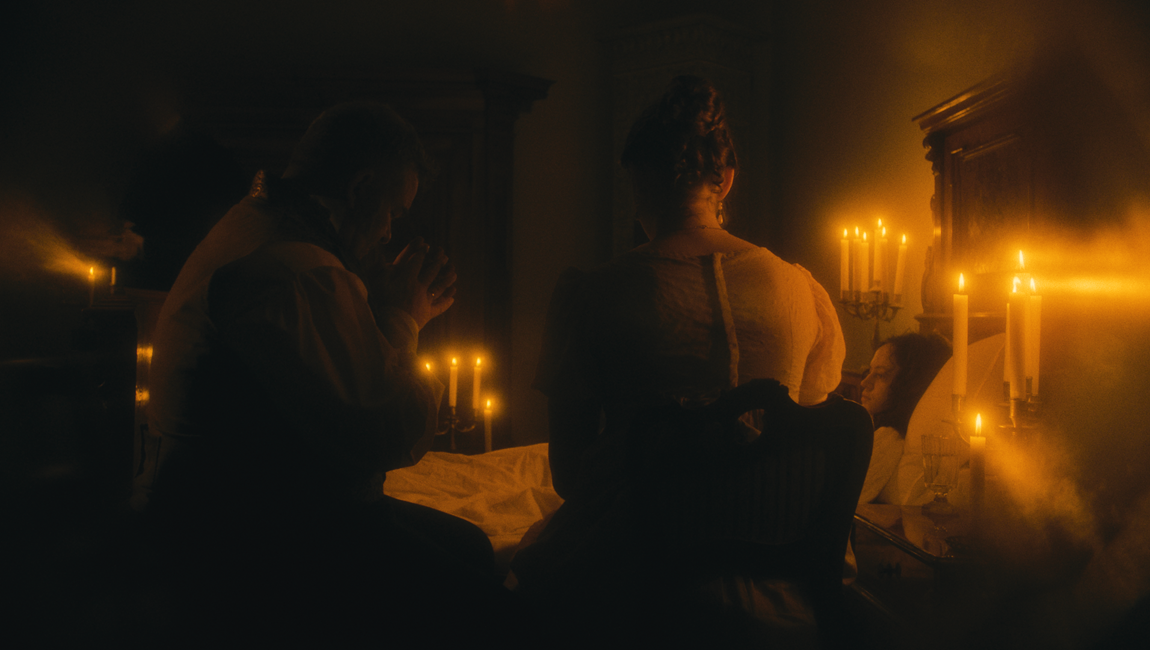
The Fated Hour
Watching Peter Hengl’s mid-length film The Fated Hour feels like handling a delicate porcelain doll: a precious encounter with a time-worn magic. The film, commissioned by Kier-La Janisse for production company Severin Films and written by Hengl, is an adaptation of a story by Friedrich Laun called “The Relationship with the Spirit World.” The story takes place in Austria in 1810 and opens on Florentine (Alina Schaller), who ought to be happy, for it is mere days before her wedding. But she is sullen. She sits down to dinner with her fiancé Bruno (Daniel Holzberg) after an evening spent at her late sister Seraphine’s (Fanny Altenburger) grave. When the concerned Bruno notices Florentine’s mood, he asks her what is wrong, and she begins telling him a secret she’s harboured for a while.
In her life, Seraphine was a sensitive young woman, possessing psychic abilities that allowed her to be in two places at once and commune with angels. One day, Seraphine receives three awful prophecies from the spirit realm: the times and circumstances of her, Florentine’s, and their father’s deaths. Seraphine dies soon thereafter, and Florentine lives in a sad fear of the future, but also with immense grief over the untimely passing of her beloved sister.
The narrative proceeds as a simple and swift gothic ghost story, the kind we might have whispered through giggles at a sleepover. But Hengl takes this story and turns it into something quite like a trance. It isn’t just that the production design and aura are at once sumptuous and foreboding, redolent of a Henry James story; it’s that the film’s gaze itself feels like looking through the translucent bodies of wraiths, through silvered glass. The edges of frames are soft and as if delicately doubled, as though we were watching Seraphine in a dream. Dialogue is hushed, the sound is feathery, and the light is gossamer and warm, almost like out of a Jean Rollin film; these delicate aspects come together to make a film that one feels more than sees.
The Fated Hour seems like a lost memory, even though its story takes place centuries ago. Perhaps it will remind viewers, as it does this writer, of ghost stories a grandmother one imparted; or perhaps of a doomed past life. Either way, The Fated Hour is a work of art to treasure, and this writer will carry it forward not unlike an antique pocket watch. — ALISHA MUGHAL
Comments are closed.