
The first of a two-part biopic of Charles de Gaulle’s efforts leading the French Resistance, with a title like De Gaulle: Résistance it comes as no surprise that Antonin Baudry’s film lionizes the arguably most understudied of the major WWII leaders. The most expensive production to come out of France this year lasts an arduous two hours and 40 minutes, just one minute longer than Part Two. The result is that this is certainly the biggest the French Resistance has ever looked, even if it is simplified into one-noted nationalism rather than a symphony of ideologically discordant factions united to squash fascism.
Inspired by British historian of modern France Julian Jackson’s book A Certain Idea of France: The Life of Charles de Gaulle, the first of Baudry’s two-film project follows de Gaulle — played by French-Armenian actor Simon Abkarian with a slight deadpan to go along with the mythic gravitas — from the invasion of Poland in 1939 to the assassination of François Darlan (Mathieu Kassovitz), the high-ranking Vichy puppet-admiral that the Americans decided to take over as puppet-master after the Allied invasion of North Africa in December of 1942. The film moves from de Gaulle refusing to accept defeat and not recognizing the Vichy compromise with Hitler to his complicated relationship with Winston Churchill (an unserious Simon Russell Beale, here playing the prime minister for a second time), whom both legitimizes and props up Free France, through de Gaulle’s militaristic assent to actual (rather than hypothetical and recognized) power.
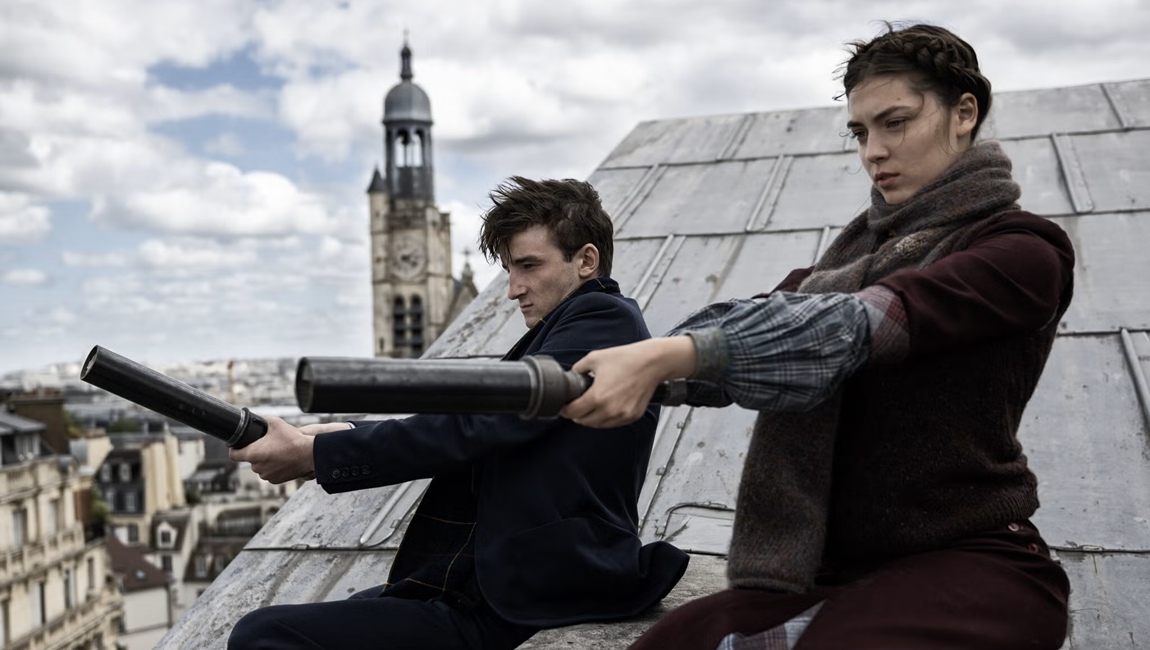
But the most interesting character here isn’t Abkarian’s mostly unknowable de Gaulle, and rather is Florian Lesieur’s young romantic Fernand Bonnier de La Chapelle, the man who assassinates Darlan at the film’s end. Résistance cuts between de Gaulle’s ascension and Bonnier and his friends, including his ahistorical Jewish lover, played by underrated showstopper Anamaria Vartolomei, which adds both the Shoah edge that Baudry largely puts aside for French sovereignty and the requisite romantic angle for the action blockbuster. (The university student turned action-first resistor may well resonate with contemporary French audiences given recent political events.) The real Bonnier was no Gaullist and, in fact, was a monarchist — though his ideology is re-written for dramatic political continuity and palatability in Résistance. After all, who cares who kills the Nazi collaborator?
Just as important as what is on screen is what is not. There are just two mentions of the existence of the Soviet Union, both delivered in the form of “the Russians,” and only one of the references points toward their war efforts; the other comes from a proverb that Winston Churchill quotes. Both references come with just 20 minutes left in the film, after de Gaulle’s unelected claim to French sovereignty had been secured and after the Americans joined the war effort. Perhaps Part Two will challenge this historical amnesia, but in Résistance’s meta-narrative editing, the Soviets remain peripheral to the inevitable victory of the Allied Forces.
Also left off the table are de Gaulle’s colonial and neo-colonial ambitions of French grandeur and what would ultimately come with the French Union. Given the timeline of this first film, the French leader’s dependency on the French colonies of Africa to secure momentum to rival Vichy is an unavoidable subject, but a subject broached with an eerie neutrality rather than any more complex understanding of modernity. When he establishes the capital of Free France in Brazzaville, French Congo, a wall of Black soldiers forms a corridor separating the (mostly) white audience cheering for him in the background from de Gaulle and his troupe. The wall of Black troops ends and a white one begins. But the magnitude of the moment, amplified by its cultish chants and lightly swelling classical music, casts a more romantic atmopshere to the event, and thus fails to leverage the potential power of its images of segregation. Instead, Baudry presents a photo from a newspaper as if self-congratulate for this historical authenticity.
The political talky-talk that constitutes the best of Résistance is ultimately suboordinated for a dull action finale covering the pivotal Battle of Bir Hakeim. The film’s eponymous protagonist plays a passive role far away from the combat, while an ensemble of secondary characters and unknown French soldiers sacrifice themselves for le tricolore and to help their British allies. And none of this is helped by the fact that Baudry orchestrates the action quite dryly. Guns go pow and tanks go boom, sure, but the action lacks both emotional connection to the film’s narrative drama and any kinetic urgency, which makes for a rather dull and perfunctory finale. Any film that chooses to disentangle itself from ideology in the service of populist action better make sure said action is at least be entertaining. At least Part Two will give Baudry one more chance.
DIRECTOR: Antonin Baudry; CAST: Simon Abkarian, Simon Russell Beale, Florian Lesieur, Benoît Magimel, Mathieu Kassovitz; DISTRIBUTOR: Samuel Goldwyn Films; IN THEATERS: November 6; RUNTIME: 2 hr. 40 min.
Comments are closed.