
Walt Disney’s history-making Snow White and the Seven Dwarfs is many things: it’s the movie that put Disney on the map, a landmark achievement in hand-drawn animation and sync sound, one of the highest-grossing movies ever made (adjusted for inflation), and — most simply — a movie about a maternal figure who is fiercely jealous of her daughter. Disney was never one to know a Mommy Problem that couldn’t be animated, and this dynamic would be the prevailing depiction of mother/daughter relationships in Walk Disney Animated Studios (WDAS) productions, from Cinderella and Sleeping Beauty to Tangled’s announcement of the first 3D-animated Disney princess.
Disney’s Hexed, WDAS’ newest release, harkens back to the original blueprint with a new spin on the studio’s struggle to imagine harmony between women within families. A prologue introduces Billie Doe (Hailee Steinfeld), daughter to single mother Alice (Rashida Jones), and a witch. Where she fits into the broader lore of witches described in the movie’s prologue is a secret Alice holds close to the chest. Powerful baby Billie has no control over her powers, and one night she opens a mysterious portal. Alice, a witch herself, is understandably concerned about her daughter’s safety, and forges and enchanted bracelet that mutes Billie’s powers. Alice decides to run away from all things magic, uproots her and Billie from Salem to Ohio, and raises her daughter under a strict, protective eye, never letting her remove the bracelet or informing her of her powers (an early, solid visual gag shows Alice’s stack of parenting books, which includes “Why Lying to Your Child is Good”).
Billie grows up, and as Disney convention dictates, she wants much more than this provincial life. When will her life begin? One day, she’ll know how far she’ll go. Wanderin’ free, she wishes she could be part of that — well, you get it. The movie does little to develop Alice and Billie’s relationship in the 15-ish years since the prologue beyond Billie’s general rebellious streak. After a misguided attempt to rescue her school’s animal mascot lands her in hot water, Billie accidentally breaks off her bracelet, accidentally destroys a school bathroom with her powers, and is expelled. She realizes her mom has been hiding things from her, and through these powers she may have a path toward escape. She generates a new portal and finds herself in Hexe — a safe haven for witches and wizards.
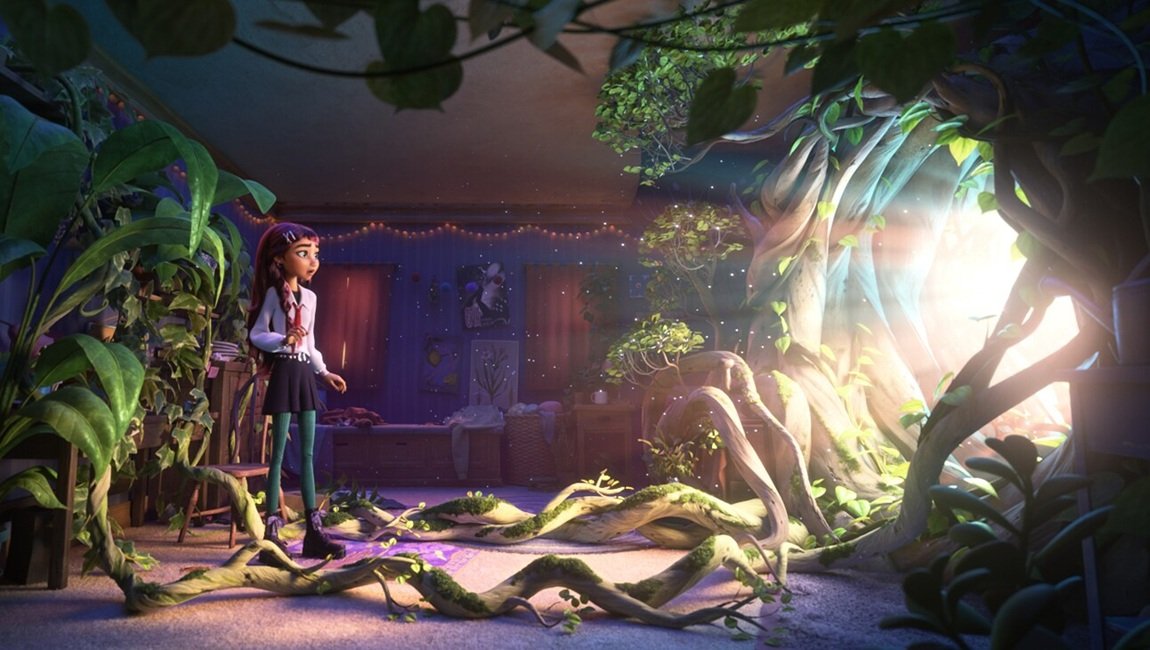
The introduction to Hexe is a depressing low for Disney, and perhaps 3D animation writ large. As brought to screen by directors Jason Hand and Fawn Veerasunthorn, the production design for Hexe’s town square is a far cry from the floral cottages of Tangled or detailed urbanism of Zootopia. Instead, the introduction to this magic town is more in line with Illumination and takes on Doctor Seuss, and the character designs resemble the same studio’s house style — long spindly legs, exaggerated physiques, and plump faces. This is frustrating when there are little glimpses of real care put into the animation, particularly in light and texture; an embroidered shirt cuff, a tweed skirt suit, ribbon shoelaces, stained glass, and moss, but what dominates the screen and makes up character expressions and emotion lacks the nuance of these details. And the jokes are as unremarkable as the design. The magic in Hexed seems to be written for the sake of the movie’s overreliance on puns, as spell incantations are executed with the literal semantics of a Monkey’s Paw. Another joke features Billie telling a witch that her mole is “a little on the nose,” to which the witch responds, “It’s my resting witch face.” This goes on for some time.
The film stutters in trying to get its second act going, introducing several expositional elements — including that Billie can fly (apparently one of only three witches known to do so). Alice has followed her daughter into Hexe, and reveals that the witch queen Celeste (Jodie Foster) is Alice’s mother — and Billie’s grandmother. But Celeste is not who she says she is, and she’s trying to complete a prophecy, and there are these flying witches that aren’t really flying witches but witches that can turn into ravens to fly, which is a technicality… In other words, it’s a whole lot at once, and meanwhile we still don’t have a real sense of Billie and Alice’s relationship that makes up the crux of the film. Quickly enough, the drama is escalated: mother and daughter are separated, and Billie, revealing that her mother’s treatment has always made her feel like something is wrong with her (now we’re getting somewhere!), decides that she will prove herself to her mother by saving the day, demonstrating that she is capable and exceptional. Phew.
It is here where the movie finally, thankfully, truly starts.
Billie might be a classic, Disney heroine, but Alice is the grown-up product of a princess raised by a narcissistic mother who treated her like competition, withholding love, and telling her daughter that she is undeserving of admiration. Disney’s previous bad moms (usually step-moms) may have been homicidal, but Celeste arguably takes the cake as the worst of the studio’s worst. For one, she is a biological bad mom, which is much different from the evil interloper or baby-napper of maternal past. Second, we see the consequences of her cruelty toward her daughter, which are, unfortunately, common in real life mother/daughter relationships. The older generation of women, who have faced genuine strife and limitations (the movie itself acknowledges the historical persecution of witches), internalize the patriarchal obstacles they’ve faced until it crystallizes as bitter envy toward the younger generations who have opportunities that were never before within reach. Celeste was jealous of her daughter’s heightened powers and the suggested freedom and leadership that comes from them, and, in turn, she hurt a child who never thought they were in competition. She just wanted a mom.
Hexed intelligently approaches how a daughter whose rebellion was in response to an unloving home and who goes no-contact without properly processing her trauma might make parenting mistakes of her own. Alice tries to make her love for Billie the central part of Billie’s life as an overcorrection for Celeste’s poor parenting, but it’s just a different kind of overpowering isolation she’s inflicted upon her daughter. Despite Alice’s good faith attempts to prevent it from happening, Billie feels exactly as Alice did: alone, unspecial.
It’s these parts of Hexed that are strongest, and clearly written for the parents in the audience who may be contending with the idea of generational trauma. It’s handled maturely and carried well by Jones’ vocal performance. The weakest parts of Hexed, then, are best summarized by the fact that the title, as officially highlighted in press materials, is actually Disney’s Hexed. It is a Disney movie, and that sense of control and ambiguous filmmaking identity repeatedly pull away from standout moments. Billie in particular is underdeveloped, and the parts focused on her perspective insufficiently reinvent the rote coming-of-age, “chosen one” character beats.
And that leads into the troubling part of Hexed, which is how the movie reconciles the mother/daughter relationship. Billie ends up serving as Alice’s liberator — a superficially sweet idea, but a problematic one that waves away Billie’s feelings to prioritize Alice’s. It is Billie’s job to help Alice see the strength within herself, Billie’s job to break the curse Celeste placed on Alice as a child, Billie’s job to save her mother. Billie only comes to her own in service to her mom. Sure, any viewer in a codependent relationship with a parent will feel painfully seen, but any child watching might get the wrong lesson about how to see one’s parents as people. (An idea much better accomplished in Brave, where Merida’s heroism isn’t about saving her mother from herself, but about both characters mutually coming to each other with new generosity.)
There are moments of beauty in the film, such as a golden hour flight sequence and a particularly inspired animation style for when characters turn inward to search for the root of a curses. And one would be remiss to go without mentioning Walter Goggins’ playful turn as B.R. Crummchuk, Alice’s old familiar fulfilling the dutiful role of Disney animal companion. Which is to say, Hexed is not without magic, but it is also not without Disney. In 1937, that may have been an enchanting ingredient, but today, it is simply tiring.
DIRECTOR: Jason Hand & Fawn Veerasunthorn; CAST: Hailee Steinfeld, Rashida Jones, Jodie Foster, Walton Goggins, Tracey Ullman, Stephen Fry; DISTRIBUTOR: Walt Disney Pictures; IN THEATERS: November 25; RUNTIME: 1 hr. 43 min.
Comments are closed.