
Yoshiyuki Okuyama’s 5 Centimeters Per Second is only on its face a romantic story, about a lovelorn boy and his lost childhood love. If only considered as a love story, then, Okuyama’s film — based on the 2007 animated film of the same name, written and directed by Makoto Shinkai — would be sweetly sad, like pressing on a yellow bruise. If only considered as a love story, 5 Centimeters Per Second is an emotionally evocative film. But consider it from a melancholic mien, and the film serrates, morphing before our eyes, like a moth to a butterfly, into a gutting existential tale of what we lose when we refuse to live life.
The film centers around Takaki (Hokuto Matsumura), a 29-year-old who had erstwhile dreams of becoming an astronaut, but who now works in coding. He spends what seems like every waking moment in the office, headphones in his ears as stoppers against the social sphere of his colleagues. He’s in a relationship with a coworker, a shy, quiet girl with whom Takaki shares silent dinners before the TV, but the girl breaks things off with Takaki when she senses that he’s not present — in the relationship, in general. It’s not so much that he’s settled for what he feels is the best he can get in life, but rather it’s as if he’s on autopilot, carried by the current of events. Immediately, we get the sense that Takaki is insulating himself against life’s abrasions, but really, he’s stopped being an active agent.
Spliced through the present is Takaki’s past, his childhood. As a kid, Takaki moved around a lot, and never having a consistent home, he never really had enduring friendships. That is, until he met Akari (Mitsuki Takahata), who moved around as much as Takaki. The two wandering souls sense an anchor in each other and become instant friends, teaching each other how to find happiness, and indeed finding it in their friendship. As their friendship becomes deeper, they also find that a romantic love has blossomed between them. But just as things begin getting good, Akari’s family moves away, and Takaki is torn in two. The pain of this wound, sustained at such a young age, leaves him with a fear that numbs. Okuyama’s film proceeds to depict a life fearful of the pain returning and so stowing itself away within itself; Takaki moves from moment to moment with a soul that has dimmed and is in hiding.
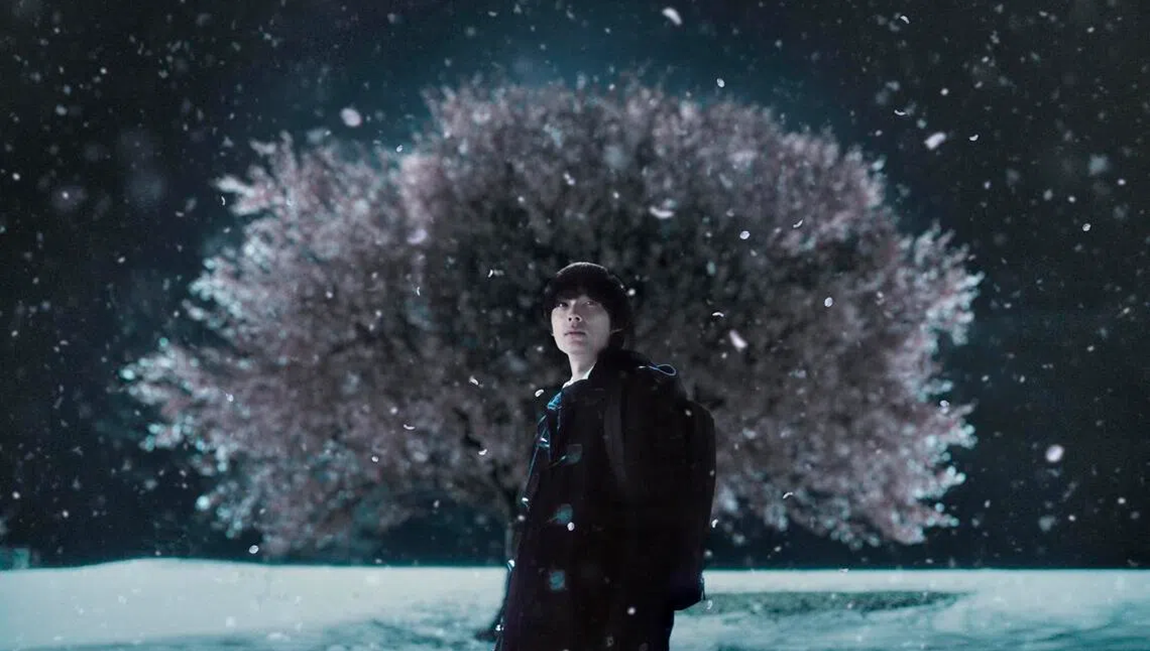
5 Centimeters Per Second is visually and sonically stunning: muted blues for a present that is more dead than alive, and powdery pinks for a past alive with feeling, with love. This feathery touch feels a kindness from cinematographer Keisuke Imamura, understanding Takaki’s state — both scared and numbed, tender like a gash that refuses to heal. The film’s visual beauty handles Takaki’s story with care, never passing judgement so much as expressing concern. In this way, the film also becomes a masterclass in subtle storytelling, excelling at showing and rather than telling, which allows the proceedings to gain a heaviness as Takaki’s life comes into greater focus, and gain an increasing amount of sadness as the film rolls on. But we don’t pity Takaki so much as feel a pitched sort of empathy, supported and punctuated by the film’s cinematographic beauty and the tenderness of Okuyama’s handling.
Matsumura, meanwhile, is perfectly restrained as Takaki, his face almost unemotive, but never is he framed coolly by Okuyama. The director instead lays bare Takaki’s existential state through soft closeups that function like an embrace, in which Matsumura’s mouth remains unmoving, but his gaze, we see, is downcast, his eyes often working hard to not drown in tears. This is a man who is shown to move slowly, who — as Okuyama and Matsumura depict through pacing and movement that is deliberately syrupy, as if having a hard time gaining purchase on anything worthwhile — is working hard to stay afloat, in so much pain that being alive itself is a titanic task; his grip, not strong enough to begin with, is always giving up on the present.
Mired in the darkness and grief of past wounds, anchored in unabating pain, Takaki has forgotten to live in the present, has forgotten that moving on, that forging new happinesses, through new friends and relationships, is even an option. Everyone around him has moved on, has made a life, while Takaki hasn’t, and in Takaki we see not so much a condemnation of living in the past, but how easy it can be for anyone, for us, to forget to be alive right now. In not choosing to live in the present, everything and everyone falls away from him like dry skin, and the cycle of loneliness perpetuates itself.
There is an immense love and understanding for Takaki in this film, but his story, how it is handled by Okuyama, is a gentle reminder, a loving hand on one’s shoulder: I know you’re in pain, the film seems to say to Takaki and by extension to us, but you need to move forward, you need to keep going. The film’s title describes the speed at which cherry blossom petals fall to the ground; it’s syrupy, slow, almost miniscule and unmeaningful, but it is movement nonetheless. We can take our time in living our lives, but what matters is that we live at all. 5 Centimeters Per Second, like a heartbreaking love letter to our past selves, a veritable breath of fresh air, reminds us of this fundamental dictate.
DIRECTOR: Yoshiyuki Okuyama; CAST: Hokuto Matsumura, Mitsuki Takahata, Yuzu Aoki, Nana Mori, Mai Kiryu; DISTRIBUTOR: GKIDS; IN THEATERS: October 23; RUNTIME: 2 hr. 1 min.
Comments are closed.