
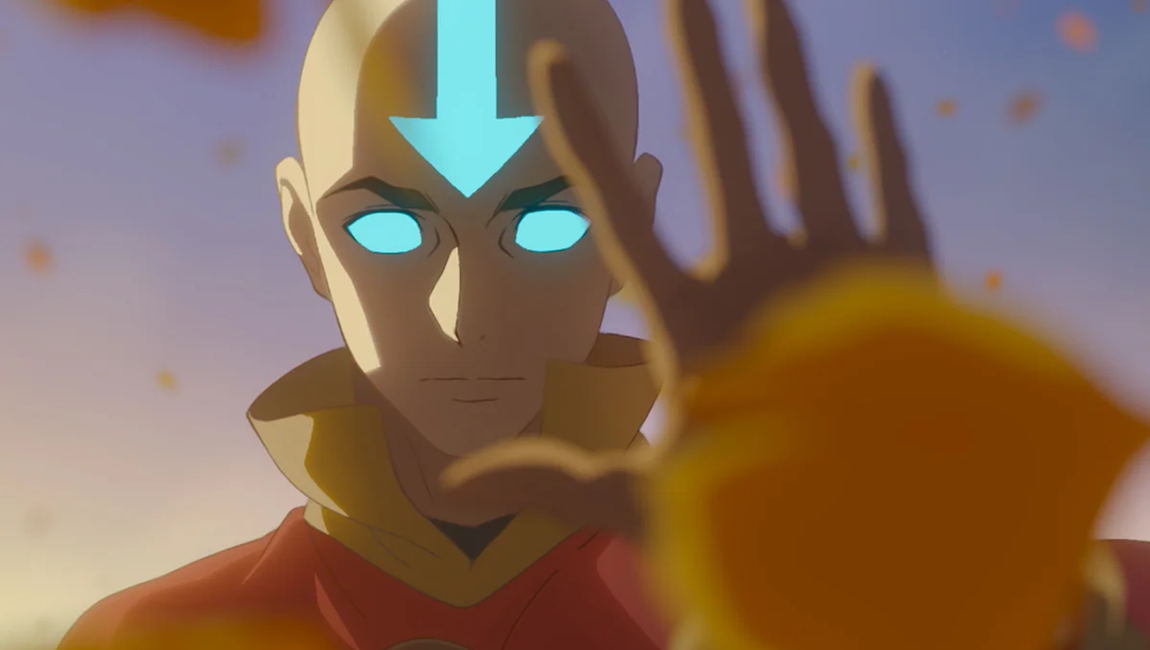
18 years after the end of Avatar: The Last Airbender and 12 years after the conclusion of its sequel series, The Legend of Korra, creators Bryan Konietzko and Michael Dante DiMartino are back in the Avatar (not the James Cameron one) universe, shepherding a new entry in their beloved franchise. The first production from the newly inaugurated Avatar Studios, Avatar Aang is both the first film in the saga and a bridge between the two series.
13 years have passed since Aang and his friends defeated Fire Lord Ozai, bringing peace and balance to all the nations. The new Republic City — the brainchild of Aang and Katara — is thriving, a symbol of what can be achieved when people work together instead of against one another. Still, Aang is troubled. Being the last airbender means he alone carries his people’s culture and values. It also means spending more and more time searching for relics and restoring old Air Temples to honor his roots.
During one of these expeditions, he’s attacked by a group known as The Denied, whose mission is to find a staff belonging to the mysterious Avatar Sonam — a staff said to grant airbending abilities to non-benders. Concerned, Aang summons Katara and the rest of the gang: earthbender Toph, firebender and former enemy Zuko, and his best friend, the non-bender Sokka. Together, they discover a frozen airbender named Tagah, who once served Sonam, and embark on a journey to find the staff. Convinced it could bring airbenders back, Aang throws himself into the mission, but when Tagah begins to threaten both his friends and his cause, he must decide whether his past is more important than his present and future.
Before delving into the film itself, its botched release strategy must be addressed. Originally slated for an October theatrical release, Paramount inexplicably reversed course and made it a Paramount+ exclusive (with a very limited theatrical engagement), only for the film to leak online, forcing them to release it three months earlier with very little fanfare. Anyone unfamiliar with Paramount’s management of the franchise could be forgiven for thinking this was an unfortunate mistake, but this is hardly the first time the company has mishandled the property, as Legend of Korra fans can attest (though that’s an entirely different article). It’s truly baffling how a company can seem so indifferent toward a property that remains as popular as ever and continues to boast millions of fans around the world.
Fortunately, despite Paramount’s utter disregard for the film, director Lauren Montgomery and her crew have created a genuine love letter to what came before while also exploring exciting new avenues for these characters. From the very first frame, it’s clear how much care has gone into the film’s visuals — it’s undeniably beautiful to look at, with vivid colors, breathtaking vistas, and fluid animation. And in 2026, it’s refreshing to see an American animated film embrace traditional animation, serving as a welcome change of pace from the CGI productions that dominate theaters and streaming services today. More importantly, those striking visuals support a memorable story that feels entirely in keeping with the TV series without simply repeating it, further deepening its ethos and themes. Survivor’s guilt, grief, revenge, and forgiveness have always been central to Avatar, and while those ideas are prevalent here as well, they never feel like mere retread. Instead, the film argues that happy endings are never definitive — that battling your demons is a lifelong endeavor.
This is most apparent in the characters of Aang and Tagah. Just because Aang is the Avatar and saved the world doesn’t mean he no longer feels alone or carries guilt over the extermination of his people. Even when surrounded by loyal friends, he experiences a loneliness that no one else can truly understand. That is, until he meets Tagah, another airbender who not only teaches him forgotten techniques from their people, but also understands the demons Aang is battling. That’s what makes Tagah’s eventual unmasking so heartbreaking, revealing a deeply vengeful individual hell-bent on world domination. Yet the brilliance of the film — and the series before it — lies in its refusal to paint with broad strokes, resisting the temptation to make Tagah a one-note antagonist. Instead, he’s a man carrying profound emotional scars, consumed by guilt and unprocessed trauma, convinced that only might and brute strength can bring him peace. The film invites us to understand where he comes from without ever excusing his actions, making its central character concern — the way that victims can become victimizers — especially relevant to the world we live in today. Aang actively pushing against Tagah’s worldview and breaking the cycle offers a powerful message for a family film.
Because this is such an Aang-centric story, the rest of the gang admittedly takes a backseat, and longtime fans may be disappointed by how little they have to do. Even so, the filmmakers have aged the characters gracefully, preserving the traits audiences fell in love with while allowing them to mature organically. Katara is the real standout in this regard, serving not only as Aang’s emotional anchor but also as the heart and soul of the film. But it isn’t just the characters who have changed: if there are criticisms to be made, the most obvious is that the cast isn’t the same as the original series. While the new voice actors do a commendable job in their respective roles — and the cast now better reflects the characters’ ethnicities — the change can still feel a little jarring for longtime fans, especially given how beloved the original performances are. Another point of contention comes via the presence — or, relative absence — of The Denied. Despite a promising introduction, they don’t end up playing much of a role, and their arc feels underdeveloped compared to the rest of the film. It’s understandable given that this is a 100-minute feature rather than a 60-episode television series, but it nevertheless feels like they could’ve been utilized in more effective narrative ways.
Still, that final point isn’t so much a criticism as an acknowledgment of the reality of telling a new story within an established franchise. While the film does a great job of bringing newcomers up to speed, the time spent doing so limits the film’s scope, and longtime fans will inevitably get more out of the whole thing because the emotional stakes are already built-in and so can be deepened by the knowledge of everything that came before. New audiences will certainly be able to enjoy Avatar Aang, but they’ll be even better served by watching the series afterward (or, for the time-rich, before). These are all relatively minor caveats, though, because Avatar Aang is a decidedly promising beginning for this new era of Avatar, despite any hiccups in its launch. Filled with the familiar — potent themes, sharp humor (including a delightful nod to the longtime Katara/Zuko ship), thrilling action sequences, and gorgeous visuals — it’s a must-watch for longtime fans, while also serving as an enticing invite to the franchise for the uninitiated.
DIRECTOR: Lauren Montgomery; CAST: Eric Nam, Dave Bautista, Steven Yeun, Jessica Matten, Román Zaragoza; DISTRIBUTOR: Paramount+; IN THEATERS/STREAMING: July 25; RUNTIME: 1 hr. 39 min.
Comments are closed.