
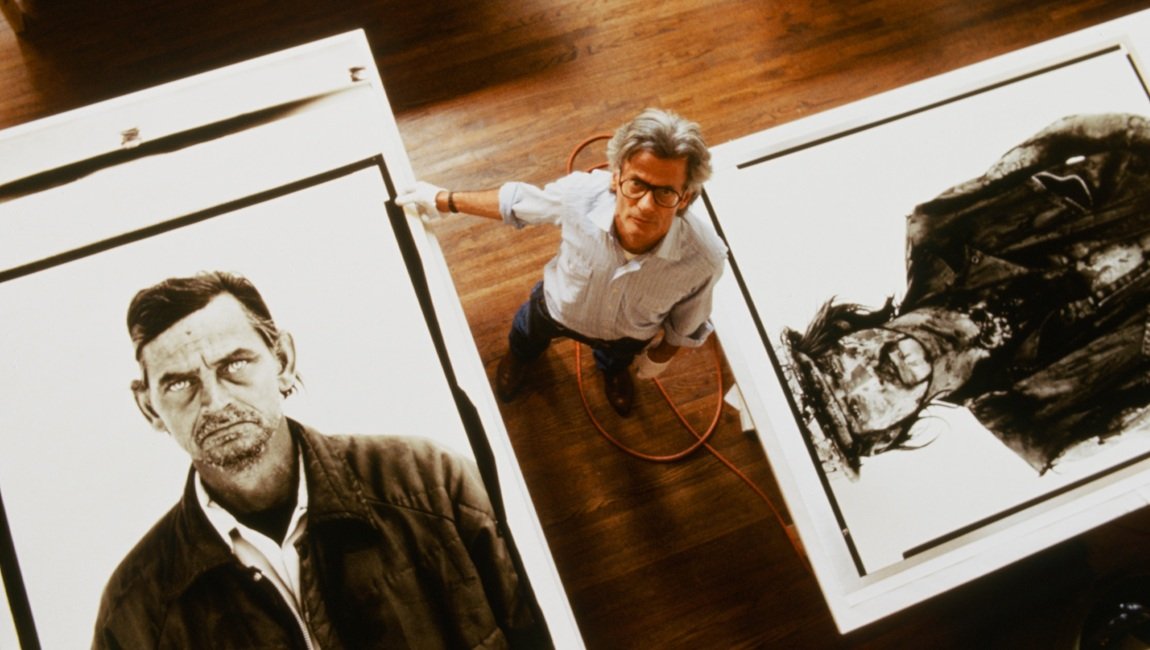
A quarter of the way through Ron Howard’s documentary portrait of the famous — perhaps most famous — magazine photographer, Richard Avedon, his subject touches on his working philosophy: “The most interesting thing about photography for me is that I’m writing my autobiography through the faces of other people.” At first, it’s an achingly familiar credo — write what you know, for instance — one shared by artists across disciplines, but rarely applied to commercial photography. The nature of the medium seems to repel the diaristic. Unless the artist is snapping a self-portrait, as a fashion photographer rarely does, the act seems to do the exact opposite, sublimating the photographer’s identity in favor of the subject’s. It’s a movement closer to suicide than memoir.
But Richard Avedon was not the average fashion photographer. He made a name for himself, first in the pages of Harper’s Bazaar with highly cinematic, ornate portraits of postwar France at the height of the Christian Dior craze, then actually in the cinema, as a creative consultant on Stanley Donen’s Funny Face, and finally as the premier portrait artist in the world. Odds are, if Avedon snapped a photo of a person, it ended the most recognizable ever taken of its subject. It’s also frequently the strangest. The “Sad Marilyn” photo is his most ubiquitous work. Marilyn Monroe slumps down against grey, mugshot backdrops, looks slightly to the left in a frowning, exhausted state. “He got the Norma Jean out of Marilyn,” one commentator remarks. Avedon compelled those hidden facets of person — often sadness, emptiness, or insecurity — to enter the foreground, often for the first time in the public eye. From these numerous famous faces, he searched desperately for those inadequacies he found in himself, like a writer finding troublesome similarities between himself and his characters.
Given this material background, it would be fair to at first conclude that Richard Avedon and Ron Howard seem an odd combination. Howard has never claimed any autobiographical tendencies, and a solid majority of his work has been relegated to the realms of fantasy, science fiction, and cookie-cutter Hollywood blockbuster fare. Yet Howard here handles his subject, if not with ingenuity, then with genuine affection and reverence for another man’s life-work.
Much like Avedon, Howard has photographed many of the 20th and 21st century’s most iconic luminaries, and much like Avedon, he seeks to subvert the “star persona” in search of an authentic character, or a brief brush with real emotion. At the base of Howard’s auteurist concerns, from Cocoon to Thirteen Lives, are studies of American masculinity and the nuclear family. Even in his most spectacular failures, his painstaking attention toward performance never falters. As the documentary probes, photograph by photograph, the essential neuroses and tragedies that shape Avedon’s craft, it’s impossible not to speculate on Howard’s own self-mythologizing. The auteur as autobiographer is a tenuous argument to wage, but in Howard’s documentary, one gets the feeling that, if photography has an element of self-portraiture for Avedon, then composing a portrait of Avedon has an element of self-portraiture for Howard. Avedon the film never divulges this metatextual dialogue, but it’s this interplay of filmmaker and subject that compellingly propels the film forward.
DIRECTOR: Ron Howard; DISTRIBUTOR: Netflix; STREAMING: November 11; RUNTIME: 1 hr. 44 min.
Comments are closed.