
“Horror is like a serpent, always shedding its skin, always changing,” as Dario Argento reminds us. Among other things, Zachary Wigon’s third feature, Victorian Psycho — adapted from the novel of the same name — is a contemporary indication of this quote’s validity, moving freely between genres and ensconcing itself, all the while, within its director’s off-kilter brand of cinema.
Starring Maika Monroe, Victorian Psycho satisfies its title, following Winifred Notty, a young governess who attempts to shroud her psychopathy from her employers and fellow inhabitants of Ensor House, a gothic mansion home to the affluent Pound family. Like Wigon’s previous work, Sanctuary, the film’s tangential swings between genre and form evoke a kind of guessing game unto themselves. Naturally, this is part of the film’s enjoyment: the notion that we too, like Winifred, don’t know whether to laugh or scream, or both.
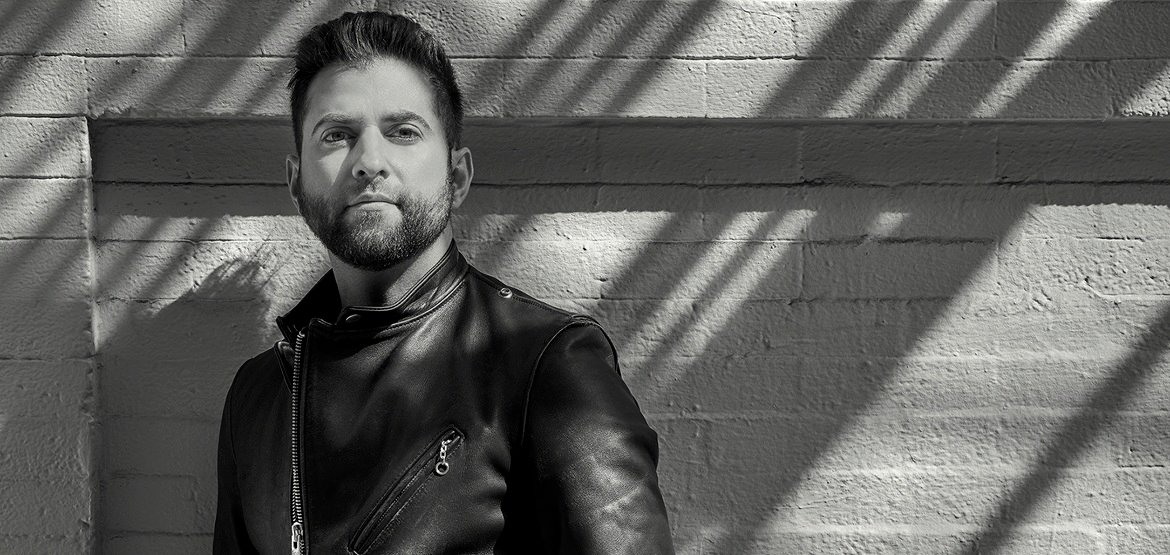
Ahead of Victorian Psycho’s U.S. theatrical release, I sat down with Wigon to discuss genre, shooting in Ireland, working with actors, and more.
Joseph Dimacchia: I wanted to begin by touching on Sanctuary [2022], not only because I love that film, but also because it does similar things with genre that you’re doing here. By that, I mean the blending of [genres]; in Sanctuary, it’s a psychosexual thriller, but also a romcom in many ways, and then here, you’re working with both comedy and horror. I’m curious as to how you try to balance the film tonally.
Zachary Wigon: It’s a great question, because what you’re speaking to is central to one of the reasons that I was interested in making Victorian Psycho. You’re always looking for an emotional reaction to the material, which I had when I read the novel; you’re always looking for an opportunity for interesting performance, which I felt there was in this character of Winifred Notty. But I was also interested in continuing and getting the chance to complete, to have a culmination of something artistic that I was exploring in Sanctuary, and I wanted to push it further, sort of push it to the endpoint. Sanctuary is very much a genre-blending movie, as you said, and I thought the genre-blending in that film was very interesting and very exciting, but I also was curious to see what it would feel like to take those formal hard-left turns, the intense switching between genres, to a much further extent. I sort of wanted to put the gas pedal all the way to the floor and see what happened to the car. I was fascinated by that, and that’s a big part of why I wanted to make Victorian Psycho.
What I thought was interesting was to be able to have a kind of aggressive jumping between genres [that] would give me the opportunity not simply to make a movie about a character who is mad, but to make a film whose atmosphere itself is mad. I didn’t want to simply make a movie that was about madness, I wanted the movie to be madness itself, almost as if Winifred was directing the film in a certain way. I wanted to put the audience so deep inside her head with these jumps between genres, and that was very exciting for me.
JD: I was actually going to follow up by asking about what you’re describing: the notion that the formal style is very much within her psyche. Because of that, it can feel claustrophobic at times, and I’m curious as to if you ever had a consideration to tell the story from an outside perspective? Or rather, to have the camera sit from an outside vantage point?
ZW: No, it was always going to be a subjective story because the pleasure of the novel, and the pleasure of the movie, was always going to be the ways in which the performance and the style gave you access to what it felt like to be Winifred. That was the project of the story, so it was never a third-person, kind of observational approach with this one. This always felt like… in the same way Winifred is on a roller coaster, perpetually trying to fit into Victorian society and repress her madness — even though she’s functionally, effectively, constitutionally incapable of doing these things over a long enough time scale — that was always the drama of the story. That was where the variation and intensity came from. We had to be connected to her subjectivity in order to feel the kind of yo-yo that it feels like to be inside her.
JD: On that note, so much of this story invariably lies in the performance, and Maika Monroe is so incredibly physical, so expressive — especially, as I mentioned, with the formal style — in the extreme close-ups. How much preparation went into her performance with you two, together, collaborating? Like you said, the character is mad, but do you want your performers to bring aspects of themselves into the character? Or is it more about being free, though with the source material in mind?
ZW: I don’t operate dogmatically with respect to actors. Every actor is different, and the way that I’ve worked with every actor that I’ve worked with has been different. [With] each actor, you have to find a unique way into both how to communicate with them and collaborate with them artistically, because everybody’s different, but also because each character is different. There are a lot of different dimensions to how each collaboration works.
With Maika, in particular, it was never about finding something from her personally to bring into Winifred. It was a series of a couple things. We had a lot of conversations in prep about both the feel of the movie and the feel of the character; the sense that she has a kind of heightened, expressionistic quality about her, that it’s not a naturalistic performance. It’s not a naturalistic story, it’s a heightened story. We talked a lot about The Shining, in that regard.
And then on the flip side, on a naturalistic, research front, we talked a lot about facial ticks and gestures that she could bring to the character to convey her sense of madness. I sent a YouTube video that a forensic psychologist had made breaking down an interview with Ted Bundy, where basically every minute or so, he would pause the interview and the psychologist would start pointing out things that Bundy was doing with his facial expressions and his physicality that were at odds with what he was communicating verbally. All the tension between his verbal communication and his physical communication made for something that was really unnerving and visually striking. That was also a big part of how we talked about the character.
But at the end of the day, there’s this expression, “80% of directing an actor is casting an actor,” and I think that that’s true. I like to talk a lot with the actors in prep, but it gets to a certain point where you’ve basically talked all that you can and it’s in their hands now to go and create the character. When Maika showed up in Ireland, it was there, she had found Winifred. She was a full, coherent idea of the performance of this character, and I give her all the credit in the world for that. It was really cool to see.
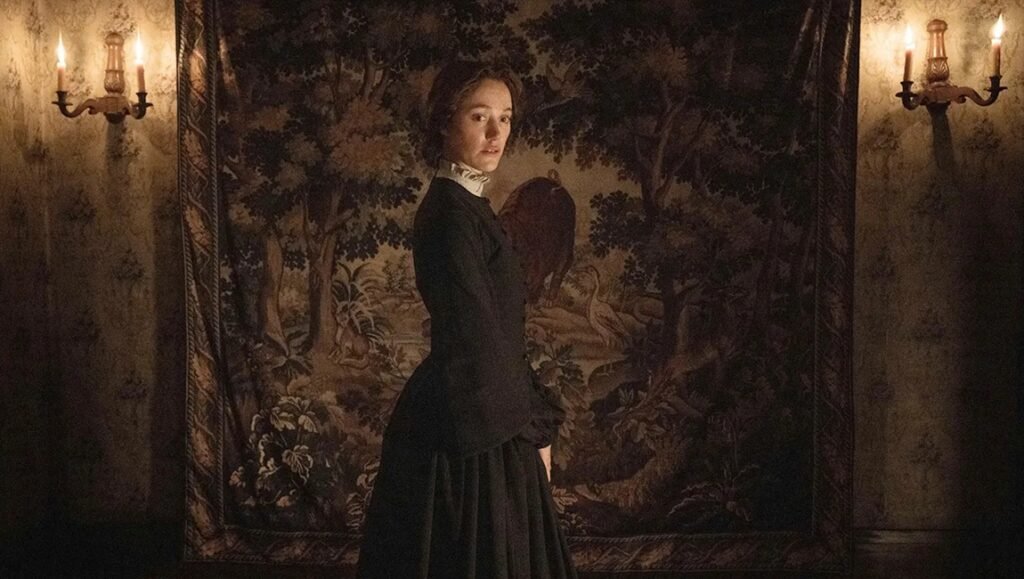
JD: You mentioned The Shining, and also shooting in Ireland, which pertains to what I was going to ask about the physical spaces. I think Last Year at Marienbad you also mentioned along with The Shining as a physical inspiration with the sort of labyrinth-like nature of those sets and houses. What do you find is different about what cinema can capture when you’re shooting on a real, physical location as opposed to a soundstage? Is there something that, in other words, can’t be recreated on a constructed set, especially with a film like this?
ZW: Well, it’s a great question. There’s something to be said for the authenticity of being in a genuine space. I mean, a build on a soundstage could theoretically recreate any freestanding, practical location, but the one thing you can’t recreate on a soundstage is the sensation of being in the world at a property with a certain amount of history, with the authenticity that this space holds. So that can’t be recreated. Everything else, I think, basically can; although, how close can you get to perfect when you’re trying to recreate a physical space on a soundstage? You can probably get pretty close, but I don’t know if you could get all the way there.
The biggest difference, I think, leaving aside the theoretical idea that I’m running with — that you could find the perfect location and then build it identically — leaving that aside, when you’re shooting on a real location, you’re invariably going to find architectural details and ideas that you probably never would have been able to think of. It’s sort of like, if you’re trying to think of the production design for an apartment, for somebody’s bathroom in a scene, you can think a lot about what a bathroom might look like, but if you go into random people’s bathrooms and you’re taking photographs and notes, you’re invariably, surely, going to find things that are so unusual that you never would have been able to. Reality has more detail than anything that we can conjure up in our imagination. You sort of got me on a tangent. It’s a great question. [laughs]
JD: No, go ahead!
ZW: I hope that’s a helpful answer. I think all that is to say, there are more ideas in reality than one individual could ever conjure in their imagination, and that is probably the greatest advantage of working in a practical location. On the flip side, for control over space and being able to do anything you want, you can’t beat a stage.
JD: I think to your point, the location that you shot on broadens the feeling of the film insofar as it feels very vast; homes of this nature, these Gothic, castle-like structures. Jumping back to Sanctuary, that is a film that takes place in one apartment between two characters, and then here, you broaden that into a larger social environment, and with that comes its own considerations of class and other Victorian-era themes. I’m curious if you’d agree: I still see a kind of throughline between the two films regarding performances of identity and how that manifests in power struggles, things of that nature.
ZW: That’s a really interesting question. Both films are about repression and a performance of identity. In Sanctuary, you have this strange, inverted situation where the roleplaying performance is who they actually are, and who they actually are in the real world is the performance. So Sanctuary is built upon a pretty fundamental paradox, and that movie is about performance. Victorian Psycho is about a number of things, but I think repression and performance are also central to this film. One of the axes that every scene in the film is operating on is the question of how capably Winifred is deploying her performance of Victorian accepted normality. Her whole life, her ability to be accepted hinges upon her being able to play the role adequately, and she does the best that she can. But in the end, she sort of succumbs, the mask drops, and she unleashes what she actually is. That’s how I would see the connective tissue between the films in that particular regard.
JD: With that, like you said, repression can lead to this sort of blow-up, you could say, which stems from the social conditions of the era — and more broadly, the conditions of women. How do you toe the line between what you find to be necessary and what you find to be excessive when it comes to onscreen grotesquerie? What you do in this film is present a backbone to Winifred that makes some of her actions necessary, in some way.
ZW: I don’t know if there is a formula for it. I think that it’s probably intuitive. In terms of gore, for example, you know the right level of gore when you see it. It’s hard to really know it intellectually. It’s a constant refining process. You know, you’re working with special effects, and you’re seeing a seven out of ten, you’re seeing a four out of ten, and then you might land at a five and a half, let’s say. It’s primarily a process of intuition and taste, like so much of movie directing, because there’s not enough time to rely on an intellectual concept for most of this stuff. It’s all happening so quickly and decisions have to be made quickly. Your sensibility and your sense of taste — that really is your compass for making those decisions.
Comments are closed.