
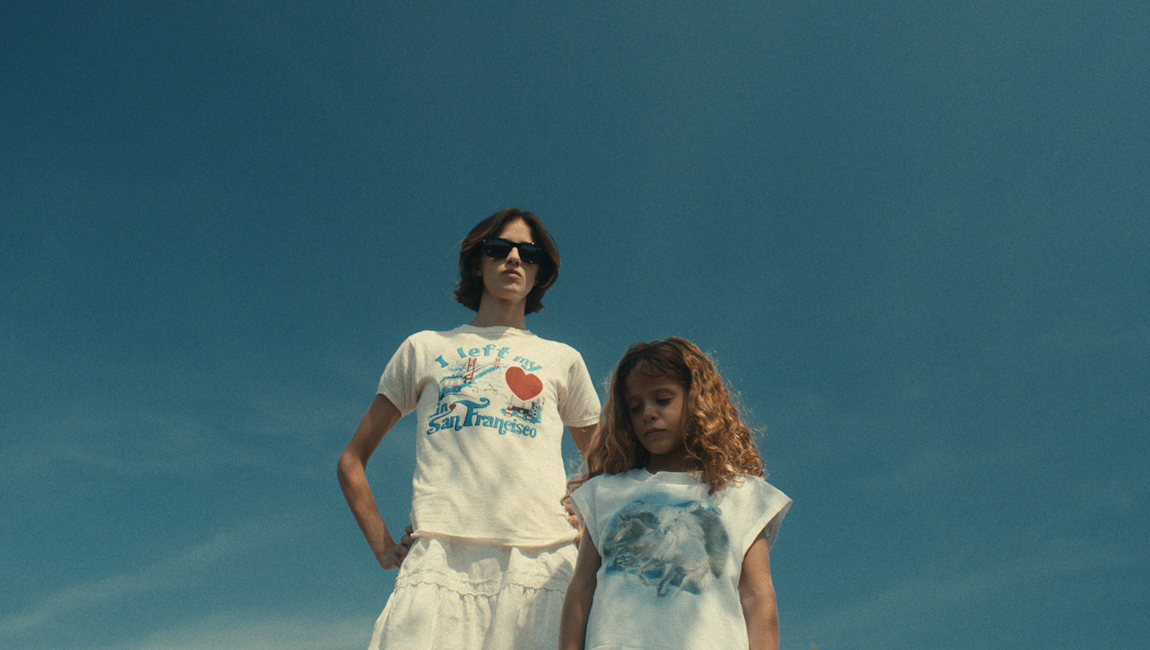
Does ill-discipline equal rebelliousness? If so, then Carolina Cavalli’s The Kidnapping of Arabella is already one of the best films of the year. Cavalli, who has the sole writing credit for the film, structures it as a coming-of-age story about two misfits traveling across seemingly nondescript parts of Italy to (re)discover the true meaning of la dolce vita (the sweet life). But the writer-director doesn’t just want to focus on her film’s central — extremely thorny — relationship, involving our annoyingly childlike middle-aged protagonist, Holly (Benedetta Porcaroli), kidnapping the annoyingly precocious 8-year-old Arabella (Lucrezia Guglielmino) because of her belief that Arabella is, in fact, Holly’s past self “telling” her to give herself a second chance; Cavalli also wants to make an overly formalist, absurdist comedy structured around tertiary characters — like Arabella’s negligent father (Chris Pine, speaking and shouting fluently in Italian) and Holly’s boring (and bored) lover (Marco Bonadei).
The film’s intention is simple and sound: to juxtapose these very different kinds of movies to demonstrate the freedom — to think, to play around, to simply fuck up — people lose when they grow up. And so, broad — almost melodramatic — contrasts abound. Formally, Cavalli intercuts static shots capturing the humdrum nature of the adults’ lives with free-form musical montages of Arabella and Holly’s growing “friendship.” Narratively, the director sharply contrasts Arabella’s father’s inability to communicate with Arabella’s ability to, well, shriek and shout. And thematically, Cavalli, through these extreme contrasts, hammers home the idea that freedom, essentially, is unattainable in adulthood; the promise of childhood carries within it the spirit of rebellion.
But crucially, at no point does Cavalli sell this idea emotionally. Conceptually, contrasting these varying tonalities (and narratives) makes logical sense. But in practice, the tonal (and narrative) dissonance is entirely alienating. Firstly, using musical montages as the primary way to build the film’s central relationship always works against it: the relationship between the kidnapper and the kidnapped, supposed to be fraught with discomfort bubbling underneath the whimsy, comes across as neither tragic (Porcaroli, as Holly, is almost fighting against the film to imbue it with a consistent sense of desperation and melancholy) nor comic. Then, intercutting this already undeveloped relationship with another, tonally divergent narrative further distances us from an already distant relationship. The Kidnapping of Arabella only works as a rebellious text (or a text about rebellion) in theory, then. In execution, Cavalli’s ill-disciplined balancing of disparate narratives and form undermines the text — and, particularly, the central relationship’s — inherent sense of rebellion.
DIRECTOR: Carolina Cavalli; CAST: Benedetta Porcaroli, Chris Pine, Lucrezia Guglielmino, Roberto Zibetti, Roberta Da Soller; DISTRIBUTOR: Oscilloscope Laboratories; IN THEATERS: July 15; RUNTIME: 1 hr. 47 min.
Comments are closed.