
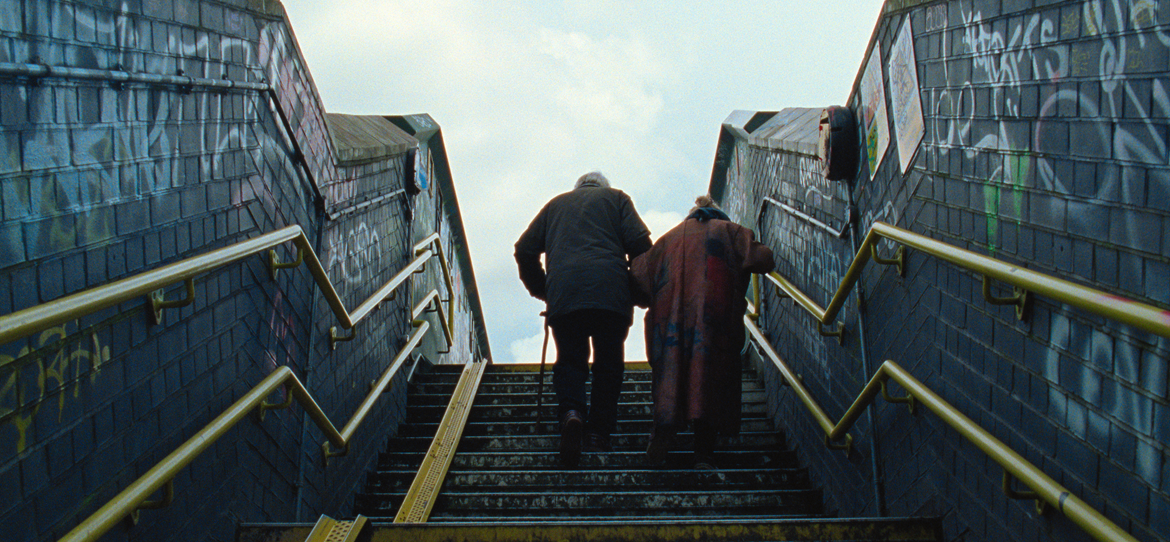
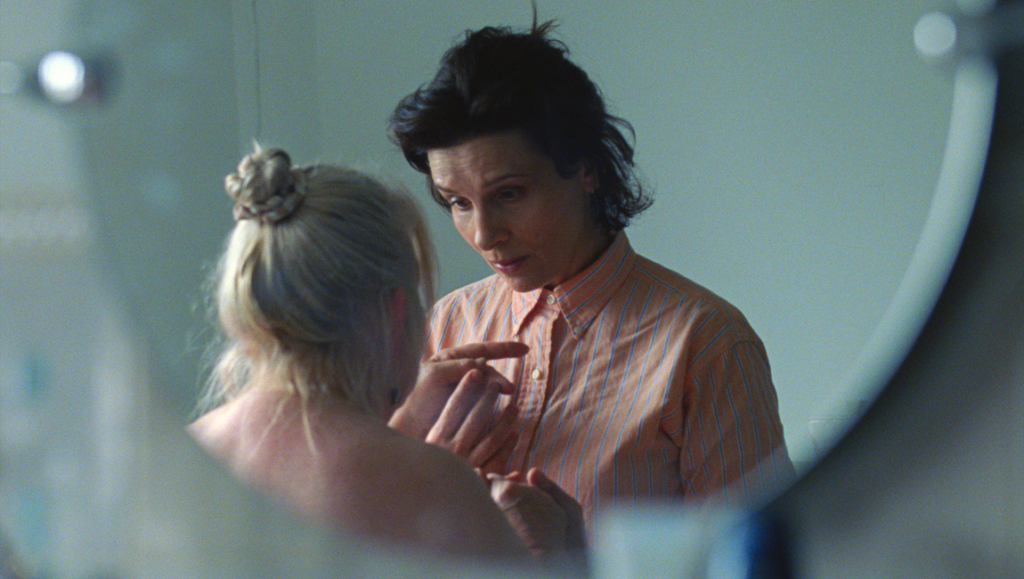
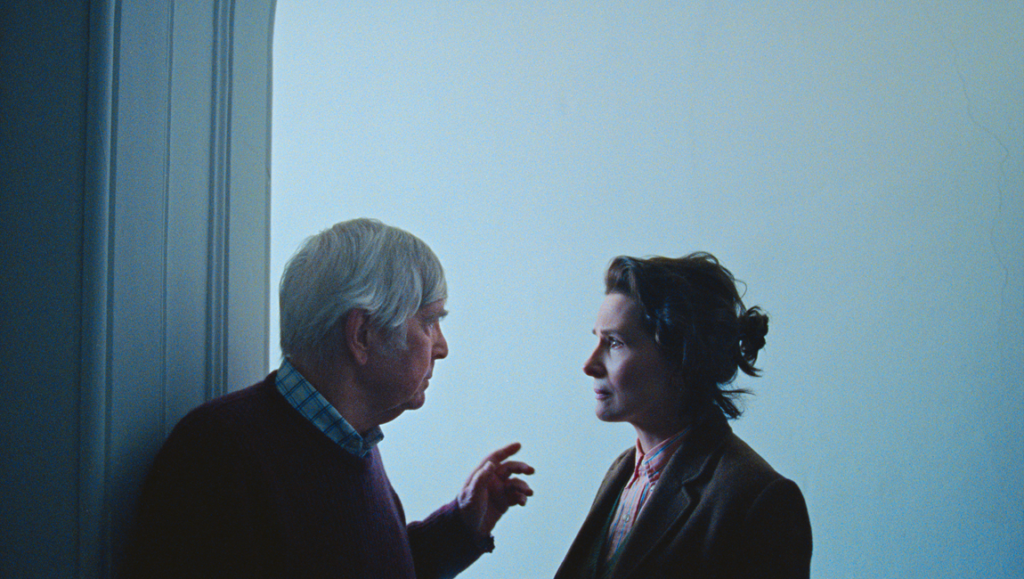
After his debut feature in 2008, Lance Hammer has finally arrived — or maybe one should say re-arrived. His first film in nearly two decades, Queen at Sea is a work of maturation, not only for its director, perhaps, but also in its concerns with aging, and with deterioration as a byproduct of this aging. Simultaneously, though, the film’s chief preoccupation is that of the caretaking necessitated by such deterioration — in this case, dementia. Thus, as opposed to focusing solely on Leslie (Anna Calder-Marshall), Queen at Sea most deliberately follows Leslie’s daughter, Amanda (Academy Award winner Juliette Binoche) as she navigates the ethical and familial implications of caretaking. All the while, she is forced to grapple with her stepfather Martin (Tom Courtenay), as well as her 16 year-old daughter, Sara (Florence Hunt). As one might expect based on this brutal premise, Queen at Sea is not a particularly pleasurable film, but it is a work of deep-seated truth and attention to realism — an indication, if nothing else, of Lance Hammer’s abilities as a filmmaker, regardless of how often he chooses to direct.
On the occasion of the film’s U.S. theatrical release, I spoke with Hammer
Joseph Dimacchia: As someone who has had numerous members of my family deal with dementia, I think not only that the film was very truthful in a lot of ways, but interesting in that it’s told from the perspective of the caretaker. It’s very refreshing, in that sense, because a lot of films of this subject matter tell the story from the vantage point of the person suffering from dementia. I’m curious as to if that was always the perspective that you were going to take, or if early in the writing process, perhaps you had thought that it might be told from Leslie’s perspective?
Lance Hammer: That was always the position I was going to take. In fact, that was one of the reasons why I wanted to write the story. I mean, I do think it’s possible to create a story from the point of view of somebody who can’t communicate, actually communicate their point of view, their emotional experience. But it becomes a fantasy, right? Fantasy is great. Fantasy is fair game in art, but I wanted this to be more realistic, so to say that I could tell you what Leslie’s emotional experience is would be false. You can’t. That’s the whole point of the story — they’re opaque and you can’t understand what their experience is, and that’s the horror.
She is experiencing horror for sure, but we don’t know what it is, and the next order of horror comes from those that love her, and they can communicate what they’re feeling. I thought it was viable and truthful to give you their experience, their point of view. This is a story from the caretaker’s point of view because that is something we can know. We can’t know what Leslie’s experience is, so that was important to me. There have been a number of films about dementia which have tried to do the opposite, but then they’ve tried to be realistic, and it’s just not true. You can’t know, so I wanted to be accurate.
JD: I was going to follow up, actually — and you touched on this — by asking about the limits of the camera within cinema. If someone is in that headspace, that mental deterioration that we cannot understand, are there limits to cinema, in that sense? In the same vein, if you had decided to take that vantage point, how might the film have been different formally?
LH: I think it is a valid position to take, a valid vantage to take, but it has to become fantasy. If I were to do it, for example, I would want it to be clearly a fantastical voyage, and it would have to be clear immediately in the film — “This is not real. This is an imagined experience of somebody whose experience we can’t actually know.” But I didn’t want to make that film. I think the camera in this case, and the mise-en-scène, has to follow whichever tack you take. I’m going to try the fantastical one, and so the camera should follow that, and it should have a fantastical language. But if you don’t, and you’re trying to be realistic and naturalistic, the camera can’t work in counter to what you’re trying to do.
In other words, it can’t suggest a subjective experience of your subject, of the person suffering dementia. You can’t give it an actual camera POV from their eyes, for example, because we can’t know what’s happening, and you wouldn’t want to confuse your languages: your visual camera language and your kind of narrative strategy. The camera, in this case, is very objective. It stands away from the subject, it’s observational. It’s not a subjective camera, it’s an objective camera.
I haven’t really thought tremendously about that recently, but that’s [something] I always try to do with my films. I like to say, “We’re watching somebody. We’re not in their shoes.” In that sense, the camera is attempting to be an empathetic camera. I’m trying to understand what these people are feeling. I’m not trying to be in their shoes and show you what they’re feeling. I’m trying to stand back and look at them as an observer and try to understand and empathize with them.
JD: The camera really works to that, though, because I think with this kind of story, you have to attempt to get at a kind of realism with it. To connect that to your past in architecture, which I find is really interesting. I’m not incredibly knowledgeable within architecture, but on the outside, it seems very complex and potentially ornate — design and the carrying out of design. In what ways has architecture influenced your visual style? Do you feel like there is a throughline between the two mediums?
LH: I think there’s more than a throughline — there’s an impossibility to separate them. [Laughs] It has to do with the creative process, which I learned in architecture school when I was very young. I was always a creative person, an artist. I drew a lot as a child, but the rigor of an architectural creative process is something that’s learned, largely. It has to do with an abstract idea that’s inchoate and very unformed, but it has an intuitive something to it, that you can feel the totality of a thing and yet you only have a shred of it at the beginning. You have to have faith in it, and methodically, through a rigorous process, develop it and give it more concrete form. You remove the things that are superfluous and start delimiting and making your choices narrower and narrower, and pretty soon you have something that’s material. At least, a design, not necessarily a built building. And that’s exactly the same thing for me making a film.
In fact, I’ve just now realized something: I think that’s why I like to write, direct, and edit something, because it’s all the same process for me. The writing is inseparable from the production, the manifestation of it, the filming of it, and the editing — which is the organization of the patterns and the themes, and distilling it into its parts that are organized in a way that makes sense. And this is a process I learned in my architectural education, but I imagine in film school — which I did not go to — it might be similar. Film school graduates might have been good architects, I don’t know.
I’m really grateful that I studied architecture because it taught me how to do this and stick with something. I haven’t made many things, but the things I have made, that’s been the way I’ve done it, and it starts with this notion of a glimpse of an idea which is felt. It’s not mental, it’s just something you feel, and that’s the kernel of this story. The script has to be written over a lot of time, and you have all these false starts, and you have too much information and you keep removing, removing, removing. And then it’s time to shoot it, and that’s kind of like the construction of the thing, the realization and the building of the building. So I really approach it like an architect, I guess.
JD: As it pertains to that construction, you could use the metaphor and say that a finished film is like a finished building. Is it difficult, or different — more thought-provoking — when you watch the finished works? I know you’re editing, so you’re seeing all the footage for hours and hours, but once you have that finished product, how does the relationship change?
LH: I think by the time I finish it, I lose interest with it, and I can’t see it anymore. In the edit, I rely on instinct because you start to lose your ability to see it, but I found that it doesn’t really matter that you lose some ability to see something. You still manage to edit it properly and make good choices. Once it’s done, it’s really hard. Like right now, this is a hard time for me, because it’s out of my head. It has to be banished because it’s no longer in the creative process, and that’s the thing I care about, and I want to be involved in the next creative process. There’s a kind of shutting of the door that happens at this point, and I don’t go back.
JD: The problem with filmmaking is that it’s not simply… this incredibly rigorous process but then, at the end of it, it escapes your mind. And then you have to take on distribution, press, things of that nature, but I find retrospect to be so interesting in this regard. I was reading an interview you did for Ballast (2008), where you said, “Freud said he thought everything was about sex and only eventually discovered it was all about death.” With this film, almost two decades later, it begins with this notion of sex, and then pretty soon one realizes that it seemed to be about death all along. Do you keep questions like that in mind when you’re making films, or is it just this retrospective thing that occurs at the end of it? You’ll look back and say, “Maybe that’s what this is about.”
LH: It’s interesting, I think some of those things are on my mind when I’m making something. A quote like that, for example, might be something that I’m thinking about as I’m conceiving of scenes, but I think you’re right, it’s dangerous to have something like that conscious on your mind as you’re in the creative process. I think it’s better to live in a very unconscious place, and only when it’s done do you go back and analyze it in a psychoanalytic way. The analysis is a bringing of something out of the unconscious into the conscious. When you do that, you kill its power, you kill its creative power, so it’s not a good thing to do while you’re creating, but it’s a good thing to do when you’re done to try to understand what you’ve done. It’s a step that helps you grow, so you’re right about that.
That is an important thing to do when you’re done with something: see what you’ve done. What did I do? Where was this coming from? How did I grow? And now, what did I leave behind and not have to keep visiting because it’s an obsession or something? How has this creative process healed me in some way? Healed a wound, if you’re thinking about this in psychoanalytic terms. So yeah, it’s very important to go back, but only then, only at the end, should you make it mental, should you make it conscious, because then there’s no more creative power in it. It only has creative power when it’s unconscious, I think. That’s not a hard rule; I mean, a lot of things have to be conscious when you’re creating, but maybe some of the bigger things shouldn’t be touched until the end.
JD: Yeah, I mean, as it relates to your process or your education in architecture, maybe it’s about finding a middle ground between that unconscious state when you’re creating and a state where it [becomes] analytical in some way, an arduous process to get to your finished product.
LH: Yeah.
JD: Regarding those Freudian questions you mentioned in the interview — about aging, sex, death — a great point in the film was the [Sara’s] concurrent storyline, and how it creates this juxtaposition. But also this sameness through juxtaposition, with that parallel — the undressing parallel — toward the end of the film. Why do you think it was important to bring Sara in and have that juxtaposition between aging, mental deterioration, death, and youth, flourishing, losing your virginity?
LH: The story, by design, is putting a microscope on one family inside the doors of one house, really. In a way, it’s not seeing the rest of existence in the world, and when you have a tragedy happening, an emergency happening within a household, all energy gets focused on something very specific and minute. But the world’s happening, life is happening, so it’s not only that, it’s not only death. This is what’s happening with this family, and they’re preoccupied with it to the point that they can’t think about anything else, but there are other things happening in life: new people are being born, there are 16-year-old teenagers having their first sexual experience, and there’s great hope and optimism and boundlessness, and this ascension into life and all the joy that comes with that. That’s also happening.
You can lose the forest for the trees. We’re examining the tree, the single tree with this story, but we’re losing sight of the whole forest. Sara, for me, her story was a way to say: there’s death happening, there’s end of life happening, and there’s suffering, but there’s also this, and it will always be this way. There’ll be new life replacing old all the time, and everything’s okay. Everything’s okay.
JD: In a total sense, thematically it can feel bleak, but I also read that you wanted to shoot primarily during cloudy conditions. I think that creates a very distinct, but also truthful, visual ambiance to the film. Was that a consideration to not be so overtly bleak by bringing in some kind of hope to the story?
LH: Yeah. At some point, I realized in the writing that this can only go one way, and it’s not going to be a redemptive ending. I want to follow something I feel is truthful. This story does not end well, but it has meaning. The experience has meaning, but it’s going to be dark, darker than I really want it to be. But I don’t want to be artificial to lighten it, so I’m going to follow the truth.
The Sara story I also thought was truthful. I guess it sort of is an attempt to say, “There’s also light.” This family is going to suffer something dark, and then it will end and things will lighten again in their lives. Sara is on a course of lightness and that’s also happening. So I guess there was an attempt to say that, to lighten the tone of the film. It’s probably part of it.
JD: I read that everything between Sara and her boyfriend was improvised, so I think it plays to that point.
LH: Sara’s scenes with Juliette [Binoche], when she interacts with the other story, the main story, those are scripted, but they were workshopped like everything else. There was some improvisation that happened in the workshops and some changes were made, but when she’s with her other teenage friends, it’s entirely improvised, yeah.
JD: I wanted to finish off by asking about the future. Where do you see yourself going from this film? Did coming back to filmmaking, in a way, reignite some kind of creative drive to make films? That this is the medium that you want to be working in as much as possible?
LH: Yeah, definitely. Yeah, like, I want to make something very quickly. I’m a different person now from when I started writing this story 10 years ago. Having made a very, very dark film, I don’t want to dwell in that space because that’s like what I was saying with Sara, that’s not all that’s in me. That’s not who I am. It’s a part of who I am, and that part is something I’m interested in. I’m interested in truthfulness, but truthfulness can apply to things that are lighter and they can be just as profound. Life and the experience of something light can be just as profound as something heavy and dark, and I’m very much interested in exploring the other parts of me too, which are more life-affirming. Now my focus can be on another part of life, as well as something that’s the end of life. That’s what I’m doing, [what I’m] currently working on.
Comments are closed.