
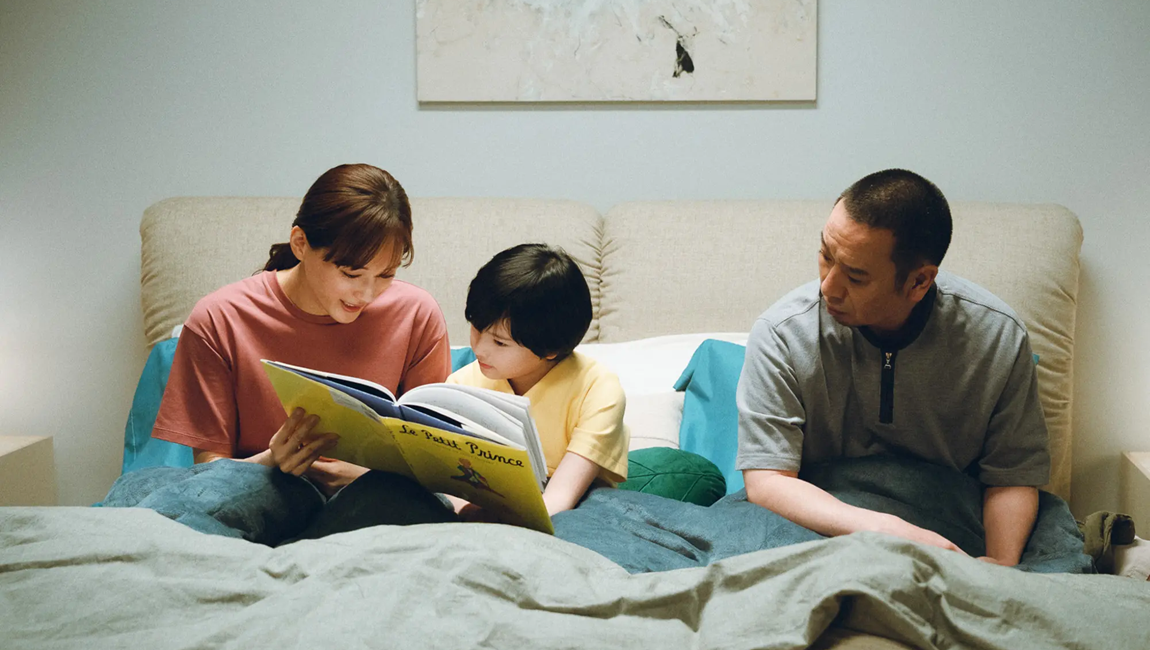
Based on its tepid reception in Cannes earlier this year, one might reasonably expect Hirokazu Kore-eda’s new film Sheep in the Box to be a major misfire. And it’s true that Sheep in the Box is a second-tier effort, roughly along the lines of Hana or Air Doll. But mainly it seems that the negative reaction to Kore-eda’s new film stems from his treatment of his chosen subject matter. After all, this is the story of a couple who are selected to test out a humanoid robot made in the likeness of their young son Kakeru (Kuwaki Remu), who died in a train accident two years earlier. The plot immediately brings to mind Spielberg’s A.I., along with lesser-known robot-replacement films such as Michael Almereyda’s Marjorie Prime, and it does suffer in the comparison. What’s more, Sheep in the Box opens itself to greater scrutiny because in 2026, artificial intelligence isn’t the stuff of Isaac Asimov futurism, but is instead reaching its corporate tentacles into all facets of daily life.
In other words, Sheep in the Box is cursed with topicality, and it’s true that Kore-eda isn’t necessarily interested in the scientific or ethical ramifications of tech that purports to be family. Instead, the premise is mostly a structure onto which Kore-eda can apply many of the concerns that have guided his cinematic career. What is love? What is the meaning of family? Are people defined by their circumstances, or does the human being maintain an innate spark regardless of external pressures? And above all, why does society allow children to experience abandonment and suffering? Although the scenario of Sheep in the Box butts up against cutting-edge technological questions, Koreeda seems less interested in exploring them for their own sake, and this might seem like a missed opportunity.
And it’s true, Sheep in the Box is not an entirely successful film, but for somewhat different reasons. Kore-eda is given to tackling the big questions, and in his best films — After Life, Still Walking, Maborosi, and Distance — he narrows his inquiry down by focusing on the specific parameters of his premise. After Life is about the art of dying well, leaving behind some small trace of meaning. Distance (Kore-eda’s most underrated film) considers mortality and the death drive, in the context of an Aum-like suicide cult. One might reasonably expect Sheep in the Box to operate in the same manner, using the advent of AI to explore the meanings of family attachment.
But in fact, the robotic replacement of a dead child doesn’t narrow down Kore-eda’s ideas so much as it gives them free rein. Kore-eda’s films are always formally precise, with a tonal and compositional evenhandedness that unconsciously communicates a level of intellectual control to the viewer, and for this reason it can be difficult to perceive just how scattershot Sheep in a Box actually is. Kore-eda’s post-Ozu style confers an audiovisual holism that the screenplay simply cannot follow through on. This can seem even more confusing given that Kakeru’s parents are themselves fastidious structuralists. The mother, Otone (Haruka Ayase), is an architect who specializes in combining modernism and traditional Japanese elements. The father, Ken (Daigo Yamamoto), is a master builder who helps Otone realize her visions.
In a more streamlined version of Sheep in the Box, the couple’s careers and general temperament would have been the main drivers of the plot, particularly their ability or inability to accept the robotic Kakeru. Time and change are significant throughlines in the film. Otone retains models of older, failed projects because she wants to have the option of recycling those ideas in new situations. Otone’s pushy, churlish mother (Mari Hoshino) summarily rejects the cyber child and tells Otone that she should just have another child. When our memories can be made “flesh” through technology, what does that do to those memories, or our fundamental relationship to time? Are we all simply data points that can be recycled infinitely, in new situations? How easily can we be replaced?
One of the most off-putting aspects of Sheep is the fact that Otone and Ken accept this brand-new technology with minimal resistance. Ken initially rejects his robot son, comparing him first to a Tamagotchi, and later on to a Roomba. Otone chooses to embrace their replacement son, but eventually becomes even more ambivalent than her husband. But neither of them really questions the ethics of adopting a mechanical replacement son. As the film progresses, Kore-eda introduces greater ambiguity about “life” as a meaningful category. An older woodworker, Akio (Min Tanaka), believes that all wood retains traces of the tree’s prior living state. And if wooden blocks or planks are “alive,” why isn’t Kakeru?
In other words, if the animatronic Kakeru isn’t the couple’s son, what is he? A toy? A pet? An appliance? Kore-eda chooses not to answer these questions, and this leads to a certain frustration. Why tackle one of society’s hottest hot-button issues and refrain from taking a stand? Given Kore-eda’s often diffident artistic voice, it is unrealistic to think he’d stake out a firm position. (We have Miyazaki for that.) But we did have a right to expect Kore-eda to take the premise seriously in terms of what it might mean for the future of the family unit. By the end, when Kakeru leaves his parents behind to join a community of other, mostly robotic children, Ken remarks that all children leave their parents eventually. Does this mean that all children “die” by growing up, and the loss of the original Kakeru was merely a more acute version of a universal parental loss? Kore-eda doesn’t have an answer for us, and while he certainly has the right to avoid prescriptive moralism, he might’ve offered something richer in return. Sheep in the Box ultimately does not.
DIRECTOR: Hirokazu Kore-eda; CAST: Haruka Ayase, Daigo Yamamoto, Kuwaki Rimu, Nana Seino, Kanichiro; DISTRIBUTOR: NEON; IN THEATERS: July 24; RUNTIME: 2 hr. 6 min.
Originally published as part of Japan Cuts 2026 — Dispatch 1.
Comments are closed.