
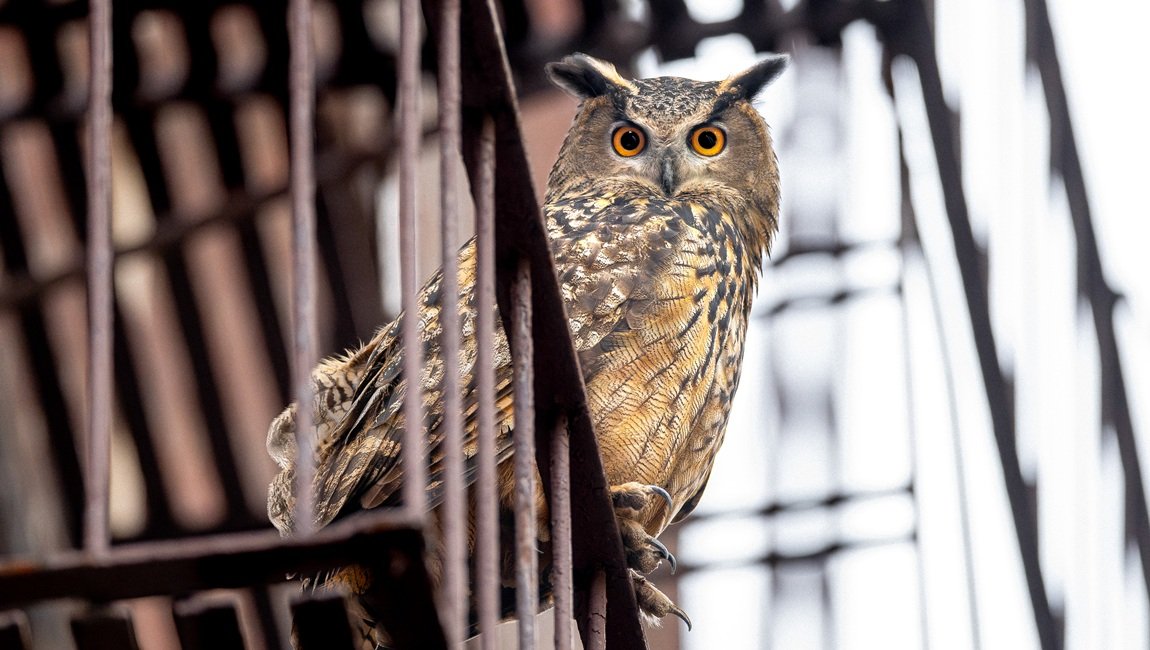
In February 2023, when the world was shaking off COVID-induced anxiety around confined spaces and returning to schools, offices, and restaurants in droves, New Yorkers found an unlikely mascot for this hard-won freedom: Flaco, a Eurasian eagle-owl who escaped his enclosure in Central Park Zoo and became an overnight folk hero. Veteran documentarian Penny Lane’s newest venture, the engaging and heartfelt Wild Inside, frames Flaco’s escape as both a lighthearted cultural phenomenon and a thorny philosophical quandary. Lane has a knack for excavating subcultures (Hail Satan?) and pop culture (Listening to Kenny G) with incisive humor, so it seemed like a bit of a missed opportunity to mention, but not investigate, the fact that the chain-link fencing around Flaco’s enclosure was seemingly cut on purpose. Alas, a hoo-dunnit this is not.
As passersby mutter when Flaco is first discovered, dazed and bemused on 5th Avenue, “Only in New York.” But Lane raises thoughtful questions about Flaco’s place in an urban landscape he was never meant to roam. Bred in captivity, he spent the entirety of his 13 years in an enclosure the size of a bus shelter, adjacent to a clock tower whose chimes must have been bone-rattingly loud for a creature with such keen hearing. No wonder he relished the chance to finally spread his wings. And yet, he is undeniably an apex predator, and a non-native species to boot. How much would his presence disrupt the ecosystem of Central Park, which is home to not just squirrels and pigeons, but also rabbits, raccoons, foxes, and coyotes?
Flaco’s nightly journeys were tracked by dedicated owlers who lugged huge cameras with telescoping lenses, looking more like Nat Geo photographers (or ancient astronomers) than city-dwellers. This was as much to sate their own curiosity as to ensure Flaco’s safety, since his first few days of freedom were endearingly tentative. Zoo officials tried multiple times to trap him with succulent white lab rats — the rarefied fare to which he was accustomed — but gave up once he learned the thrill of the hunt (rattophiles be warned: there is ample footage of Flaco tapping into his killer instincts).
Most of the documentary’s footage is mined from crowdsourced videos and photos of the large, incongruous owl perched on rooftops, air conditioners, and balconies across his home borough (Flaco, like millions of Manhattanites before him, didn’t seem interested in alighting further afield). As such, the film has a charmingly homespun quality, stuffed with blurry, pixelated photos, grainy videos, and people dropping F-bombs when they notice a pair of glowing orange eyes on their fire escape. As his freedom stretched from the doldrums of winter into the spring and summer, his mythology grew accordingly. He seemed to drop in on those most eager to see him, conjured from thin air like a visiting spirit. Yet there are plenty who take comfort in his more distant presence, whether it’s his reassuring hoot or distinct silhouette. Merch proliferates; murals appear; tattoo shops start offering Flaco flash.
Lane also interviews a large cross-section of Flaco fans, including two owlers who met through their nightly vigils and fell in love, a recent empty nester who needed something to fill her newfound time, and a rescuer who takes in rabbits that would otherwise be part of the animal kingdom’s food chain. But most affecting are interviews with staff at the Wild Bird Fund, who know all too well what happens when wild but seemingly self-sufficient creatures get tangled in an environment that was never built to accommodate them. Their comments tie back to a broader conversation about the ethics of conservation and raise trenchant questions about how humans and animals can coexist in increasingly dense, resource-depleted environments.
What ultimately happens to Flaco might be a moment of vindication for those who fretted over the dangers of his newfound freedom. As one conservationist notes, he could have lived decades longer in captivity. However, for a majestic predator and born hunter, is a life behind a fence even worth living? As tempting and natural as it is to project our human desires and foibles onto this inscrutable animal, none of us have any idea what Flaco actually wanted, nor how much of his life outside the zoo was based on calculation versus instinct. Yet that doesn’t lessen the impact he had on the countless people who looked out for him, worried about him, and excitedly reported sightings and updates to their community. In a city of eight million people (and who knows how many animals), sometimes it takes the creature farthest from home to bring everyone else together.
DIRECTOR: Penny Lane; CAST: Flaco; DISTRIBUTOR: Sandbox Films; IN THEATERS: July 31; RUNTIME: 1 hr. 35 min.
Comments are closed.