
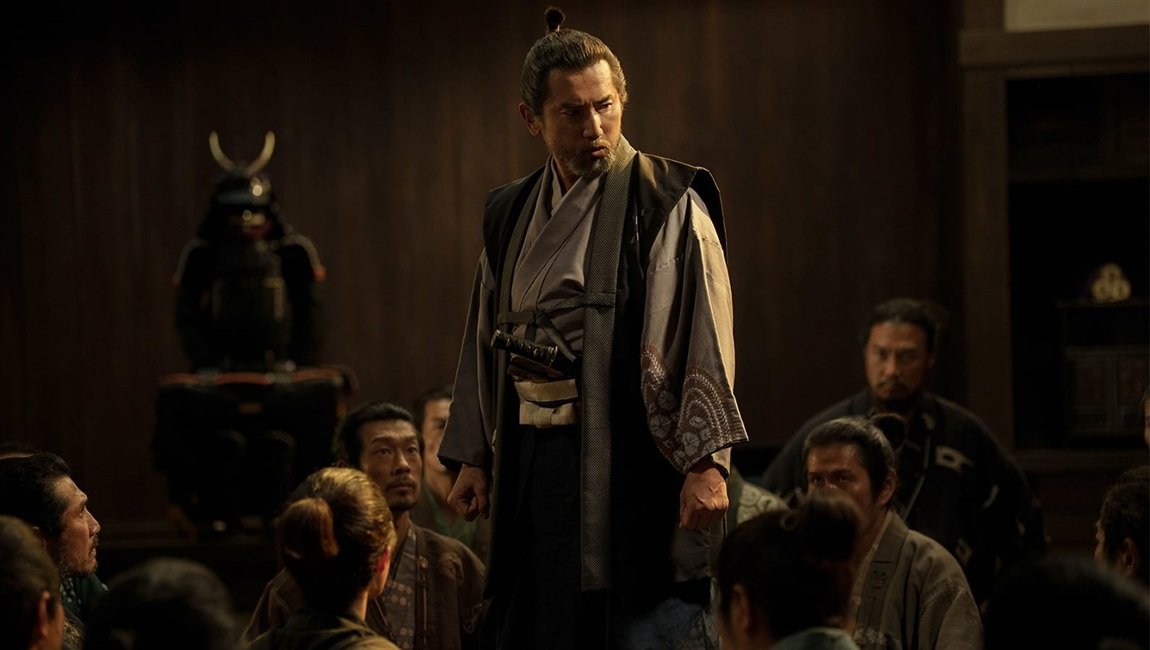
Over 40 years and as many movies into his career, Kiyoshi Kurosawa has finally made his first samurai film. Maybe it was the looming shadow of that other Kurosawa keeping him from the most iconic Japanese genre. Or perhaps it was just a matter of budget, since achieving the look of the distant past is usually far more expensive. Besides, few filmmakers are as of the moment as Kurosawa, whose Pulse imbued the nascent internet with metaphysical terror at a time when his contemporaries were still dicking around with the analog terror of VHS and whose recent Cloud centered a chase movie around the absurdity of online resellers. He’s made a few period pieces, like 2020’s Wife of a Spy, but The Samurai and the Prisoner, an adaptation of Honobu Yonezawa’s historical novel, is his first jidaigeki.
The formal promise of Kurosawa doing such a project — that the clean, geometrical lines of period Japanese architecture would be an ideal match for the director’s still frames and precise staging of actors — is realized within the walls of Arioka Castle where Araki Murashige (Masahiro Motoki), former retainer of Oda Nobunaga, holes up against his former boss’s siege. Murashige seeks to be a different kind of daimyō than Oda and the other samurai lords, resisting senseless execution, even when death is essential to his captives’ honor. But when he refuses, against the wishes of his devout Buddhist wife, to execute a child whose traitorous father has perished, the boy dies anyway, falling victim to a bizarre crime — an invisible arrow passed through the three-inch opening of the door to his chamber. The Samurai and the Prisoner thus reveals itself as a mystery story — another heralded literary tradition in Japan — but this is merely the first strange case Murashige will face during his yearlong siege. The film is split into chapters, each focusing on a different incident, like the disembodied head of a slain enemy becoming disfigured or the divine striking down of one of Murashige’s samurai, which gives the impression of an anthology of brief adventures that are eventually tied together.
A murder this inexplicable is too great a puzzle for Murashige, smart as he is, and so he enlists the help of the renowned samurai strategist Kuroda Kanbei (Masaki Suda), held captive in the dungeon after urging Murashige not to defect. These men and the matter of Kanbei’s imprisonment are taken from historical record, but Yonezawa’s novel imagines a new dimension to their relationship not unlike that between Will Graham and Hannibal Lecter. Brilliant Kanbei can solve these mysteries with just the information Murashige shares, but instead of revealing the answer to his captor, he gives arcane clues that lead to a solution only once Murashige considers them. As he visits the prisoner, Murashige grows closer to Kanbei, giving over his trust and, in turn, enabling Kanbei to have outsized influence beyond the dungeon’s walls.
Though not his invention, this dynamic is pure Kiyoshi Kurosawa, a filmmaker who constantly probes questions of influence, especially as they pertain to violent action. A scene midway through the film recalls Mamiya’s deadly mesmerism in Cure: Kanbei, having been brutally beaten in the dungeon, whispers something we’re not privy to in his assailant’s ear, leading the guard to attack Murashige, who cuts him down. Kanbei remarks on his ability to kill from within captivity, and this indirect violence proves key to the larger undertaking here. Though Murashige objects to murder, an ostensibly moral stand that flies in the face of traditional understandings of samurai honor, the circumstances of war around him make it so that those he spares, like the boy in the first chapter, meet their doom anyway. Worse, some of his inaction, namely capturing Kanbei rather than allowing him to save face in death, has a rippling effect of greater violence down the line.
All the hallmarks of the genre, from stern, strategically minded samurai warriors to swordplay and palace intrigue, are in some measure present in The Samurai and the Prisoner, but the qualities that buoy the film are those specific to Kurosawa’s filmmaking. As this is ultimately a chamber drama, focused more on terse exchanges of dialog than on the flashing of blades, it sometimes risks feeling stagebound, but Kurosawa’s signature sense of space, conveyed in the wide master shots he returns to, enlivens scenes beyond their already sharp scripting. The space between Murashige and Kanbei when they first sit across from each other in the dungeon feels wider than the image itself, a gap further accentuated by the pillar that cuts across the frame, separating them. Elsewhere, Kurosawa, who never really leaves his horror bona fides behind, can make the simple crossing of a room into a violent act worth a gasp.
In the climactic confrontation between Murashige and the person behind the schemes — to say who would be to spoil, obviously, but the performer in question brings the house down in this scene and deserves mention — the camera tracks as his antagonist walks around the room delivering a monologue, coming close to Murashige a few times before heading in a different direction. Then, the two collide, their bodies coming together dramatically for the first time in the film. Their faces in close proximity, this evaporation of physical and emotional distance, is The Samurai and the Prisoner’s most violent image.
DIRECTOR: Kiyoshi Kurosawa; CAST: Masahiro Motoki, Masaki Suda, Yuriko Yoshitaka, Munetaka Aoki, Shingo Bando; DISTRIBUTOR: Janus Films; IN THEATERS: July 31; RUNTIME: 2 hr. 27 min.
Comments are closed.