
Christopher Nolan is the movies now. For good or ill, he has been anointed as the ultimate modern filmmaker, a Spielbergian master pushing the medium of mainstream moviegoing into a purely experiential realm. We’ve got people traveling cross-country to see his movies in 70mm IMAX — even if they don’t know what that is. Would Jurassic Park have sold out screenings a year before its eventual 1993 release? Who can say? If that sounds like skepticism, well, it is. But Nolan is also uniquely positioned to offer his vision to a willing and eager audience. Debate the merits of his filmography if you must, but historically few filmmakers have demonstrated a similar grip on the zeitgeist. Here’s a guy who not only made three Batman movies, but also scored a billion-dollar worldwide gross and a handful of Oscars with a biopic about a sad physicist who just happened to be one of the most important humans of his century.
Which brings us to Nolan’s The Odyssey, a very loose adaptation of the Homeric epic that reorders events, elides massive amounts of the original text, amalgamates and alters characters, and applies modern morality to the themes. Homer’s Odysseus is a wily tactician, almost a schemer, with an ancient Greek’s love of war and violence. Nolan’s, here realized by Matt Damon, is a weary pragmatist searching for peace after an endless campaign of brutality. In the aftermath of Troy’s sacking, he has yet to return home to his kingdom of Ithaca, and his wife and son, Penelope (Anne Hathaway) and Telemachus (Tom Holland), respectively. Decades have passed. His journey takes him to the cave of Polyphemus the Cyclops, whose murder curses Odysseus and his men to become lost at sea; to Circe’s island, where his crewmates are turned literally into pigs; and further still past the whirlpool Charybdis and the sea monster Scylla. Then he’s exiled — essentially held a romantic hostage — by the sea nymph Calypso (Charlize Theron). Meanwhile, Penelope must contend with her suitors, a boorish glut of awful bros who wish to marry her, usurping Telemachus and claiming Ithaca’s throne. They’re led by Antionus (Robert Pattinson), a hissing, conniving asshole who immediately registers as one of recent cinema’s more despicable villains. With the help of Odysseus’ loyal swineherd Eumeaus (a mildly revelatory John Leguizamo), Telemachus sets off to find his father and save the kingdom.
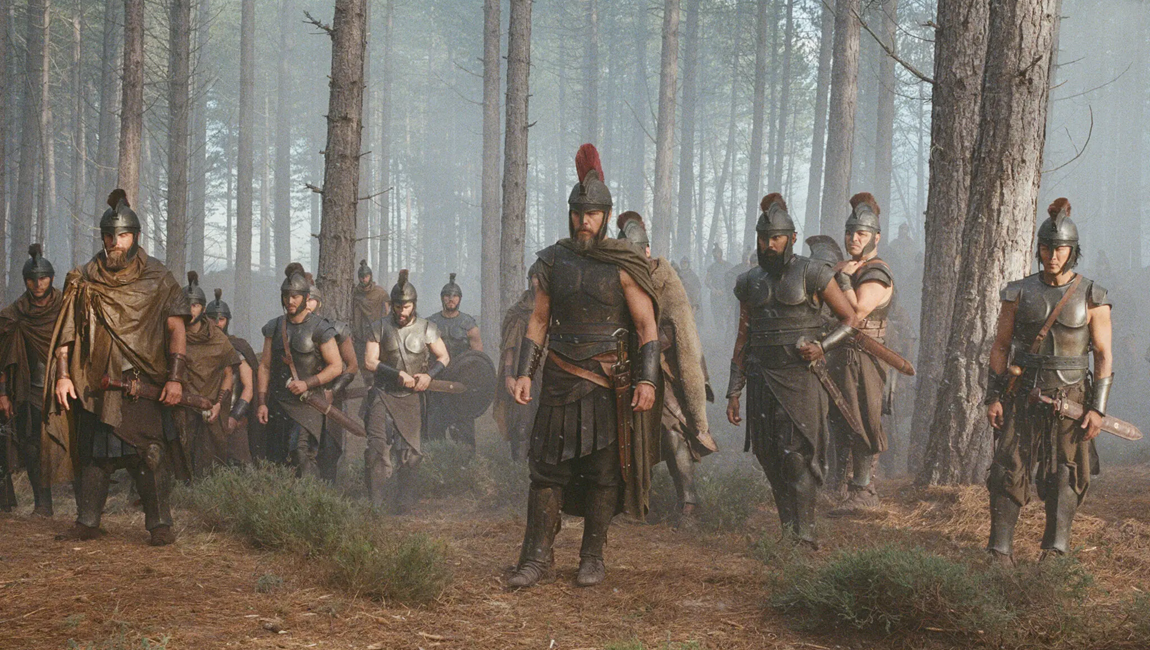
The Odyssey is an almost textbook example of Nolan’s formidable strengths and perennial weaknesses. To begin with, it’s a staggering work of robust, tactile filmmaking featuring incredible vistas, gorgeous landscapes, and a heavy slant toward practical, in-camera effects augmented by largely seamless digital VFX work. To put a period on it, the film looks absolutely incredible. Nolan’s sense of scope and simple image-making is unparalleled, and The Odyssey is more than anything an exciting, visceral experience. That praise being so heaped, it must be noted that the editing here is some of the most rickety in his career (which is riddled with rickety editing). And while the IMAX presentation is integral to Nolan’s playbook here, the simple limits of an IMAX film platter restrict the runtime to three hours, forcing the film to hurtle through plot points and cram exposition into every nook and cranny the script can find — more than once important details are dumped into dialogue that’s been hastily ADR’ed into a shot of someone’s back. Crucial actions even sometimes only last a few frames, and — most typically for Nolan — action beats suffer. Even the film’s foundational set pieces are inconsistent: the large-scale spectacle of the sacking of Troy is legitimately astounding, but a climactic skirmish between Odysseus and the suitors is shredded to bits, rendering it both incoherent and bloodless. For all his myriad and monumental talents, Nolan still can’t cut a simple fight scene together.
Despite that, The Odyssey manages to be one of Nolan’s more deeply felt emotional works. Recasting Odysseus as Inception’s “old man, filled with regret and waiting to die alone” might be a wholesale invention unheard of in the source material, but it recodes an epic poem of men trapped by the capriciousness of the Gods into a timely look at the cost of violence. Odysseus may make it home and vanquish the men scheming for his throne, but ultimately the film suggests that the cruelty he’s inflicted as a soldier in a pointless war of vanity and in the desertion of his wife and son is the real thing that has prevented him from “coming home,” and that nothing can heal those wounds. Resolution can only come with his disappearance into history, forgotten, and there’s nothing of value left but to honor those dead by his hand.
In a strange way, then, The Odyssey is a companion piece to Oppenheimer. Both are uniquely Nolan-esque adaptations of unwieldy material that the director has molded into subjective, psychic analyses of men steeped in regret for their actions and the lives that those actions have cost. Oppenheimer opens with a title card that explains that man was punished for stealing fire from the Gods, an epigraph that would fit just as snugly at the top of Nolan’s latest epic.
DIRECTOR: Christopher Nolan; CAST: Matt Damon, Tom Holland, Robert Pattinson, Anne Hathaway, Lupita Nyong’o, Zendaya; DISTRIBUTOR: Universal Pictures; IN THEATERS: July 17; RUNTIME: 2 hr. 53 min.
Comments are closed.