
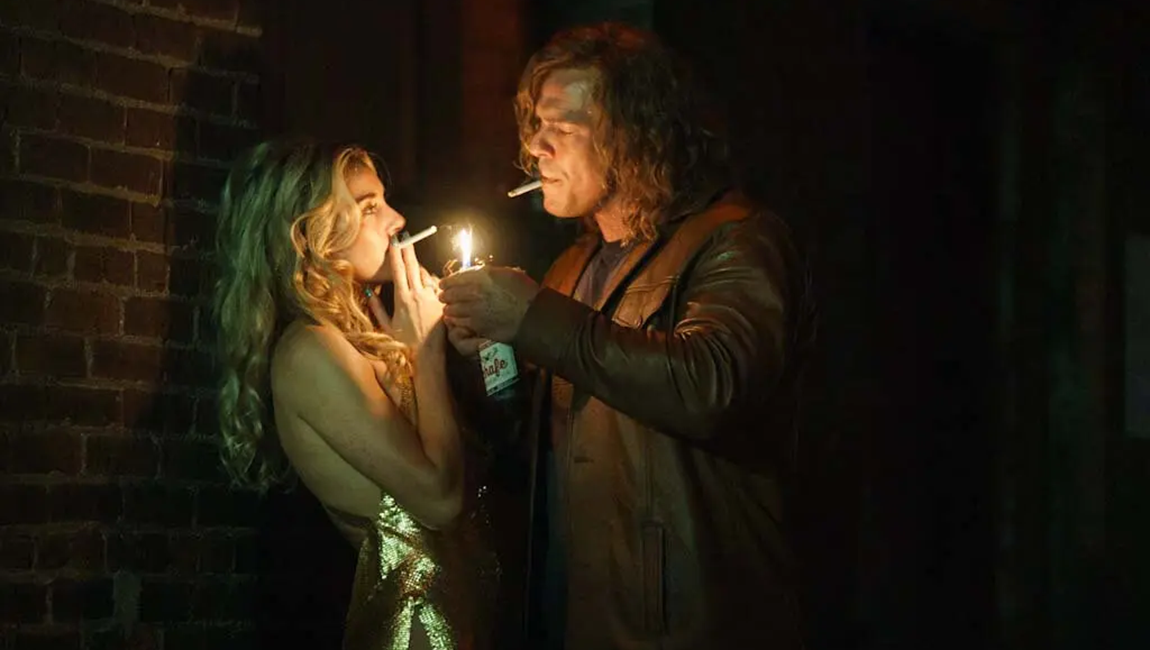
The actor Alan Ritchson is a little bit of an anomaly as far as modern leading men go. Best known for playing the title role on the Amazon series Reacher, the actor is 6′ 3″ and, depending on what articles you read, weighs anywhere from 200 to 240 pounds. He looks like he’s carved from an oak tree when most modern movie stars tend toward the twig-like (you could imagine several Timothée Chalamets fitting comfortably inside one Ritchson). He’s a throwback to superstars like Schwarzenegger and Stallone, who appeared as though they could lift a car and famously became household names despite not having “conventional” speaking voices — the kinds of performers you kind of can’t take your eyes off of. Perhaps that’s why the makers of Motor City thought the actor would be a good fit for the rather atypical nature of the film. A crime drama set in 1970s Detroit (although it was mostly shot in New Jersey), Motor City follows a rudimentary template: a wronged man out for vengeance, a sleazy powerbroker pulling the strings, and the woman caught between them. It’s got dirty cops with oily handlebar mustaches and feathered hair, reckless chases in vintage cars and extended shootouts. It also contains less than a dozen total lines of dialogue in its 100-minute runtime. Of course, when a film only trafficks in the hoariest of genre tropes, what really needs to be said aloud?
Ritchson stars as John Miller (even the character’s name is generic), a Vietnam vet and ex-con who is turning his life around. John went to prison for dealing drugs, but these days he’s on the straight and narrow. He works a legit job, he no longer needs to check in with his parole officer, and he just proposed to his former party girl-turned-greasy spoon waitress girlfriend Sophia (Shelaine Woodley). When his car gets stolen, he even has the good luck of recovering it without it being stripped for parts or the diamond ring he bought for Sophia taken from the glovebox. But it was all a setup: the thieves planted drugs in his trunk and someone dropped a dime to the cops, leading to John being marched back to jail while a despondent Sophia calls off the engagement. It seems that some years earlier John ran afoul of Sophia’s ex, the local drug lord Reynolds (Ben Foster, looking like a sentient leisure suit), who’s been counting the days until he can exact his revenge. With half the cops in the city on his payroll — most usefully Pablo Schrieber’s shady narcotics detective — Reynolds is able to railroad John back to state prison, giving himself an undefended opportunity to slither back into Sophia’s pants. And all the while, John stews behind bars, planning his escape with the help of a couple Army Ranger buddies so that he can get his hands on Reynolds and resume a life with Sophia.
Working from a decidedly threadbare screenplay by Chad St. John, director Potsy Ponciroli (Old Henry) defaults, in nearly every instance, to the archetypal. Motor City is shot in a hyper-stylized manner that recalls the panels of a graphic novel — an early scene frames Ritchson next to towering neon letters, followed shortly thereafter by a shot where he fires an engagement ring from the barrels of a sawed off shotgun directly toward the camera — which is probably an imperative in a film where characters never talk to one another. Instead, Ponciroli stages the film like a feature-length music video where characters go through the motions of clichéd scenarios, all of it edited into slick montages and set to a soundtrack that is dominated by instantly recognizable, presumably expensive needle drops. We open with a version of David Bowie’s “Cat People (Putting Out Fire)” and the song selections don’t get any more obscure from there: a police raid set to Fleetwood Mac’s “The Chain”; an ode to drugs, decadence, and disco dancing scored to Donna Summer’s “I Feel Love”; a downtempo shift into melancholy accompanied by “Nights in White Satin” by the Moody Blues; and so it goes. There’s something like a little “stolen valor” in leveraging pop songs this iconic (and often associated with other, better movies) and doing absolutely nothing compelling or original with them. It’s as though the filmmakers believed the audience’s affection for the music would spill over to the rest of the film.
Even with access to a “Super Sounds of the Seventies” playlist, making what amounts to a silent film is no easy thing. As Norma Desmond famously put it while reminiscing about the era before sound, “We didn’t need dialogue. We had faces!” Modern actors though, not so much. The cast, many of whom are primarily known for their work on television (not a taciturn medium, that), run up against the simplistic way their characters have been defined and the entirely arbitrary nature of the central gimmick. It’s as though the actors have been roped into a drama school exercise: make a situation where someone really ought to be speaking, but for some reason doesn’t, appear naturalistic. It’s an assignment that Motor City rarely passes. Characters will sit down opposite one another in a diner and stare at one another endlessly, silently pantomiming and smirking in anticipation of a title card that’s not coming. Finally, after many awkward seconds of this, Ponciroli will cut to an exterior shot or a wide angle which allows for the impression that something important has been said, but it’s either muffled by physical barriers or we’re just too far away to hear it. It becomes a perverse sport, trying to anticipate how the film will overcomplicate a common scene in service of an arch stunt that’s working against its own interests. In one of the sillier examples of this, the film cuts to a shot of the musician Jack White, appearing in a cameo as a piano player, in a restaurant where two of our main characters are having an animated conversation out of focus, in the background, and out of earshot. Our attention is constantly being diverted from what’s ostensibly important because that’s the easiest way to explain why nobody is opening their mouths.
The other consequence of ditching the dialogue is that everything needs to be distilled down to its most unambiguous form in order for the story to register with the viewer. Any sort of plotting or character motivations that rise above the basic necessities of moving from one scene to the next go out the window; it’s all flattened out and dropped right on the surface. It’s how we end up with ridiculous scenes like a bizarro cuckold dream sequence where John, still behind bars — that the penitentiary is named Brubaker State Prison is what qualifies as clever here — imagines Sofia and Reynolds having sex in front of him (Oh, now it’s clear: he’s jealous and angry). A plot point as logistically complex as breaking a man the size of a refrigerator out of jail is made to look astonishingly easy because the film’s under zero obligation to explain things like “how did that accomplice get into that part of the prison?” or “why are there so few guards?” and “is it really that easy to make a shiv out of melted hard candy?” And then there are the moments of unintentional comedy, like when John has to switch clothing with a “normal sized” prison guard where the officer’s uniform has expanded to fit Ritchson’s XXL frame like the Incredible Hulk’s pants.
Ritchson’s imposing physique becomes a bit of a mixed blessing. On the one hand, the actor is nothing if not visually distinctive and practically serves as a special effect unto himself. And there’s a certain amount of novelty watching someone of his build clinging to the front of speeding vehicles, being thrown through the air, or hoisting grown men onto his shoulders and deploying their lifeless forms like bombs dropped from great heights. But a hugely commanding presence he is not, and the film doesn’t put him into positions that would accentuate the affability and sense of humor he gets to show off on television. He’s leaning hard into initial impressions because there’s no space for the actor to subvert them. Further, once Ritchson is asked to go mano a mano with his costars — say, a close confines fight scene in an elevator with Schreiber that concludes with a particularly gruesome punctuation mark — the whole thing becomes faintly absurd; like watching an adult wrestle with a small child where they pull their punches to give the impression it’s a fair fight. But what’s one more bug in the architecture of Motor City, a film trying so hard to be different or unique that it has instead painted itself into a corner where its only recourse is to become the most reductive version of itself. Ponciroli has met the challenge of telling a story without dialogue by dumbing his film down and engaging in meathead spectacle. The film’s shallowness speaks volumes.
DIRECTOR: Potsy Ponciroli; CAST: Alan Ritchson, Shailene Woodley, Ben Foster, Pablo Schreiber, Lionel Boyce; DISTRIBUTOR: Independent Film Company; IN THEATERS: July 24; RUNTIME: 1 hr. 43 min.
Comments are closed.