
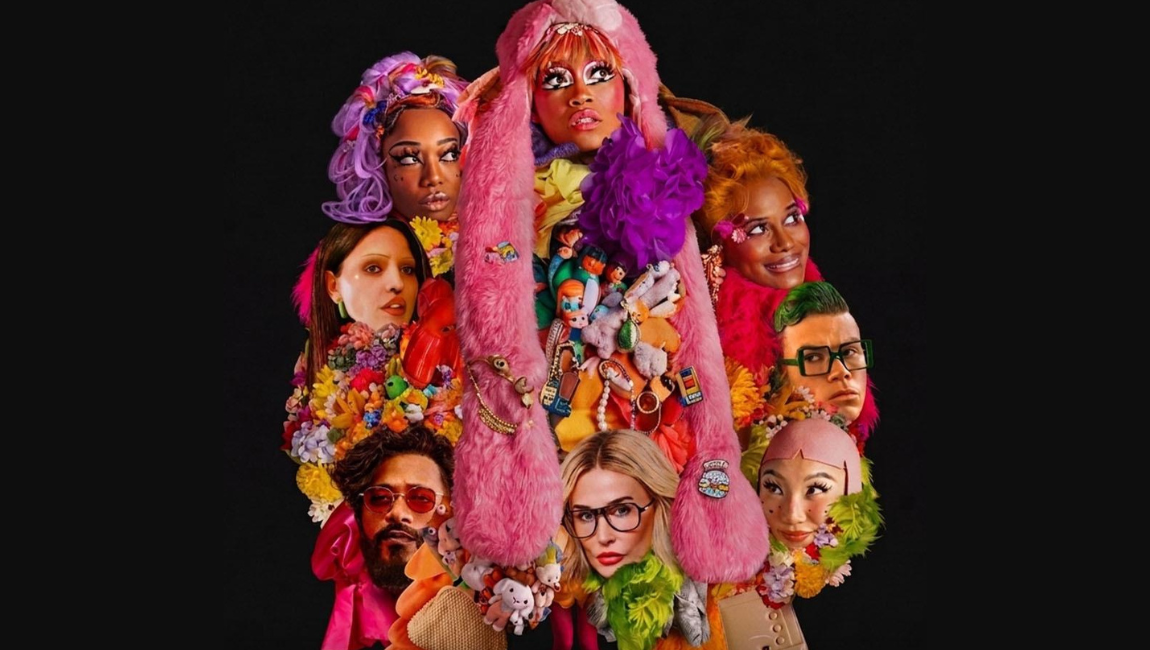
Writer-director Boots Riley serves a vital role in the world of pop filmmaking, and that sentiment is not at all diluted by the fact that his new film, I Love Boosters, is an unequivocal mess. The frontman for the Oakland-based hip-hop act The Coup and a self-professed communist, Riley has carved out a niche for himself as an explicitly political filmmaker working inside the system (his satirical 2023 miniseries, I’m a Virgo, was produced and released by Amazon). Riley operates in a mode that’s confrontational in his critiques of capitalism and entrenched hierarchies at a time when we’re increasingly seeing artists hoping to avoid the unwelcome attention of our business and political overlords. In films like I Love Boosters and his 2018 debut, Sorry to Bother You, Riley has demonstrated a willingness to conflate class and race inequality, treating societal malaise and the tendency for people to work themselves to death as the intended byproducts of big business. Further, Riley’s righteous anger is painted with a stylized palette, sharing the candy-colored sensibilities, irreverence, and ribald sense of humor of adult animation. Say what you will about the finished products, but nothing about the way Riley works looks easy.
But while there is much to admire about I Love Boosters, the chief takeaway is that Riley lost the thread somewhere along the way. For all the invention of the film’s hand-tooled production design, outré costumes, and elaborate visual gags — many of which employ endearingly janky stop-motion animation or knowingly call attention to their cartoonish internal logic — the “too-muchness” overwhelms and eventually subsumes the film’s message, its characters, and even basic coherence. Lost amid its “damn the man” slogans and fantastical plot devices is any real understanding of what the film is attempting to say at either the micro or macro level. At times, I Love Boosters feels like it would work better as a line of novelty T-shirts than a feature film.
The film stars Keke Palmer as Corvette, the de facto ringleader of The Velvet Gang, a trio of Black female Bay Area shoplifters who employ elaborate subterfuge — and white accomplices who oblivious sales clerks can dote on — to steal designer clothing from stores belonging to fashion maven Christie Smith (Demi Moore) and sell it back to the community at a heavy discount. Living under inescapable debt — which Riley depicts as a giant, Katamari-like ball made up of bills and past due notices that crushes everything it rolls over — Corvette is forced to sleep at an abandoned fried chicken restaurant to hide from her creditors. An amateur designer herself, Corvette both idolizes Christie — who we learn dropped out of MIT at 15 to pursue a career in fashion, in an initially random-seeming expository note that becomes more relevant as the shape of the film comes into focus — and relishes robbing her blind, although it remains maddeningly unclear what her actual plans are for the stolen clothing and why she continues to be mired in poverty despite possessing the means to extricate herself. After learning that Christie is planning on unveiling a limited run of suits valued at $100k each, Corvette and her fellow “boosters,” Sade (Naomi Ackie) and Mariah (Taylour Paige), infiltrate Metro Designer — a chain of high-end boutiques owned by Christie — with the intention of casing the store from the inside as well as scoring themselves invites to a gala where the suits will finally be unveiled to the public.
Once employed at Metro Designer, the undercover Velvet Gang are subject to the capricious whims of prissy store manager Grayson (Will Poulter), who keeps the music at such a deafening level that basic communication is nigh impossible, limits lunch breaks to 30 seconds (requiring his employees to launch themselves from starting blocks and move in wacky, sped-up motion), and deducts the company-mandated uniforms from this season’s collection from his employees’ paycheck — bringing everyone’s take-home down to tens of dollars a week. While their coworker Violeta (Eiza González) tries to organize a union to improve workers’ conditions, the Velvet Gang is laser-focused on robbing the store during Grayson’s lunch break (naturally, he gets a full hour). However, on the day of the heist, they find someone has beaten them to the punch. A mysterious Chinese woman named Jianhu (Poppy Liu) has improbably stolen every garment in the store through a sci-fi contraption in her purse that sucks clothing up like a high-powered vacuum. The life preserver-shaped doodad is actually a teleporter, developed at Christie’s factory in China — it was designed to circumvent tariffs to move goods around the globe instantly — and Jianhu has literally sent herself through the machine with the hope of crippling Christie’s retail business as leverage to negotiate for improved working conditions. So the Velvet Gang and Jianhu agree to work together, splitting the stolen clothes between them and kicking off a string of daring robberies that, for some reason, requires them to wear a series of ridiculous bespoke costumes (something like Fletch by way of the Teletubbies) that have Christie desperate to track down the identities of the “low-class urban bitches” who keep stealing from her.
As is his wont, Riley keeps a lot of plates spinning at all times, to the point that he frequently ignores the film’s center to dwell on its overly busy periphery. The filmmaker takes a maximalist approach to satire, smuggling cultural commentary into the film’s set dressing and non sequiturs. There’s a running gag throughout the film where anonymous Black citizens with names like “Crying Mother” are interviewed on the news, decrying the need for a greater police presence while bemoaning that corporations aren’t allowed to rip them off even more than they already are; these initially seem irrelevant to the plot, only to unexpectedly be placed front and center during the film’s bugfuck third act. Sade tries to recruit Corvette into something that is quite nakedly a pyramid scheme being run by a soft-voiced charlatan named Dr. Jack, played by Don Cheadle in a hideous-looking full-body prosthetic (it’s obviously being done for comedic effect, but you’d be hard-pressed to find a film where this many beautiful people are made up to look this physically revolting). There’s also a male model with a Prince circa Purple Rain haircut played by LaKeith Stanfield, who’s so dreamy-looking every time the film cuts to a close-up of him that he emanates heat waves. The character, who takes a shine to Corvette, is in actuality a millennia-old demon who sucks the souls out of his female victims from a part of the body one would not typically associate with such acts. The character, who is shown at one point to possess a mouth full of fangs and a serpent’s lower body when he’s not in his bipedal form, serves negligible purpose within the film — essentially, he is little more than a metaphor for the sort of bad boys women are invariably attracted to — but he does allow for the most guffaw-worthy exchange in the film: at Palmer comparing him to a vampire, Stanfield indignantly replies: “and you’re like Hitler because you both wear clothes.”
The point would appear to be that there is no shortage of predatory, bad actors with intentions of keeping the working class poor, distracted, and compliant, but it’s a little hard to reconcile that with Corvette’s dreams of becoming like Christie on the back of a Robin Hood-esque crime spree (the film also implies that Christie stole one of Corvette’s original designs through inception, although this subplot, like nearly everything else that happens in the film, is never satisfactorily resolved). Riley is indifferent to his own premise, which, on its face, is a cut-and-dry, “sell stolen goods at 100% margin to lift yourself out of poverty” situation, but whenever Sade points out that they should get around to flipping the clothing for cash, Corvette tells her to “shut the fuck up.” It’s hard to empathize with someone living in a squalid flophouse that smells of chicken fat when they literally have to walk past hundreds of thousands of dollars’ worth of inventory hanging on racks to get to their stained mattress.
It’s similarly impossible to watch I Love Boosters and not see the influence of Everything Everywhere All At Once. The Oscar-winning, genre mashup known for how chill and normal both its online defenders and detractors are, functioned as a mainstream entrée to the idea that galaxy-brained science fiction and flippancy, all but sticky with bong residue, needn’t be mutually exclusive. However, as evidenced by this film — as well as recent progeny Good Luck, Have Fun, Don’t Die and Mike and Nick and Nick and Alice — filmmakers have taken all the wrong lessons from its success. Specifically, sci-fi hijinks and random weirdness don’t mean terribly much if they’re not tethered to any sort of tangible emotional core (you know, impulses like feeling as though you’ve wasted your life, disappointing your parents, wanting to see the basic humanity in people, etc.). I Love Boosters doesn’t actually give us a reason to care about Corvette and her friends; as in the political sphere, the film uses “economic anxiety” as a catchall to look past thornier motivations, or really even the need to view people as individuals with conflicting agendas. Despite being the audience’s surrogate, Corvette is fundamentally unknowable, defined almost entirely by her fashion sense and particularly her fondness for the color aquamarine (the film only compounds the character’s shallowness by having her confuse the color with turquoise). At one point late in the film, Sade mentions that she needs to make money to support her child, and not only is this the first time we learn she has a family, but it’s also actually the first, and really only, thing we’ve learned about the character, who, like Mariah, is treated as little more than an up-for-anything sidekick.
Right around the time I Love Boosters should be thinking about trying to land the plane, the film expands outwards, becoming further disconnected from its erstwhile narrative to pursue increasingly farcical branching paths and thematic digressions that aren’t allowed the space to flower (e.g., the film briefly introduces what sounds an awful lot like a “why couldn’t AI be used in fashion?” argument, only to move onto something else). The teleportation doohickey enables Riley’s worst tendencies, liberating him from any sort of consistent dramaturgy — the gadget has multiple settings and functions as a “does whatever serves the plot” device — so the entire film devolves into something that makes roughly as much sense as a game of Calvinball. At various points throughout the film, Corvette says “now is not the time for nuance” to shut down any pesky dissent or interrogation of what the Velvet Gang hopes to accomplish, but you could just as easily swap in “clarity” or “audience investment.” The film is working backward from “workers of the world unite” wishcasting, and how the film deigns to arrive at that point is ultimately of little concern.
And yet, because the film is so clearly concerned with labor, race, gender politics, and the weaponization of the media in a way that speaks to the moment, one can’t help but begrudgingly acknowledge that Riley is at least trying to raise public consciousness about uncomfortable truths in a confectionery, memorably aestheticized medium. The filmmaker has a knack for tricking people into eating their vegetables, smuggling Molotov-throwing, revolutionary rhetoric into something that’s unapologetically silly to the point of seeming juvenile. Riley is serving much the same role in the culture as the South Park guys, and it doesn’t take much to imagine the film opening up new pathways of discourse for impressionable filmgoers. You want films like I Love Boosters to exist, even if you also wish they were a lot better than this.
DIRECTOR: Boots Riley; CAST: Keke Palmer, Naomi Ackie, Taylour Paige, LaKeith Stanfield, Will Poutler, Poppy Liu; DISTRIBUTOR: Focus Features; IN THEATERS: May 22; RUNTIME: 1 hr. 53 min.
Comments are closed.