
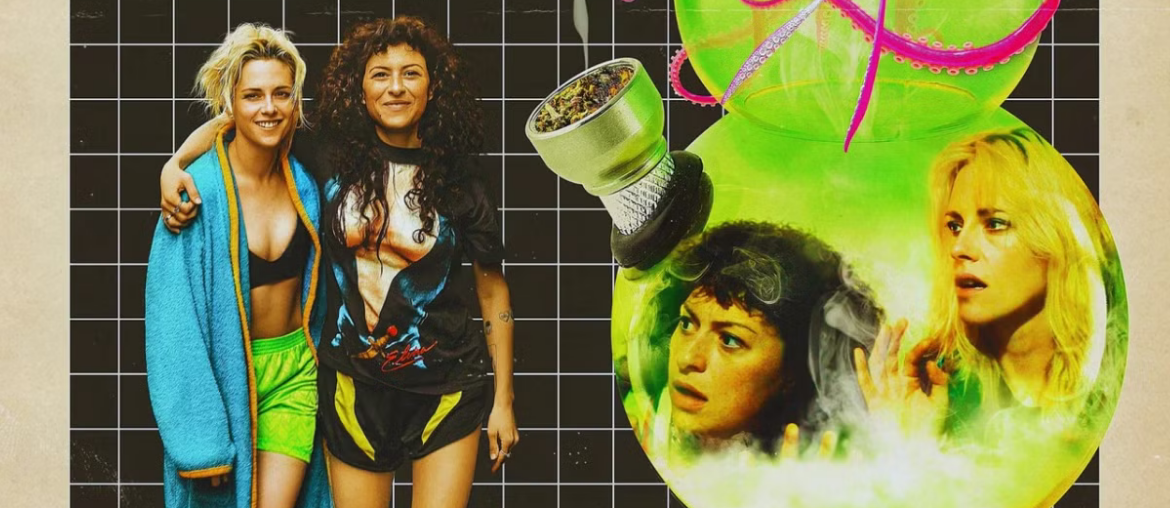
Sometimes you just need to get a little stupid with it. That’s not an insult; it’s a label writer/director Dylan Meyer wears proudly on her sleeve. With her directorial debut, The Wrong Girls, Meyer looks at the landscape of buddy comedies — specifically stoner buddy comedies — and asks: “Where are all the women?” Rather than waiting around for someone to pick up the bong, she jumped at it herself to zany, high-concept results.
Starring her wife, Kristen Stewart, and Alia Shawkat, The Wrong Girls follows Frankie and Molly as a case of mistaken identity sends them on the run from all manner of shady figures. Barely making rent, the stoners suddenly find themselves in possession of a top-secret, experimental new drug. Being irresponsible and always looking for a good time, the two, of course, try the chemical before deciding to sell the rest. The catch? This isn’t your typical drug, and instead of hallucinations, the girls are given the gift of telepathy.
The sense of hazy play that permeates The Wrong Girls is infectious, as it’s so clearly a group of friends paling around to make a movie. Stewart and Shawkat’s comedic chemistry carries the proceedings with a delightful cast of supporting players — like LaKeith Stanfield and the voices of Seth Rogen and Kumail Nanjiani as the girls’ frustrated cats — rounding them out. The Wrong Girls never rises above a light jog in terms of tension, but there’s something so calming and lovely about watching Stewart and Shawkat drift through L.A. cracking jokes together. The pair are eminently watchable and slot easily into the stoner canon alongside Cheech and Chong or Jay and Silent Bob.
Ahead of The Wrong Girls hitting theaters, I sat down with Meyer, Stewart, and Shawkat to discuss the film, being a proud idiot, and stoner authenticity.
This piece has been edited for cohesion and clarity.
Brandon Streussnig: When describing this movie, Dylan, you had a quote that I loved that was something like, “If Seth and his idiot friends can make movies like this, why can’t I? I mean, I’m an idiot, too.” Can you tell me about embracing your inner idiot for this project?
Dylan Meyer: One of the nice things about getting older is that you come to terms with who you are, and there’s a level of self-acceptance that comes with that. I think you also start to realize that the more you are comfortable with who you are, the more okay that is for everyone else. We put a lot of pressure on women to be pretty and tidy, and not be an idiot. I think that it took me a long time to come to terms with the fact that if being an idiot wasn’t part of my charm, I didn’t have any charm. There are ways to be an idiot and be very smart at the same time. A lot of my very favorite geniuses I would describe as idiots. So I don’t think it’s necessarily the one-note diss that it maybe sounds like on its face. There are many layers to being an idiot, and some of them are really, really fun, and they deserve to be a movie just the way that all the other idiots get to do it.
Alia Shawkat: It was really satisfying. I feel like I’ve always wanted to play something like this. Being a kid actor, a lot of the roles I played growing up were just like, “She’s smarter than her own good. She knows what’s going on, and no one else does.” Women always have to play the one who’s rolling their eyes like, “Ugh, these idiots, and I’m responsible.” So it’s really fun to not have to do that all the time. And I think there’s like a dumb part of all of us, and so it’s really fun to get to clown around.
Kristen Stewart: There’s nothing dumber than thinking that you’re smart or trying to project that, and then just going like, “No, I mean, I don’t know.” You’re like, “WOW. What a genius. Gosh, so self-aware.”
BS: The approach to friendship in this is so lovely. It really treats it as being its own kind of soulmate. The telepathy drives that home as well. How important was that for you to communicate?
DM: I really think that our friendships are as important as our romantic relationships, but I don’t know that you would really get that sense from periodicals or cinema or whatever. Those are your soulmates, though. In the same way, you don’t choose your family, but you do choose your friendships. There’s something so profound about surrounding yourself with the people who are your community and the people who are going to take care of you by choice, not because they’re married to you or blood-related to you. It’s sort of amazing that humans are capable of creating these really profound connections with people that are not going to mate with us or didn’t give birth to us. I think it’s substantial, and I think it deserves movies.
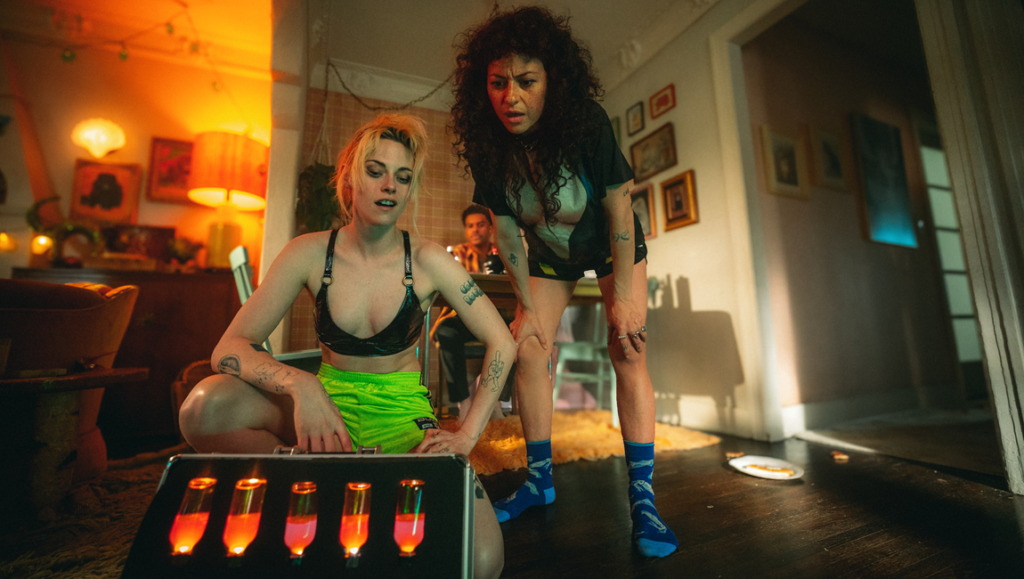
BS: Kristen and Alia, one way you really convey that is in how hilarious your chemistry is. It’s such a small moment, but the hardest laugh I had is when you find out your favorite buffet is closing, Alia starts crying, and while you’re consoling her, Kristen, you mouth “fuck you” to the girl at the counter. How much of this was the two of you riffing?
KS: I’m so happy to hear that you liked that moment because it’s also my favorite moment in the movie, when she’s buried in my shoulder. I may be saying “fuck you” to the girl, but Alia is sobbing, “Ranch, does it taste like that anywhere else?” And she’s actually sobbing. She was really feeling it. That wasn’t like that on the page at all. That was just Alia really bringing it and me going with it.
AS: What a heavy day. I mean, I think the script was so good, and Dylan created a vibe where she pretty much knew we were such good buds, and it was just about our energy coming across. Then in the text, we just got to do such silly stuff. So it was a combo. I mean, it’s like we improv’d a little bit, but it was more just encouraging the bud vibes, you know?
KS: That’s a double entendre. [Laughs]
BS: There’s a great video of you two going around where you teach the viewer how to correctly roll a joint. You can always tell when someone’s never gotten high before in a movie, and it kind of takes you out of it. Talk to me about stoner authenticity.
KS: Oh, I’ve just been preparing for this role my whole life. [Laughs] Yeah, even in casting, it’s so important because this movie has seen so many potential lives kind of fall apart and then find themselves again. We were supposed to make the movie before Alia had a kid, and then maybe it would’ve come together with someone else. But I don’t even know who that ever could have possibly been, because we were truly born to play together and to have done this together. It’s so nice to be able to rely on how good a script is, but then know that, yeah, the only way that this is going to live and breathe and be something that other people are going to want to jump into is if you jump into it with all four legs, like the cats that we are.
AS: My only audition was I had to be able to smoke a joint and not be weird. It was like, normally I’m pretending I’m not high.
KS: That’s actually how you play high. You don’t play it.
AS: Never play it.
BS: Dylan, you mentioned building community before. One way you’re doing that is with the production company you and Kristen started, Nevermind Pictures. These first two films, The Wrong Girls and Chronology of Water, couldn’t be more different. Was that always the goal?
DM: Yeah, we joke that they’re sort of the bookends of our tonal range. You have Chronology of Water over here, which is a very heady, intense, but serious art film. Then you have The Wrong Girls, which is a willfully stupid sunny joyride. But they’re both about women being allowed to be themselves. I think there’s a major tonal throughfare between both of those things. Not just for women, but for everyone, investigating unseen or overlooked communities and the nuances of those things. That’s all within Nevermind’s range. So even though there are really different vehicles to get there, I think that the mission is very clear in both and very connected.
Comments are closed.