
Herman Yau has always courted the transgressive. One of the key names in Hong Kong’s early-to-mid-’90s exploitation scene, his Category III films (the strictest rating Hong Kong’s ratings board could give) are legendary. Often starring Anthony Wong, films like The Untold Story or Ebola Syndrome were violent and garish on the surface, but often exposed the rot bubbling beneath Hong Kong’s surface. Beginning his career as the territory was handed back to China from England, his films usually circled the anger and isolation felt by those living in a region struggling for identity. His cops or people in power are generally corrupt, even bumbling, and his ostracized are always shot through with an empathy usually missing from these films.
Whispers and Moans and Two Women For Sale centered on sex workers, Yau never fully devolving into the standard stereotypes about them. Taxi Hunter, released the same year as Falling Down, saw a bespectacled Anthony Wong in a button-up and tie explode with rage over perceived injustice. Even in his recent blockbusters — the Shock Wave series, where bomb-squad thrills intertwine with procedure and scientific accuracy — show that Yau has more going on under the hood than most filmmakers. It’s been a long, winding career, and he’s been a working director like anyone else, but Yau remains one of one. In his latest feature, We’re Nothing At All, Yau finds himself swirling many of his past concerns into a sprawling and gorgeous romantic crime saga.
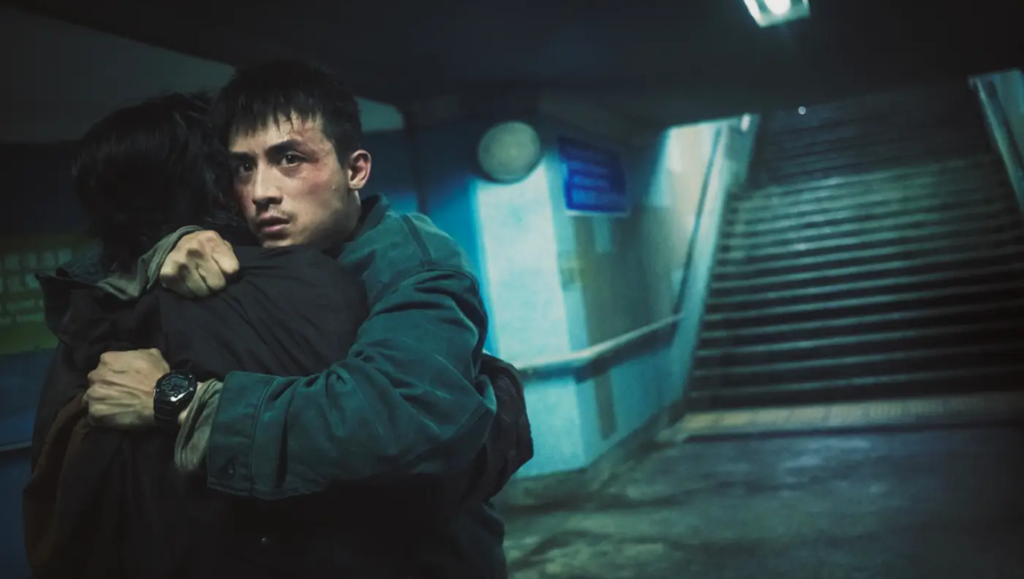
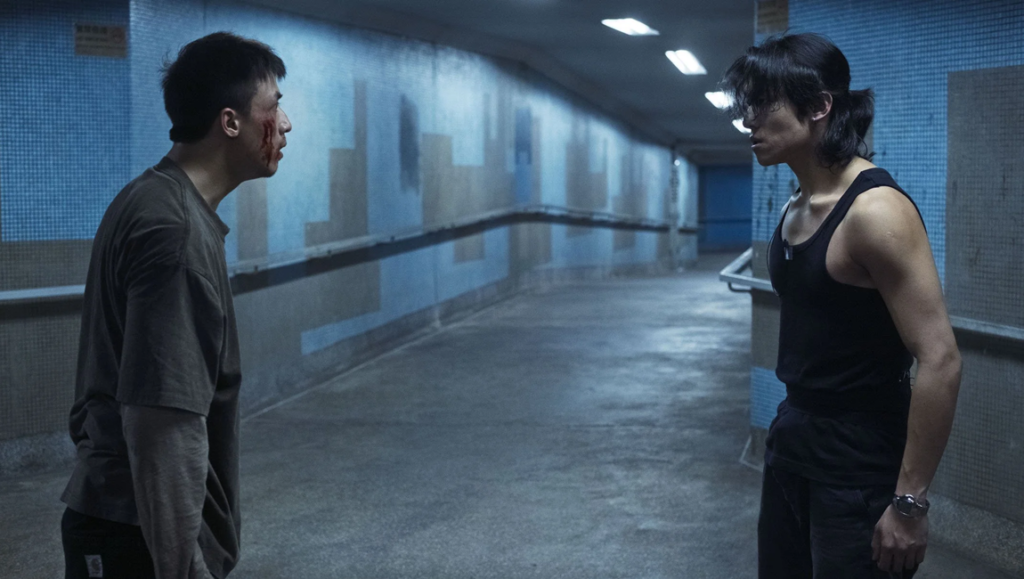
Loosely based on the 1998 Valentine’s Day Bus Bombing in Hong Kong, We’re Nothing At All follows the parallel stories of the queer couple who blew up the bus and the detective trying to piece the tragedy together. In a move that’s almost as transgressive as the film itself, Hong Kong pop idols, Anson Kong and Ansonbean play the couple, Fai and Ike. Their romance is tender, sensual, and moving, often shocking in its depiction. It’s shocking only because it’s so rare to see a love like this in Hong Kong cinema. This is why Yau had to self-finance the project, and the film has been given a Category III rating in China. Rewiring the motivation behind the real attack, Yau follows a pair of farmers fed up with being exploited, channeling their anger at a world that mistreats them for simply existing. Their suicide is all the more devastating as you watch them fall in love while Tam’s Detective Lung searches for answers in the present.
Taking his fascination with process, Yau also delivers as thrilling a forensic picture as you’ll ever see. Using what he learned on the Shock Wave films, he parcels out exactly how an investigation like this would go. All the while weaving in honest and lovely portrayals of sex workers, questions of identity and queer love. It’s a stunning film.
As We’re Nothing At All begins to roll out to theaters, I sat down with Yau to discuss the film, the need to speak truth to power, and scientific accuracy.
Brandon Streussnig: Tell me about self-financing this.
Herman Yau: A movie with this subject, homosexuality, is rated Category III. As such, this movie would not be allowed in mainland China. With all these criteria, it’s very hard for me to secure investors. So last year I made the decision that I would finance this film myself. I had faith because, despite it being controversial, I don’t think a movie like this will have a small audience. So that’s why I decided to bet on myself.
BS: You’ve always approached transgressive material. But as you’ve gone on, you’ve tackled what might be deemed controversial with a lot of sensitivity. Where does that come from?
HY: I seldom think about this, but it’s a good question. Why do I do this? I think I have some concerns about those subjects. I’m quite aware of the world and the society I’m living in, and I’m also curious about so many things. Sometimes I think the drive to make some movies comes from things I can’t bear or tolerate happening to those people. It seems that no one cares about those people or those issues. Gradually, that force grows in my heart, and I really feel the need to make it.
BS: Was that what drew you to change the motivation of those behind the bus bombing? Because in real life it was politically driven, but you changed it to something different, yet equally important socially.
HY: I was working on the script for Shock Wave 3, and then I found this explosion — the bombing incident in Wuhan. Shock Wave 3 is supposed to be a large-scale action film. This real incident is too small in scale to fit a blockbuster.
At that time, I used that incident as a framework. With this framework, I injected some very Hong Kong elements and social issues, including what people have been going through and the unhappiness in recent years. So I would not say that it’s totally adapted from real incidents. I used it as a framework, then expanded the story.
A gay couple bombing a bus — such a framework is not difficult for me to invent. I’ve seen so many incidents and news reports about people facing issues like that. I feel responsible for telling audiences about them. That’s why I chose this framework. Hopefully, audiences will not confuse this with the real story.
BS: It’s pretty incredible that you cast two straight pop idols, Anson Kong and Ansonbean, as the couple. That, in and of itself, feels transgressive. Tell me about that.
HY: Because of the lead characters’ ages in the story, they were a perfect fit. Part of it was commercial: at least in Hong Kong, many young people know them, and they have a fan base. Second, and this is very important, I think they are such good actors, with so much potential. For the moment, they don’t have a track record for people to judge them by. But my hunch is they will be [stars] in the industry in no time.
BS: Were they nervous at all about playing this kind of role?
HY: Not at all. Both Ansons were very excited. They accepted all the so-called sensitive parts of the story, like the love scene between two boys. For Ansonbean, his character has a scene with very subtle masturbation. He accepted all of this and put a lot of thought into his performance. They didn’t ask me anything. They didn’t ask why those parts needed to appear in the movie.
With Anson Kong, because he’s a member of the Mirror, a pop group in Hong Kong, he has his own manager. His manager didn’t want him to appear in this movie at first. I understand why, and I expected that when I approached AK. However, AK insisted that he must take part in the film right in front of his manager. So now, I have AK in my film.
BS: You’ve worked with Patrick Tam a few times, but this is your first film with him in two decades. You both have seen the Hong Kong industry go through so many changes. What’s that relationship like?
HY: I’ve worked with him before, but interestingly, we are not that close. Not so close in the sense that when we meet, we behave like very good friends. He doesn’t ask me out for dinner, and I don’t ask him out for dinner, but when we get the chance to meet, we always have a good relationship.
In terms of performance, when I first worked with him more than 20 years ago, Patrick was green. Now he’s an actor with quite a lot of experience. It’s been hard for him, though, because he struggled in the industry for so many years. Many audiences know him. However, his movies didn’t have much mainstream success. With that in mind, I had a hunch he’d accept the role, and he said yes right away.
BS: It’s his role that makes this such a forensic-heavy film. I really love that because it lets us see the process of real detective work. What was that research like?
HY: I did a lot of research about that because all that information must be accurate. I have a good friend, and we always drink together. He’s very famous, but he passed away this year, early this year. He’s a very famous forensic expert in Hong Kong’s medical community, and I asked him for some technical information.
For those burnt bodies, those burned corpses, I have a friend who is a photojournalist for a famous newspaper in Hong Kong. Some years ago there was a very large fire incident in Hong Kong that caused a great number of casualties. He went to the site and took photographs. So for the parts with burned bodies, I let him check whether it was realistic enough for the audience. For the other scientific things, like the power of the explosion, how much TNT should it be? I did that kind of research while making the Shock Wave movies. I now have a deep knowledge of explosions.
BS: When you’re crafting an explosion, how does it differ for a major blockbuster like Shock Wave vs. something more serious and subdued like We Are Nothing at All?
HY: Actually, it’s more or less the same. Just scale-wise, you have to focus on how big or how small it is. For Shock Wave, because I needed to make it big, I first focused on what it would be like to blow up one car. From there, I then think about what it would be like to blow up five cars. For We Are Nothing At All, I just think about what is necessary for the story. It must make sense in reality. For Shock Wave, I lean a bit on scientific data. I try my best to make it accurate, but I don’t care whether this kind of incident can happen in reality. I almost ignore it. For this film, everything should feel real, in the sense that it could happen in reality.
BS: I can’t stop thinking about what you said earlier about being a person in the world and speaking up about the injustices you’re witnessing. I can’t imagine that’s easy as a filmmaker in your position. What gives you the courage to continue to do this?
HY: I just think I have to say these things. I must say these things. As I say these things, I try my best to be smart. I comply with every law, every regulation. And then, under all those constraints, I try to speak that truth as a legal person.
BS: You’ve truly seen and done it all in the Hong Kong film industry. It’s remarkable. As you’ve moved through your career, how do you think the industry has changed?
HY: I think the taste of the audience… it’s not the same as before. Of course, contextually, Hong Kong has undergone a lot of changes in the past 20 years. In the minds of most Hong Kong audiences, I feel that they want some solid things in movies. Like in the 1980s or ’90s, they really wanted something to kill time or pass the time, and then they wanted entertainment.
But now there’s a great number of audiences who want nutrients in entertainment, not just time killers. Nowadays, people say that time is very precious to them. They are not willing to spend time seeing nonsense. That’s why I think this change is quite dominant among Hong Kong moviegoers. Of course, on the other hand, the number of moviegoers is not the same as before. I mean actual moviegoers, people who buy tickets, go into a theater, and watch movies. The number of these people is not the same as before. It’s in a downtrend.
BS: How do you think that can be changed?
HY: I think we should try our best to bring people back to the theaters. We should keep that in mind, but at the same time, that is very difficult. What I mean is, we shouldn’t surrender to the digital era or a digital way of life. I still think that some movie fans want to watch movies in the theater. On the other hand, with that in mind, younger filmmakers should accept that their films may not be seen by as big an audience as there used to be. At the same time, audiences should not watch movies on their phones. Please! That is the saddest thing to me.
Comments are closed.