
Very often in cinema, it’s as if we know the director of a film; we know their basic predilections, visual and thematic preoccupations, but only insofar as this information is a part of the screen — all there for our viewing. Perhaps we may even catch a behind-the-scenes glimpse into their life and work, but usually only in the form of “the making of…” pictures: transient glances in a filmmaker’s direction that are typically informative if not very dense. Very rarely, however, do these methods of knowing coalesce; a notion of relation to both the director of a work and a director-as-subject within the work.
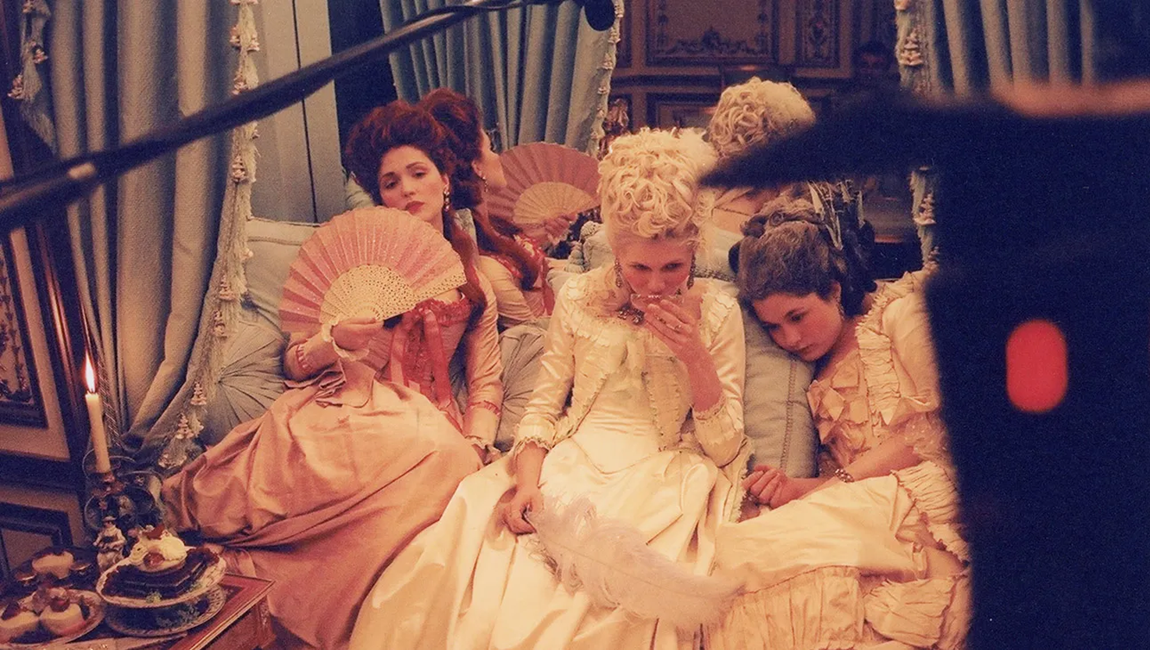
If she did not invent this approach, Eleanor Coppola seems to have perfected it. She is known for perhaps the most famous of all behind-the-scenes films, Hearts of Darkness: A Filmmaker’s Apocalypse (1991), the production chronicle of her husband Francis Ford Coppola’s film Apocalypse Now (1979). Two years after her death at the age of 87, another Eleanor Coppola picture is set to be released, Making Marie Antoinette, a work detailing the production of Marie Antoinette (2006), yet another large-budget film directed by a member of the auteur family, her daughter Sofia Coppola. This time, however, Eleanor also turns the lens on herself, perhaps inadvertently, as Diane Lane acts as a posthumous auditory stand-in for the director, reading dozens of journal entries written by Eleanor during the production.
It is not to be confused, though; this is still an Eleanor Coppola picture through and through. As the first pieces of text in the film assert, Eleanor shot over 80 hours of footage from the set of Marie Antoinette, only beginning to work through it with her daughter some 15 years later. Tragically, she passed away before the project was completed, but the outside intervention of family, friends, and colleagues transforms the resulting film into as much a tribute to Eleanor as it is a tribute to Sofia or Marie Antoinette.
The film, as expected, makes use of the 80 hours of footage, showcasing the arduous nature of filmmaking — particularly large-budget filmmaking — as Sofia is seen battling bronchitis and schedule-induced stress for much of the 57-day production. Making Marie Antoinette additionally employs the use of interviews conducted by Eleanor with various cast and crew, with some such scenes capturing quiet, evocative moments between mother and daughter or bouts of exhaustion during long shoot days. This all feels rather secondary, however, as the film’s brilliance is predicated upon the extent to which it is about Eleanor herself.
Take, for example, the very first of Eleanor’s journal entries that is read in the film: “It’s counter to my personality to shoot a documentary. Yet over and over, I do it. I will constantly be in people’s way, and be somewhat of an irritant to the production. The last thing I want is to be annoying, especially to Sofia.” This, coupled with a number of shots of Eleanor herself at work, shooting the production, makes Marie Antoinette an entirely self-reflexive endeavor. It is difficult to watch Eleanor shooting footage on a small camcorder and not see it as an extension of herself, not dissimilar to Agnès Varda’s The Gleaners and I (2000), a work that attempts to tackle that very notion. But Eleanor’s relationship to her camera is quite distinct. An extension of herself, her creativity? Certainly, but simultaneously a marker of the degree to which filmmaking, to her, is about remaining unobtrusive.
This presents an interesting paradox sitting within the center of Making Marie Antoinette. At one point, Eleanor’s entry reads, “My mood is a mix of resentment that I’m not doing my own thing, and exhilaration that I’m shooting a camera in a stunning location in the lovely French countryside with my daughter at the helm of a major production…” The film, in this sense, serves as an exercise through which Eleanor can grapple with her own creativity, her own place within the art form she so clearly loves. Just before the credits roll, we learn — if we haven’t already — that Eleanor was the oldest woman in cinema history to make her feature film debut at age 80. It was evident that Eleanor Coppola broke boundaries in life — that much is known — but now, it seems, she does so in death, too.
DIRECTOR: Eleanor Coppola; CAST: Sofia Coppola, Kirsten Dunst, Diane Lane, Jason Schwartzman; DISTRIBUTOR: MUBI; IN THEATERS: October 23; STREAMING: November 6; RUNTIME: 1 hr. 26 min.
Comments are closed.