
Animals, the new Netflix film from director-(co-)writer-actor Ben Affleck, is an uncredited adaptation of Ed McBain’s (nom de plume of writer Evan Hunter) 1959 novel King’s Ransom, which remains a usefully malleable text 67 years after it was first published. Famously, it served as the basis for Akira Kurosawa’s High and Low, which was itself remade last year as the overlooked but better-than-it-had-any-right-being Spike Lee joint, Highest 2 Lowest. What’s so enduring about its central conceit — where a wealthy man must decide whether to pay a huge ransom for the safe return of his employee’s child — is that it interrogates situational valor; the willingness to move heaven and earth when your own offspring is in peril versus the cold calculus inherent in sacrificing for someone else’s flesh and blood. Animals takes the premise a step further, introducing the element of politics, and with it the way it places every decision under an unforgiving microscope (where even the prolonged deliberation as to whether to pay millions of dollars to rescue someone else’s son could be viewed as politically harmful) — which, if nothing else, lends the film a timeliness as its release anticipates election day by a little less than a month. Yet, ironically considering its subject matter, the film risks little and says nothing, particularly about morality, class, the non-monetary costs of winning elections, and the idea of “doing the right thing” for largely performative reasons. It’s slick, friction-free, direct-to-streaming dross from people who probably should know better.
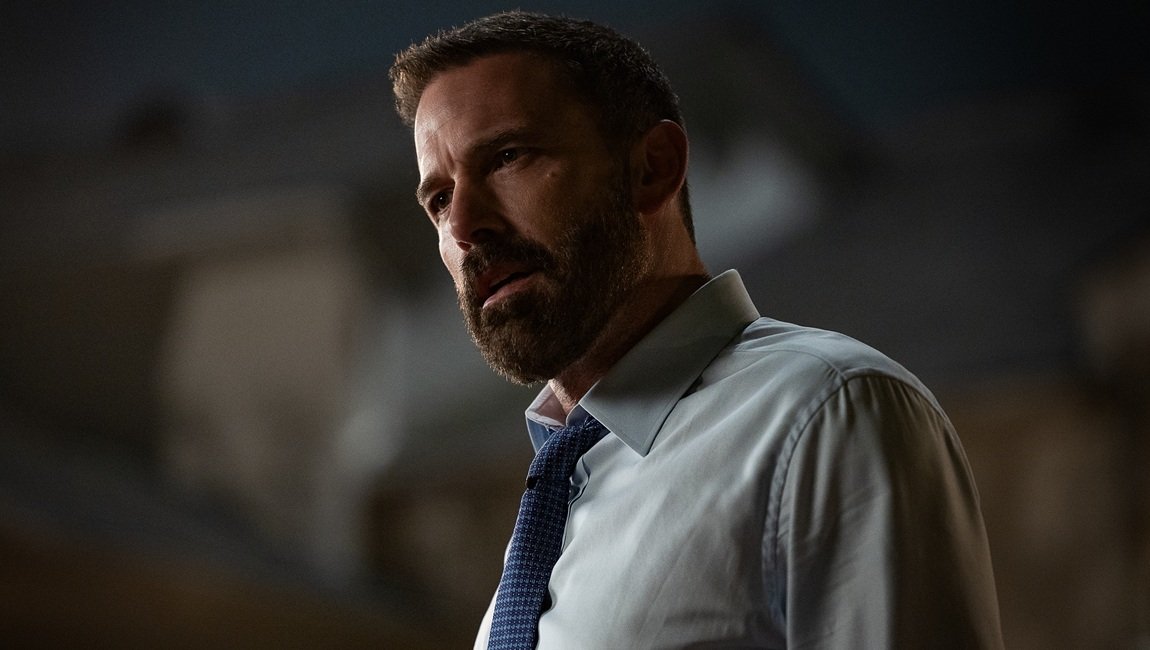
Affleck stars as Mark Kimball, a wealthy attorney running as an independent for Mayor of Los Angeles. For somewhat eye-rolling plot reasons, Mark (who — with his mixed-race family, fluency in speaking Spanish, and non-existent policy positions delivered with an approachable smile — is coded as a “common sense” liberal) refuses to affiliate with either party for purity reasons, which also seemingly explains why he refuses to raise outside money for his campaign. Instead, Mark is self-financing his run by borrowing against his inheritance and the home he shares with his wife Abigail (Kerry Washington), who has no clue how deep in the hole Mark truly is, and their young son, Denny (Christopher Woodley). Less than a week out from the November election and with the candidate trailing his incumbent opponent, Mark’s campaign manager, Sam (Steven Yeun), urges him to take a loan out against his house to pay for some last-minute TV spots to help him move the needle a few points. Mark has poured every dollar he has into the campaign, but he’s convinced that not only will he win as a long-shot candidate, but he’ll be able to pay himself back once he takes office (the film doesn’t dwell on precisely how, but the implication is through graft and kickbacks, which feels at odds with Mark’s choir boy image).
Staking your family’s financial security to winning a coin-flip election requires a special sort of megalomania, not that Animals demonstrates any interest in Mark treating the mayoral race like spinning a roulette wheel. Instead, Mark and Steve strategize how to get Mark’s numbers up with Hispanic voters by securing an endorsement from a prominent immigrant advocacy organization, while Abigail contemplates leaving Mark for her younger lover, Ron (Ray Fisher, in an extraneous subplot that exists just to beef up Washington’s character). With both parents preoccupied, there’s nobody available to take Denny trick-or-treating around the neighborhood, and so that responsibility falls to Cecilia (Adriana Paz), their loyal housekeeper. Speaking of, Cecilia hopes the Kimballs will give her undocumented boyfriend and single father Ramon (Luis Gerardo Méndez) a job as a maintenance man, something that makes Mark queasy about the potential scandal should that be uncovered by the press. It gets so that Mark can barely stomach Ramon even milling around the house when he drops off his son Hector (Jacob Estrada) to go trick-or-treating with Denny and Cecilia. Still, with the two boys heading off into the night in matching costumes and accompanied by Cecilia, it would appear to be a quiet night at the Kimball house. That is, until Mark’s cell phone rings and a man using a voice modulator tells him that he has kidnapped his son and he’s demanding a $7 million ransom, due within the next few hours.
If you’ve seen the Kurosawa or Lee films (or simply read the opening graph of this review), you know the shoe that’s about to drop: the kidnappers confused the two boys and grabbed Hector, thinking it was Denny. Panic gives way to elation when Denny walks in the door safely, but that only leads to confusion when the kidnapper insists he has Mark’s son, followed by the sickening realization that they still expect to be paid $7 million for the return of Ramon’s son unharmed. And it’s precisely here where Animals reveals itself to be an especially empty dramatic exercise that lacks the nerve to actually put its characters through the wringer or force them into making impossible choices. In an invention of the film, Sam calls in a professional fixer, a chilly British woman dressed head to toe in white, named Dayle (Gillian Anderson, given less opportunity to cut loose here than in the recent Teenage Sex and Death at Camp Miasma). Dayle may be a foreign operative or perhaps simply a lady gangster; regardless, she’s driven around in a black Suburban by a hardened killer and has access to cash on demand, albeit with a 20% vig. Previous adaptations of the McBain book actually contemplated what it meant to lose everything to do the honorable thing — it’s implied that the Toshiro Mifune character in High and Low is destitute at the end of the film — whereas Animals treats the entire scenario like a multi-millionaire borrowing against his wealth simply because he’s not liquid at the moment. Whether Affleck realizes it or not, he’s made a film about how blithely elites move through life, being only slightly inconvenienced by the sort of decisions that would destroy a regular person.
Affleck made headlines over the last year related to his coziness with Netflix, most notably selling his AI startup, InterPositive, to the streaming giant for nearly $600 million. Affleck has said Animals uses AI for post-production fixes, but has downplayed the extent to which the technology has sidelined human labor and artistry (to judge the results, feel free to pause the film during scenes that replicate street life in Los Angeles and marvel at the nonsensical billboards). However, the most revealing example of this involved Affleck doing clean-up on some eye-raising statements that his frequent collaborator and hetero life mate Matt Damon had to say about how Netflix programming has conditioned itself to accommodate disengaged viewers who are likely playing on their phones while watching their films and television shows (most damningly, that the studio mandates that the plot has to be repeated “three or four times” in the dialogue to make sure the information is retained). Affleck flatly refuted that notion, but it’s hard not to see the insidious tendrils of Netflix’s story department in moments like the one where Yeun’s character actually speaks the line “this is an important turning point” at the precise moment everyone learns that it was Hector taken instead of Denny. That’s but the most egregious example of how Animals is, in general, an overwritten affair (the film’s screenplay is credited to Connor O. McIntyre, Billy Ray, and Affleck), with the characters debating, ad nauseum, strategy, political blowback to not paying the ransom, and the ethics of having Dayle’s driver kill the kidnappers during the handoff, often with the camera rapidly circling the actors as they bellow at one another.
Affleck can be a capable filmmaker who has demonstrated thoughtful pop-storytelling instincts in the past, but the choices he makes here are rather confounding. The film fumbles the initial misdirection that Hector’s been taken instead of Denny by not cutting to an insert shot of Mark’s phone for the proof-of-life photo sent by the kidnapper; the boy is wearing a large costume head, but why would the viewer assume that? There’s also a fairly ludicrous sequence where the film cross-cuts between Ramon going rogue and trying to take out the kidnappers’s spotter perched on a nearby hillside with synchronized dancers at a fundraiser, all simply so the that the scenes can be heightened with staccato stomping. And then there’s the film’s finale set inauspiciously in a cement channel of the L.A. River, where Hector is returned in a wagon by kidnappers wearing bunny masks; the staging recalls the infamous sequence in Mac & Me that Paul Rudd helped turn into a meme. Much like its predecessors, Animals is primarily a chamber film set in the Kimballs’ well-furnished home, but even this is an opportunity for further failure, as Affleck never makes the location feel memorable or emphasizes the layout in order to heighten the tension of being observed from afar (compare this film — where characters come and go as they please and idly chit-chat in front of windows — to the gamesmanship of Kurosawa trying to conceal the presence of police detectives in the home).
What’s ultimately so underwhelming about the film is its unwillingness to complicate Affleck’s character, treating him as a paragon of virtue in a scenario that all but demands that he be compromised or bloodied in some way. In contrast to Washington’s adultery in Highest 2 Lowest, Affleck strenuously argues he would never cheat on his spouse (the film introduces the prospect that campaign aides who accused Mark of sexual harassment did so entirely as a shakedown). And what little we do learn of the kidnappers’ motives essentially amounts to grievances over Mark being too much of an attack dog in his capacity as a city prosecutor. Mark lies to Abigail about how much money he’s lent to his own campaign, sure, but it’s waved off as a forgivable transgression in light of the halo the film places around the character and the good he’ll certainly do for the city. Even the central tension of the film’s second half is whether Mark, allegedly the only honest politician in the city, can live with himself if he authorizes the extrajudicial killing of the men who tried to kidnap his son. Truthfully, it’s difficult to contemplate a dilemma that’s less compelling. The entire film seems to exist to validate Affleck’s character, even allowing Mark to get his groove back and save his marriage, which reaches a tipping point with a brief if incredulous love scene between Affleck and Washington at the end of the film’s second act. And so, the only takeaway we’re left to glean from Animals is that money actually can solve all of life’s problems, and what a city like Los Angeles needs — or hell, the nation, as Mark already has designs on the White House — is a rich guy who believes his wealth insulates him from corruption. That may reflect the world as it is, but it’s a little demoralizing to see that presented in entirely aspirational terms. Finally, things are working out for the trust fund set!
DIRECTOR: Ben Affleck; CAST: Ben Affleck, Kerry Washington, Steven Yeun, Gillian Anderson, Adriana Paz; DISTRIBUTOR: Netflix; STREAMING: October 9; RUNTIME: 1 hr. 46 min.
Comments are closed.