
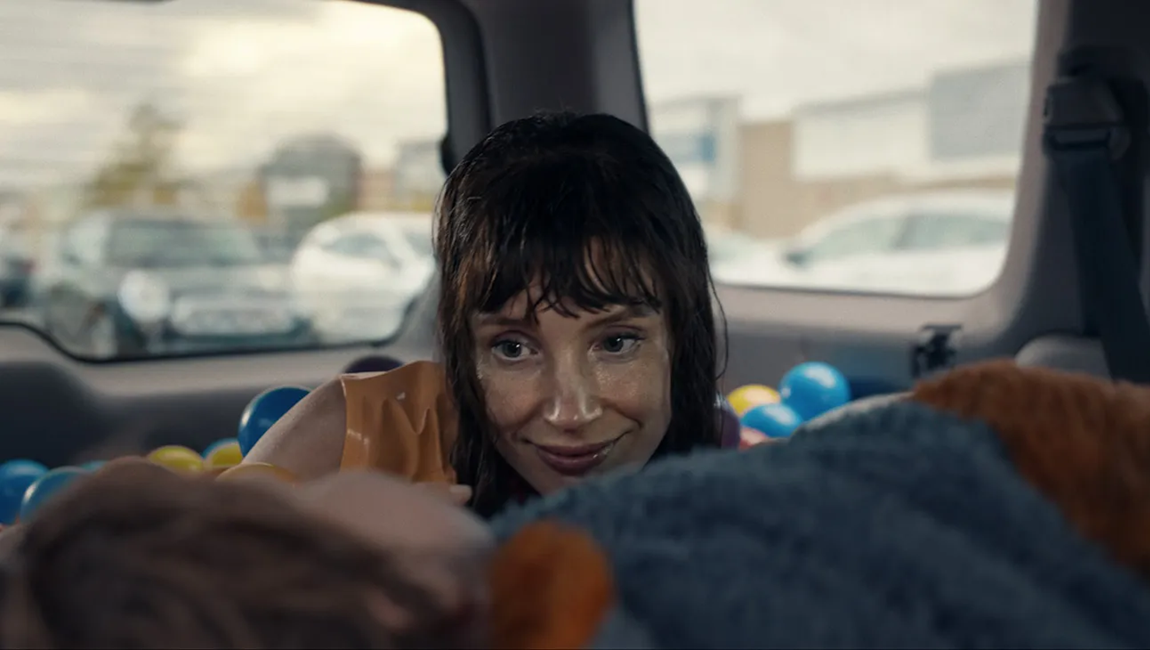
Rob Savage’s Other Mommy can best be described as confident: a bold step in the direction of an ample, maximalist horror. But it is seldom satisfying — often too optimistic and in bad faith — to consider a horror film only at its best, to eschew criticism or analysis, especially for a film like Other Mommy. Realistically, Savage’s film is a loud disappointment.
The film’s plot is disarmingly simple. Bela (Arabella Olivia Clark) is a shy seven-year-old who is nervous about attending a new school come September. Her nervousness is compounded by stress — silent and simmering and observant, as it is in children — about her mother and father and their relationship with each other. Bela’s mother Ursula (Jessica Chastain) works a corporate job that has her away from the house for long stretches of time. Ursula dresses in sleek, pointy silhouettes, her hair pin straight and her heels, which she always has on, high and sharp. Ursula is hard, her form unforgiving. Bela’s father Russ (Jay Duplass), meanwhile, is soft and elastic. He is a househusband who smokes weed after Ursula leaves for work and is asleep by the afternoon. Bela senses her parents growing apart.
To fill the gap, a being Bela calls Other Mommy (Chastain), who looks just like Ursula, appears. Other Mommy keeps asking to be let into Bela’s heart and becomes increasingly violent at Bela’s refusals. Russ and Ursula become quickly aware of and assaulted by Other Mommy, and they flee to various places in an effort to shake the violent entity that wants to possess their daughter.
If in realistic terms the film is a bore — you might have already heard of its jump scare onslaught, which has the effect of numbing the senses and leaving one divested of any care for the characters — at worst, it limns a misogynistic fear of the working woman and the husband she emasculates. In this film, Ursula is a terrible mother, a worse potential than the demon, her badness being the cause for its attempts at Bela’s life. It is in no uncertain terms that Ursula is positioned — in her physical appearance and through her flitting presence, always leaving for work or on the phone — as a cold, absent, and ultimately wrong mother. She is morally bad for her absence that leaves a glaring space within her small family, so that a malicious entity can enter and endanger Bela. Ursula ought not to be at work, but rather she should be at home; if she was at home, Bela would remain safe. If Ursula was a good, stay-at-home mother, none of this would have happened.
Ursula is framed as responsible for the presence of Other Mommy for two reasons: first, because she works, and second, because she did not want to have a child. Bela remains distant from Ursula throughout the film, and Other Mommy keeps promising the child that her mother will disappoint her, irrevocably break her heart, with a revelation: this revelation comes in the form of the confession that Ursula never wanted to be a mother, but that once Bela was born, she grew to accept motherhood. Again, the implication here is that if Ursula wanted to be a mother, she would be good, she could have kept Other Mommy at bay. It’s as if the film is asserting that it is strange, wrong, for a woman to not want to be a mother, to be disinterested, or to have qualms, or apprehensions; a woman ought to want to be a full-time, stay-at-home, observant mother. To have any sense of self that threatens the sanctity of motherhood breaks the child’s heart, leaves them vulnerable to danger, and promises trauma. All of the emphasis in this film is placed on Ursula’s feelings — specifically, her negative feelings around motherhood, which incite evil. In this focus on Ursula’s feelings (a focus without nuance), it cannot be said of the film that it argues for a woman’s right to choose to have children; rather, what the film suggests is that it is bad to feel negatively about motherhood.
Other Mommy is not an intelligent consideration of what it means to be a working mother in the modern world, nor is it emotionally intelligent as it considers what it looks like for a woman to have ambivalent feelings about motherhood. Savage’s film, by virtue of its loud jump scares and hammy digital effects, does not have the emotional space to explore the ideas it sets forth, and because it does not explore Ursula’s feelings, she, a working woman, who did not want to have a child, is rendered a villain. In this way, intentionally or not, Other Mommy regurgitates patriarchy’s abiding fears of working women and the system’s belief that a woman ought to stay within the domestic realm.
Unsurprisingly, then, Russ is Bela’s favored parent. He is kind and understanding and fun, but it is unignorable that he is here rendered as an emasculated man. Where Ursula is tall, erect, sharp, and hard, father-like in her movement outward into the world, Russ is soft and maternal as he remains within the home. The parents here have muddled traditional gender roles, a muddling that has literally endangered their child. It’s only at the film’s end, when Russ takes on the role of the protector — literally standing in the way of Other Mommy, shielding Ursula and Bela with his body — and Ursula confesses to her “badness,” that Other Mommy leaves. The suggestion here is that now that Ursula has confessed, she will take up traditional womanhood and become a proper loving mother.
It’s worth noting that Clark’s Bela is the film’s most interesting character, its only success, and it’s admirable how this story respects its young character. Bela is immediately believed by others when she speaks of Other Mommy’s dangerousness, and there is a sense of respect for her when she says “no.” This is renegade for the horror genre, which has a history-long hard time with believing women. But even as the film believes Bela, it hates Ursula.
In creating a film that boldly chooses to be a visual onslaught, that unabashedly leans into jump scares and cheap thrills, Savage has created a film that also has grim implications in regards to gender. It feels as if Savage invested all his energies into constructing a film that might be visually terrifying (which it is not, for the record), and neglected to deliver care for the story itself. The effect is a hammy spectacle that has nothing to say about the human condition in general, and nothing intelligent to say about motherhood, womanhood, or parenthood specifically. At best, Other Mommy is confident for how boldly it owns its gimmicky nature, but beyond that Savage’s film is regurgitative, retrograde, and cruel — and, worst of all, entirely forgettable.
DIRECTOR: Rob Savage; CAST: Jessica Chastain, Arabella Olivia Clark, Jay Duplass, Dichen Lachman, Arian Moayed; DISTRIBUTOR: Universal Pictures; IN THEATERS: October 9; RUNTIME: 1 hr. 33 min.
Comments are closed.