
As the popular online adage goes, Cinephilia is a disease, and few exemplify this better than filmmakers themselves. Shaped by the forms, narratives and dramaturgies that constituted their cinematic initiation, filmmakers often find it difficult to go beyond these formative (pun intended) experiences, trapped seemingly forever by their anxieties of influence, to borrow the title of Harold Bloom’s famous book. None of this means that these cinephilic filmmakers, some of whom are good and a few among them even great, do not have an auteurial stamp of their own, or an absence of thematic preoccupations, stylistic tics, and structure. It’s just that when these filmmakers, particularly those who operate in a mainstream mode, question the very cinema that made them, problems start compounding. When this happens, the majority of this cursed community churns out smugly complacent films, those which congratulate themselves for the mere act of addressing these questions without any thought about their inherited form. Consequently, these films lap up all the awards and even the approvals of many critics, for they seemingly absolve us of all guilt while projecting a “woke” image, cocooning us further in our already insulated community. But even in the mainstream, a small tribe of filmmakers — the most famous name being Martin Scorsese — grapple with these very questions that haunt cinephilia, trying to both declare their love for their influences and question their problematic elements. They understand that these questions, be it in the representations of women or marginalized communities, are very much a matter of form, and attempt to integrate them into the fabric of their aesthetic. However, more often than not, muscle memory kicks in, and these questions are often yanked by their entrenched impulses, leaving us not with a dialogue of productive contradictions, but a contest that can sadly have only one winner.
Karthick Subburaj’s films have been plagued by these very problems, in spite of his earnestness at confronting his cinephilia. An able genre filmmaker who began tackling social themes and subjects from his second film, Jigarthanda (2014), Subburaj has always sought to reconcile the macho forms of the films he loves — an eclectic mix which includes Tamil Masala cinema and dramas, martial arts and Spaghetti Westerns — with weighty themes of caste and patriarchal oppression that strike right at the roots of these very forms. His passionate love for Masala cinema and its heroes, especially a certain actor named Rajinikanth, whose superstardom has elevated him to demigod heights in Tamil Nadu, is at constant odds with his sincere efforts to undermine the masculine violence that undergird both the films and the society it springs from. In this light, there is a certain kinship with Tamil filmmakers as diverse as Pa. Ranjith and Mari Selvaraj, both of whom, in essence, are asking the same aesthetic question as Subburaj: What does a progressive Masala film that celebrates its virtues and critiques its shortcomings look like?
In Dorothy (2026), it appears that Subburaj might have found the answer that has been eluding his previous films. He has always been the kind of filmmaker to emphatically trumpet his influences, and he doubles-down on this approach in Dorothy. The film is set in the ‘80s and ‘90s, a period whose famous songs and films are frequently quoted in Subburaj’s earlier films. He goes one step further and ropes in Ilayaraja, arguably Tamil cinema’s greatest music director — behind most of the iconic film songs from the ‘80s — to fill that role here. References to Ilayaraja’s own compositions, ‘50s Tamil Songs, Bruce Lee, Rajinikanth, and Tamil directors like Mani Ratnam and Bharathiraja continually abound, and Subburaj, once again, immerses us in a testosterone-fuelled environment rife with caste violence, domestic abuse and patriarchal fiefdoms. The danger of slipping into the nostalgia of his youth always remains, but Subburaj has been unafraid to walk on this tightrope, even as his social message is often undercut by his forays into genre thrills in his earlier works. His tenacity to engage with rather than excise the aesthetic that made him rather has finally found fruit in Dorothy, where he reshapes and molds these familiar elements into something strikingly new, while still retaining the masala ethos of intermingling multiple moods and emotions — songs, dance, humor, drama, romance, and action — an ethos often likened to the multiplicity of flavors emerging from an Indian masala.
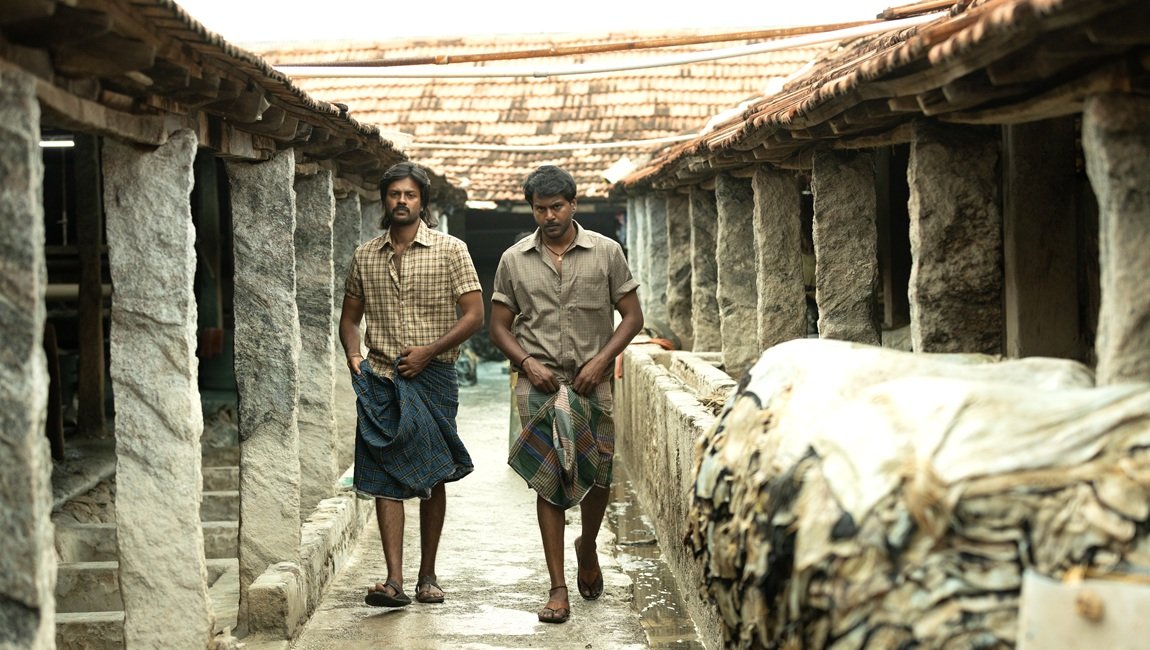
His protagonists — Subbu (Sananth) and Karthi (Rishikanth), presumably named after the forename and surname of the director himself — are two bosom buddies from a village near Madurai. Karthi tells Subbu’s brothers that he killed Subbu as requested, and the film shifts to flashbacks from their childhood as Karthi seemingly mourns his loss. We see the protagonists as children, with Subbu charmingly trying to defend Karthi from bullies through Bruce-Lee styled hijinks. Subbu passes on the masculine credo he had obtained from his monstrous brothers and father to Karthi, and they soon become close friends. In a characteristically quirky montage, we quickly witness these friends growing up in this brutish, fiercely casteist environment, enamored by the local hoodlums (or rowdies, the English term commonly used even when speaking in Tamil) and eventually becoming a part of one of the rowdies’ gangs. The roles have naturally reversed here, with Karthi taking up the masculine mantle and Subbu being the more timid sidekick. The titular character (Keerthy Suresh), meanwhile, comes into Subbu’s household as his brother’s wife, and she ends up irrevocably impacting Subbu’s and Karthi’s lives.
The territory does seem familiar, but Subburaj’s particular talent for twisting and contorting his plot in unexpected directions finds its finest expression here. In his earlier work, the initial excitement of tying together these kinds of various threads atrophied because of his recourse to easy sentimentality, but in this film, as in Jigarthanda DoubleX (2023, a spiritual sequel to Jigarthanda), his narrative bends according to a guiding principle. While he couldn’t sustain the conflicting tonalities in the latter film, as he was carried away by the overpowering impulses of his influences, his filmmaking soars in Dorothy. If Jigarthanda DoubleX was Subburaj’s first attempt to let his “content” modify his “form,” Dorothy is his first stab at critique, and what a critique it is!
The director establishes his aesthetic principle with his opening shot, where a cloud of dust gradually accumulates in the frame with increasing ferocity in a black-and-white wide shot of a truck and Karthi in the left corner of the frame. This “clouding” of emotions in an aggressive, toxic environment, where only certain modes of behavior are permissible, also primes one for a completely different film altogether. The expectations of a Tamil audience lean one toward a particular narrative logic and dramaturgy, but what appears as a film of heated passions over Dorothy morphs into a film of gender troubles and trans emergence. Subburaj’s subversion is laid bare in his ingeniously delayed title card, which appears only when Karthi and Subbu go to see Dorothy. Likewise, every genre dictate is subsequently inverted and subverted; even a throwaway reference to a famous Tamil film, Nayakan (Mani Ratnam, 1987), isn’t spared this inversion. Ilayaraja himself takes a leaf from Santosh Narayanan’s (Subburaj’s usual music director) book, subjecting his string-laden, orchestral music to the quirky, kitschy musical parodies that form the hallmark of Subburaj’s films. The director’s clever structure here of alternating between the present and past allows Karthi’s conflicting emotions to blossom out of the strictures of his environment, and if we, as spectators, have certain expectations, it’s because both us and our films are bound by the same strictures.
While there are some issues related to the occasional gender essentialism, tonal inconsistencies, and awkward didacticism, Dorothy is an almost perfect realization of Subburaj’s ideas and themes, a shining example of the wonder that can emerge by wading through the thicket of influences, mores, contradictions, and questions, rather than evading them. He confidently ushers the modern into the realm of his influences, aided amply by a terrific Ilayaraja, all while taking us along on an exhilarating, heart-wrenching rollercoaster of genres which willingly changes course according to the roiling emotions of its protagonists. The masala film is finally shown a mirror, with Subburaj revelling in its virtues while exposing its fragile masculinities. By doing so, Subburaj not only delineates alternative emotions and expressions lingering within oppressively hierarchical societies, but also finally unleashes the liberatory potential of the masala genre he has spent all these years working toward.
Published as part of TIFF 2026 — Dispatch 1.
Comments are closed.