
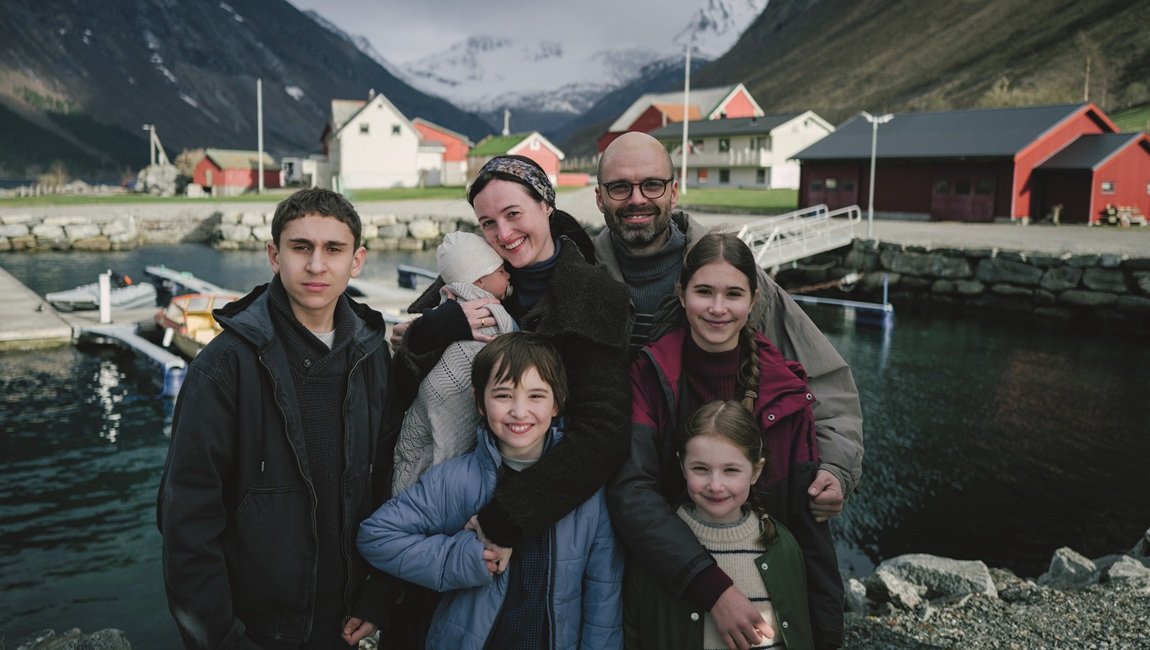
For the first time in his feature career, Cristian Mungiu has shifted his critical gaze from Romania to its western neighbors. A Cannes luminary par excellence — the recipient of the Palme d’Or for startling abortion drama 4 Months, 3 Weeks and 2 Days (2007) and awarded twice more at the Croisette for subsequent films — the auteur returned to this year’s main competition with Fjord, a recognizably sturdy exposé of how an emigrated Romanian family is suddenly plunged into the depths of Norwegian bureaucracy.
With the formal rigor you’d expect from the most reliable flagbearer of the so-called Romanian New Wave, Mungiu carefully unpacks how the bicultural family of Mihai and Lisbet Gheorghiu integrates within the remote hometown of Lisbet’s childhood. At first, the settling-in of this staunchly Christian family in the relatively liberal-minded European community is suspiciously smooth. Although their teenage children, Elia (Vanessa Ceban) and Timotei (Filip Sebastian Berau), are tasked with daily Bible studies, denied smartphone access, and forbidden from listening to secular music, they quite easily seem to find their bearings as foreign newcomers at a remarkably relaxed high school. The depths of this supposed tolerance, however, are quickly depleted once one of the teachers notices bruises on Elia’s body, prompting a routine investigation by Norwegian Child Services that, on paper, sounds justifiable but in practice resembles a Kafkaesque inquisition. Mungiu uses the judicial tribulations that follow as a critical framework to show how Romania’s more patriarchal traditions clash with Europe’s progressive pretensions.
Fjord‘s court-like proceedings see Mungiu at his most middlebrow to date. Gone are the more mystifying bureaucratic absurdities of Graduation (2016) and his grand indictment of inner-land resentment in the diagnostic R.M.N. (2022). His usual precision plays out more neatly here, resulting in a film that, while accomplished, feels textureless and even a bit soulless. It’s as if Mungiu relies too much on his narrative device and solemnly lets his characters go through the motions, of which there are many. Surely, Fjord‘s moral inquiry into the contrast between evangelical orthodoxy and secular progressivism is poignant, but the frictionless treatment of the material — in which every side receives its fair hearing, and the audience is burdened with the responsibility to render a verdict — remains lackluster.
It takes away some of the shine of Fjord‘s stellar casting, carried by Sebastian Stan — finally allowed to flex his Romanian roots — and Renate Reinsve, both compelling as the bicultural couple robbed of their five children. Their timid demeanor and solemn humiliation register perfectly against the stark white backdrop of the Norwegian seaboard village, yet the performances rarely transcend the tight squeeze of bureaucracy the way they would in a previous Mungiu picture. The more intriguing elements of this ultimately unrewarding migration drama are the ways language complicates the legal proceedings. Do the teenage children understand the extent to which they confirm their parents’ supposed crimes when they agree to receive an occasional slap? Is the corporal punishment a mere slap on the butt or a beating severe enough to produce those damning bruises? Do such linguistic nuances — easily lost when the defendants are not proficient enough in Norwegian — even matter to the policy-first Child Services inquisition? Mungiu carefully portrays the precarity of this family, but frustrates by withholding the deeper psychological insights that would allow us to understand them on a level beyond what the concerned authorities register. Instead of murky ambivalence, Fjord ultimately deals in opaque blandness.
Mungiu does place enough red herrings and canny distractions in the film to generate some suspense and intrigue. Meanwhile, the camerawork of trusted cinematographer Tudor Vladimir Panduru still produces an oppressively tight framework to squeeze drama out of Mungiu’s signature brand of realist cinema. Yet the typical ruthlessness of his much scarier earlier work is exchanged for a consistent sense of inertness. On some meta-level, you might think that — much like the Gheorghius — the foreign director is still too much of a newcomer to locate his usually grandiose cinema in the particularities of the Norwegian outskirts. It might also be the case that the Romanian master has simply grown too comfortable setting up a callous narrative he thrusts his hapless protagonists into. While the star-studded cast and convenient genre framework hint at more mainstream appeal, the wanting execution signals a rare misstep from one of Europe’s strongest, and heretofore most reliable, cinematic voices.
DIRECTOR: Cristian Mungiu; CAST: Sebastian Stan, Renate Reinsve, Lisa Carlehed, Ellen Dorrit Petersen, Lisa Loven Kongsli; DISTRIBUTOR: NEON; IN THEATERS: October 9; RUNTIME: 2 hr. 26 min.
Comments are closed.