
The gifted prodigy who’s gone to seed is a time-honored trope that will never leave us because it flatters both filmmakers and actors. A streetwise rogue who can quote Dostoevsky or play Rachmaninoff may only exist in the realm of fantasy, but it’s catnip for actors (almost always men) who want to play rough around the edges but also come across onscreen as erudite. The filmmaker James Toback has built his career on the backs of writing these sorts of characters in films like Fingers and The Gambler — ironically, both films have been remade to bring this archetype into the 21st century — while Matt Damon’s early star persona in films like Good Will Hunting and Rounders was “handsome guy who could take a punch while being the smartest guy in the room.” The latest example of this phenomenon is Leo Woodall in Daniel Roher’s diverting but ludicrous Tuner, a film that treats the character’s talents as a superpower: earning the admiration of the upper crust while proving to be especially useful to various criminal types who have designs on exploiting it. Roher’s film essentially functions as a potboiler for the NPR crowd.
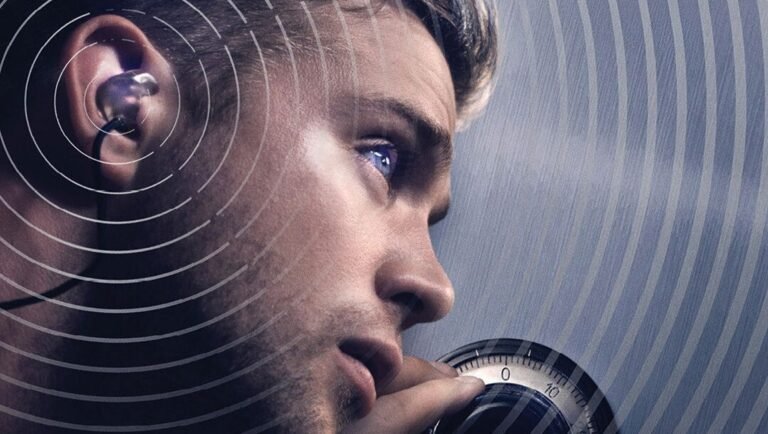
Woodall, who’s likely best known for appearing in the Italy-set season of The White Lotus, stars as Niki, a gifted classical pianist. Or he was as a child anyway, at which point he developed a rare “noise allergy” that makes him incredibly sensitive to loud sounds (it’s a real condition called hyperacusis). As even honking cars can physically incapacitate him, Niki is forced to use ear protection at all times (the actor wears earplugs or noise-canceling headphones in nearly every scene), a necessity that ended his promising career in the arts before he was even out of grade school. However, as he still has perfect pitch — a term the character bristles at — he’s found employment in the archaic profession of piano tuning. Working alongside his surrogate uncle Harry (Dustin Hoffman, at his most cantankerous), Niki drives all over New York in a work van, tuning pianos for people who can’t be bothered to play them, repeatedly reminding customers that he’s not actually a handyman (and no, he can’t fix their toilets). One night over dinner, upon learning that the mostly deaf Harry has locked his hearing aids in a small closet safe and can’t remember the combination (don’t ask; it’s as dopey as it sounds), Niki volunteers to open the safe based on little more than a hunch about his abilities. And sure enough, after watching a bunch of online videos about safecracking, Niki discovers that he can hear the internal mechanism of the combination lock falling into place simply by listening really carefully.
It doesn’t take long for profitable, real-world applications for this newly unearthed skill to present themselves. While on a late-night piano-tuning assignment at a mansion in the suburbs, Niki stumbles across a trio of shady Israeli “security professionals” led by Uri (Lior Raz) attempting to drill into the homeowners’ safe for what they claim are totally legitimate reasons (sure, Jan). Frustrated by all the noise they’re making, Niki elbows his way in and, to everyone but the viewers’ astonishment, he has the safe open in under 10 minutes, earning a little extra scratch for his trouble and a job offer from Uri to make some real money. It’s a call that goes unanswered at first, that is, until Harry suffers a medical emergency and ends up in the hospital, without insurance and owing tens of thousands of dollars in expenses. Desperate to help the closest person he has to a family, Niki joins Uri’s crew for a string of especially simple robberies: Uri’s ripping off his own wealthy clients, using his own security passcodes to get into people’s homes while they’re away and having Niki open their safes — the thinking being these people have so many valuables they’re not likely to notice some missing cash, jewelry, or rare collectables tucked away in a safe. Besides, even if they do, they’ll probably just blame the maid.
Tuner divides its time between low-impact criminal behavior — the word “police” isn’t said for nearly 90 minutes, the bad guys use an air horn instead of a gun to threaten Niki, etc. — and an understated, crosstown romance between Woodall’s character and Ruthie, a classical music student played by Havana Rose Liu. After an initial meet-cute where he’s able to call out every key she plays on the concert piano he’s just tuned, Niki and Ruthie keep crossing paths with one another until he earns her trust enough for her to reach out for a full-on musical emergency. Resembling a young Jeremy Renner — the character has tattoos all over his arms, which hint at a rough and tumble upbringing, or at least that’s what Niki wants to project — and recalling the sleepy intensity of Mickey Rourke at his most beautiful, there’s a real sweetness to Woodall’s performance. In spite of his demonstrable intelligence, the character seems humbled by his circumstances; the actor looks naturally relaxed on screen and allows his costars to dictate the energy of scenes, particularly when appearing opposite the crotchety Hoffman and hyper-neurotic Liu. The result is that Woodall and Liu are pretty adorable together, and the film doesn’t shy away from how much their relationship is built upon how they really do speak one another’s language (when Niki supports Ruthie in her quest to apprentice for a famed composer, he’s doing so as her contemporary as much as he is a boyfriend). There’s also some smartly observed class commentary to the film, with Niki living the life he was “meant” to only vicariously through Ruthie. Over time, the character’s blue-collar station — a product of poor genetics rather than lack of drive or natural ability — chafes Niki, fostering resentment he’s unable to channel in a healthy manner.
Tuner is the feature debut from Roher after having already established himself as an accomplished documentary filmmaker (he won an Academy Award for directing Navalny in 2023), and he has a better feel for the fundamentals than one might expect from someone making their first narrative. Set to jazzy accompaniment by composer Will Bates, the film moves at a brisk clip befitting a character constantly running around the city and being pulled into assorted capers. Tuner understandably draws a visual equivalent between the inner works of a piano and the cylinders of a lock, so we’re regularly getting insert shots of tiny tumblers falling into place or hammers striking strings (you can also tell Roher is feeling himself a little with all of the flashy “you’ll never guess where we put a camera” angles during the film’s numerous safecracking sequences). Even more impressive is how much the film foregrounds its sound design, employing silence as a dramatic necessity while also wielding loud discordant noises and disorientation to heighten tension; it’s hard enough to crack a safe without having to worry about ringing in your ears or low-flying airplanes above. It’s the sort of film where an offhand reference to a criminal hideout moonlighting as a venue for raves pays dividends late in the film when Niki has to break into a safe against a backdrop of blacklights and deafening dance music.
But therein lies the rub: nothing in Tuner is truly a throwaway detail. A film like this can really only afford one honking contrivance, and it calls in that marker with its central conceit (gosh, sure was fortuitous that Niki was literally watching YouTube videos on how to break into a safe mere days before stumbling across Uri’s crew). Yet the film keeps pressing its luck, stacking incredulous coincidences and dubious plot machinations on top of one another to the point that it starts to insult your intelligence a little. Nothing feels organic or spontaneous about Tuner’s screenplay (credited to Robert Ramsey and Roher), as its abundant plant-and-payoff devices are barely concealed. When Ruthie confesses that she lost a pearl wrist watch her grandmother bequeathed to her, you can be certain that Niki will find a priceless Rolex exactly like it in one of the vaults he opens, just as there can be no doubt that when he foolishly gives it to her as a gift — and lies about where he got it — that she will eventually encounter its true owner and they will be the exact worst person to have stolen from. Would it surprise you to learn that there’s a piano randomly on the floor of Harry’s hospital (all the better to wheel into the room and allow Ruthie to lift the sick old man’s spirits with an impromptu performance)? Or that Niki being strong-armed into the proverbial “one last job” is happening at the exact same time as the concert performance that Ruthie’s been working toward the entire film?
In other words, Tuner suffers from Save the Cat! brain, as in Blake Snyder’s popular mid-2000s how-to book that positions screenwriting as a series of rigid formulas that tacitly encourage clichés and familiar conventions while reducing the art form to an instant brownie recipe. Invention and emotion truth are of secondary concern to “sellability,” and the film carries itself like a tony airport novel. Roher’s film draws influence from jazz, but in the most derivative, surface-level way imaginable; it even scores a key sequence in the film’s third act to Nina Simone’s version of “Sinnerman,” as though the Thomas Crown Affair remake weren’t sitting right there. There’s little room for improvisation or experimentation here, as you can all but set your watch to the film’s plot complications. In a delicious bit of irony, the film is torn between the cold, machine-tooled precision of picking a lock and the amorphous, intuited nature of composing music. Truly, it’s a battle between the head and the heart, and as these things so often go, the head wins out.
DIRECTOR: Daniel Roher; CAST: Leo Woodall, Dustin Hoffman, Havana Rose Liu, Lior Raz; DISTRIBUTOR: Black Bear; IN THEATERS: May 22; RUNTIME: 1 hr. 49 min.
Comments are closed.