
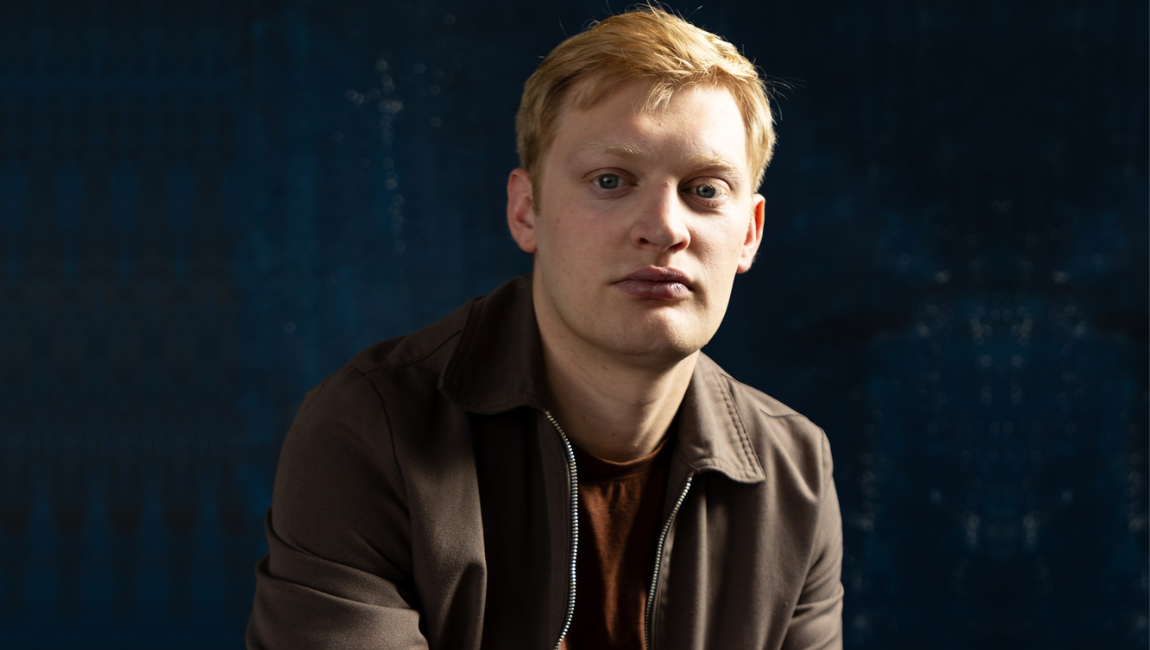
While some cinema traditionalists may wring their hands at the prospect of YouTubers taking over the world, we’re at a point where it’s no longer an inevitability. It simply is. With filmmakers like the Philippou Brothers, Markiplier, and Chris Stuckmann making the leap from your device to the multiplex, their audiences have shown up in waves to support them. Quality can be debated, and this writer personally hasn’t been sold on many of these folks, but you can’t deny that the want is there. YouTube and social media have made it easier than ever for filmmakers to be discovered, and, in some ways, the former has become a film school of sorts. With a built-in test audience via the comment section, you can refine your craft as you go. One filmmaker who is proof of this is Curry Barker.
Having started with humorous short videos with his creative partner, Cooper Tomlinson, and their sketch comedy team “that’s a bad idea,” Barker has gradually worked his way into features. His directorial feature, Milk & Serial, is a terrific found footage film following a group of YouTube pranksters whose desire to one-up one another takes a disastrous turn. Showing serious chops, particularly in his ability to scare you, Barker immediately caught the eye of BlumHouse. In just a few short years, he’d been tapped to write and direct his first theatrical feature, Obsession.
We’ve all had a crush that’s eaten away at us. Ideally, by the time you hit adulthood, that sort of thing should be an artifact of childhood, something that dissipates with maturity. Unfortunately, some people struggle to develop the confidence and responsibility that comes with getting older and, instead, blame their lack of love life on everybody but themselves. What if you could bypass doing the work on yourself and instead force the object of your desire to fall in love with you unconditionally?
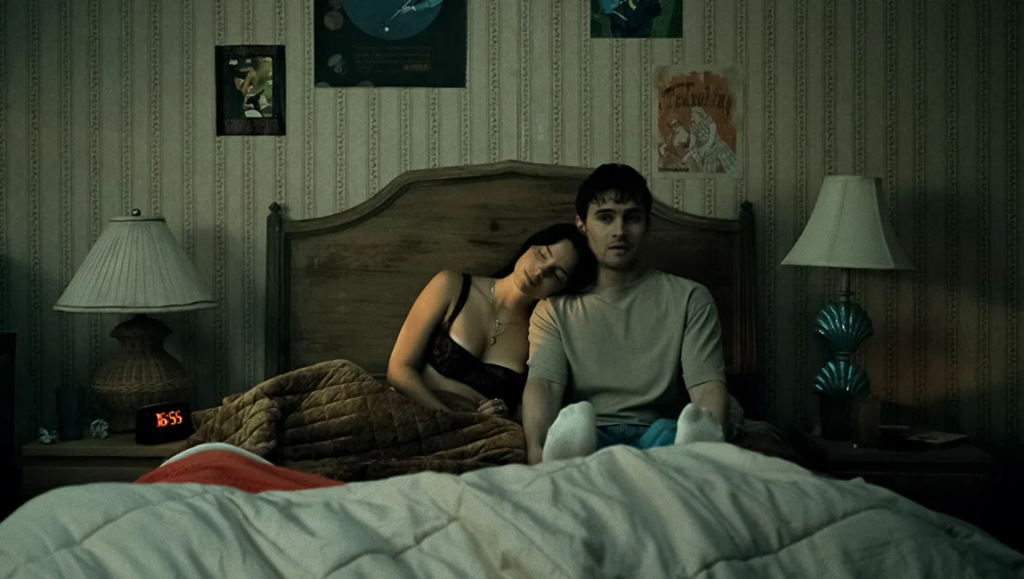
Taking the so-called “male loneliness epidemic” to its logical conclusion, Obsession follows Baron (Michael Johnston), or “Bear,” an awkward guy in love with his best friend, Nikki (Inde Navarrette). Having missed many chances to ask her out, Bear makes a last-ditch effort by wishing on a magic shop trinket, the “One-Wish-Willow.” Working immediately, Bear finds Nikki has fallen more than head over heels for him: she’s obsessed with him. Proving the adage “be careful what you wish for,” Bear’s life is thrown into wild disarray as Nikki, or the love-demon possessing Nikki, refuses to let him out of sight.
With a weasly, gross lead who seems to find the idea of consent to be murky at best, Barker has a lot of fun with making Bear’s wildest dreams come true. There’s never a moment when we aren’t on Nikki’s side, even as she becomes violent. It’s an extremely tough balancing act, but between Barker’s direction and Navarrette’s jaw-dropping physical performance, Nikki is scary — but only because Bear has made her that way. In his quest to have what he believes is his — he’s a “nice guy” after all — he’s contorted her body and mind into something desperate. Her desperation reflects his own, her public embarrassments mirroring his pathetic mind. With just a few smart tweaks, Barker upends the jilted lover trope into something potent. It’s a very funny and scary film with a central performance walking that tightrope well.
Ahead of Obsession’s release, I sat down with Barker to talk about being vaulted into the big leagues, designing the One-Wish-Willow, and his intuition when it comes to what’s “scary.”
Brandon Streussnig: You’ve been open about how your first feature, Milk & Serial, cost something like $800. What was it like making the jump into something backed by big money? How much of a challenge is that to wrap your head around?
Curry Barker: It wasn’t that hard because I was mostly just excited to have the opportunity. I mean, the only thing that was a little nerve-wracking was the first day, and just realizing that there’s a bigger ship that I’m the captain of. It was a little intimidating, but you get over it really quickly because you realize that this is the same thing [you’ve] been doing for a long time, just with slightly more people.
Having a schedule was definitely such a big learning experience for me, going from shooting on the weekends, where we all have day jobs, to 12-hour days, five days a week, for 20 days straight. Yeah, that was a lot.
BS: With that budget comes the ability to have actual sets, I imagine, and not just shooting in your own apartment. How did you go about crafting an entirely new space?
CB: Oh, man, I mean, we still did not have the luxury to build the sets. I wish we had that. Even in the next movie I did after this, we didn’t have the luxury to build sets, but what you can do is design the houses that you find. So we went on a big location scout to find Bear’s house, and really, what we were looking for were the bones that I had written in the script. So the right living room, the right bedroom, the right dining room, and kitchen, even, making sure that the house had all of these things that were in the script. Even where the bathroom is, because there are some key scenes there.
Then once you find the bones of a house that works in a neighborhood that works for the crew, then it’s about, “Okay, can we make these walls? Can we put wallpaper on these walls?” Having an art department that’s really, really good at what they do is so important, and they were great.
BS: To that point, I love the design of the One-Wish-Willow stick’s packaging. It’s got that kitschy, pop-art feel to it that feels so retro yet somehow timeless.
CB: Totally, yeah. I knew I wanted this thing to look a certain way. There was so much concept art. There are so many different boxes that we made for the One-Wish-Willow, and just looking at different references of different time periods, what toy packaging looked like in the ’80s, what toy packaging looked like in the ’60s and the ’70s, seeing these patterns, etc.
There was a certain time period we were going for, where it was kind of monochrome, where maybe the printer could only print one color. Sometimes it was a trend where you would see packaging that would just be the color red or the color blue, but that was it. There was no other color on it. Once we locked down a style and fit in one that we wanted with the box, it was just my mom and me hashing away at this thing. I was very, very, very particular. I kind of drove my mom crazy with, “Oh, these margins on the side are too big.” I’m kind of a stickler for that stuff.
BS: I think it’s fair to say, as great as your direction is here and the film is very scary because of it, Inde Navarrette is the anchor. It’s an incredible performance. What was the process in building Nikki’s character?
CB: We knew very early on that if Nikki didn’t work, the movie didn’t work. I also never wanted this movie to feel too much like a demon movie. I wanted it to lean into, yes, magic is real in this world, fine, we accept that, but then forget about that. Because to me, it’s more about the wish. “I wish this woman loved me more than anyone in the world.” What does it look like when a girl is just obsessed with a man? The note that I was constantly giving her was to play a crazy, jealous girlfriend, not to play a demon-possessed woman.
So with that, you get a lot of whininess and a desperation in her voice that’s a lot different than just playing robotic demon all the time. I didn’t want it to be this thing where it’s like, “I’m an angry demon that’s possessed, and I’ve got a knife, and I’m going to go wreak havoc around town and start killing people because I’m a demon.” I just wanted it to feel like a really heightened, relatable thing.
BS: It’s interesting, too, how you imbue Bear with a certain amount of empathy, but I like that every chance he has to make the right decision, particularly with consent, he doesn’t. He’s almost like a Xander from Buffy, or an incel, even, pushed to its logical conclusion.
CB: I never went out of my way to make Bear any sort of type of archetype. I mean, I actually wanted to approach it from a very relatable position. He starts from a very innocent place, making a wish that we can all relate to. A wish that his crush loved him back. Everyone back in high school had that one boy or girl that they were obsessed with that they wished liked them back, that it’ll never happen because they’re way out of their league, or something like that.
It was really about wanting to start from a place of innocence there. Then it’s what he chooses to do after that that shows his true colors. What I really wanted to do, and what I thought would be interesting, is to tell a story about where the demon or the bad guy is kind of a victim, because I just don’t think we’ve seen a lot of that. I didn’t want a character that’s so one-dimensional, because when you’re a hero, it’s so boring to me. It’s one-dimensional to just always do the right thing. That doesn’t interest me, writing a character like that.
BS: Something I was so impressed with in Milk & Serial and then here, in Obsession, is how you shoot horror. The way you capture light hitting eyes is so unsettling. Where does the intuition come from in how long to hold on a subject versus when to pull back?
CB: You shoot everything. I’m very intentional about what I shoot on the day. So even on the day, I knew what coverage we needed. If we’re going to go to a wide shot, I knew what lines we’d probably cut to that wide shot, because I’ve kind of already edited the movie in my head.
When you’re in the editing bay, you just test things out. I don’t like to bring people in immediately. I like to test it out with myself first to make myself feel weird. I kind of know what I’m going for. You can push those boundaries, and then you can go to sleep, and you wake up the next day, and you watch it again, and you think, “Oh, maybe this was a little too long, or maybe this beat needs a little bit longer.” I kind of follow my heart, as cheesy as it sounds, when it comes to that. Did I feel something? Then you become numb to it after a while, you have to bring other people in, because you’ve seen it too many times.
Comments are closed.