
Successful parody requires affection. The reason why something like Young Frankenstein works – and—why anything directed by anyone named Friedberg and/or Seltzer categorically does not — is because Mel Brooks and co. clearly have a fondness for the material they are sending up, going so far as to craft a film that looks and feels like it could have been airlifted right out of the heyday of the Universal Monster era. All one need do is add jokes. Young Frankenstein is uproarious, but it’s also quite distinctly a labor of love, nailing the finer details of features made four decades prior. Some genuine TLC makes all the difference.
This mode of conduct is also endemic in the filmography of fellow cinematic rapscallion Stephen Chow, who made his own directorial debut lovingly riffing on James Bond with From Beijing with Love in 1994. Apart from directing and appearing in his own work, Chow forged a storied acting career through the late 1980s and 1990s, with notable projects such as Love on Delivery, A Chinese Odyssey, and Fight Back to School. But despite Chow’s prominence as a superstar in his native Hong Kong, it wasn’t until 2001’s Shaolin Soccer that he became more widely familiar to Western audiences. A characteristically hilarious celebration of the Sports Movie paradigm, Shaolin Soccer put Chow on the map in the U.S., but the film was a greater success still in Hong Kong, becoming its highest-grossing film ever up until that point — a feat that would not be surpassed until Chow’s next film, Kung Fu Hustle.
As far as the U.S. was concerned, if Shaolin Soccer was Chow’s opening act, then Kung Fu Hustle was the headliner. Surely anyone who can recall the release of Chow’s sixth directorial effort will remember the ubiquity of the film’s marketing. (I am serious, and don’t call me Shirley). Promotional trailers leaned into the goofier, toe-tapping antics of the film, frequently set to “Ballroom Blitz” by Sweet as the backing track. Even Roger Ebert’s review offered this loose-fitting description that became a pull quote adorned on all U.S. one sheets: “Imagine a film in which Jackie Chan and Buster Keaton meet Quentin Tarantino and Bugs Bunny.” That itself is an amusing time capsule, suggesting that even a critic of Ebert’s stature had very few cultural touchstones of Chinese cinema, his knowledge derived from Chan’s status as a global megastar and the multitude of references Tarantino had co-opted for his own films (it’s worth mentioning that Kill Bill Vol. 1 & 2 had been released just prior to Kung Fu Hustle).
Thanks to the advent of social media — namely, film cataloguing application Letterboxd — and the continued heroic efforts of film preservation and physical media releases, the knowledge and familiarity with the landscape of Hong Kong cinema has experienced quite a boon over the last 20 years. But cinema is always in conversation with itself, as The Wachowskis famously adopted the free-flowing art of wire-fu to build out their digital world of The Matrix, and Chow himself would pay homage to The Matrix Reloaded’s Burly Brawl sequence in Kung Fu Hustle. (As an added bonus: these films were all choreographed by the legendary Yuen Woo-ping.) Chinese cinema may be more prevalent in contemporary film circle discussions, but credit to Kung Fu Hustle for emerging as a self-contained phenomenon upon release, one that reflected Chow at the height of his powers and carefully balanced many disparate genres and elements into a satisfying whole, all for the love of the game.
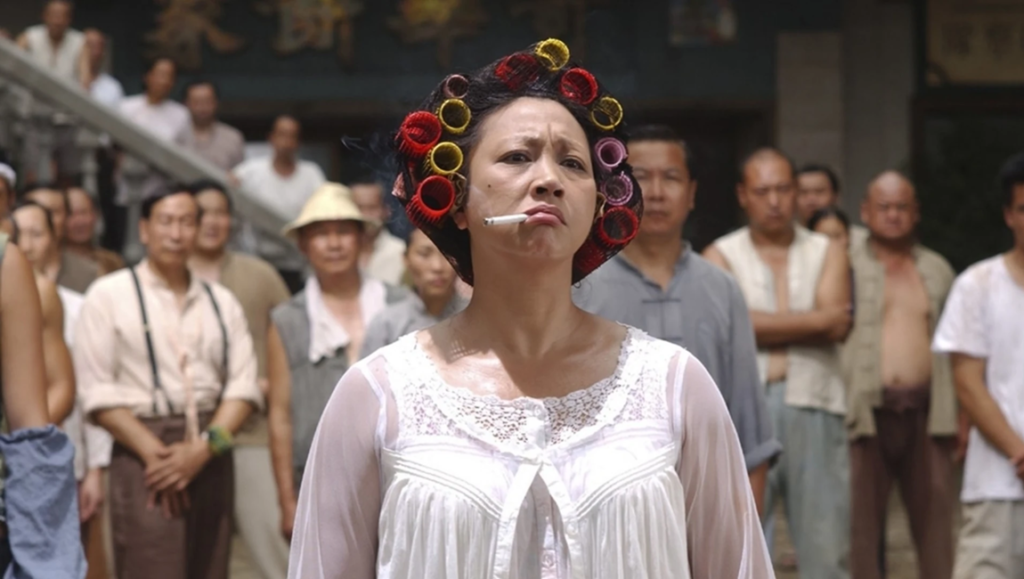
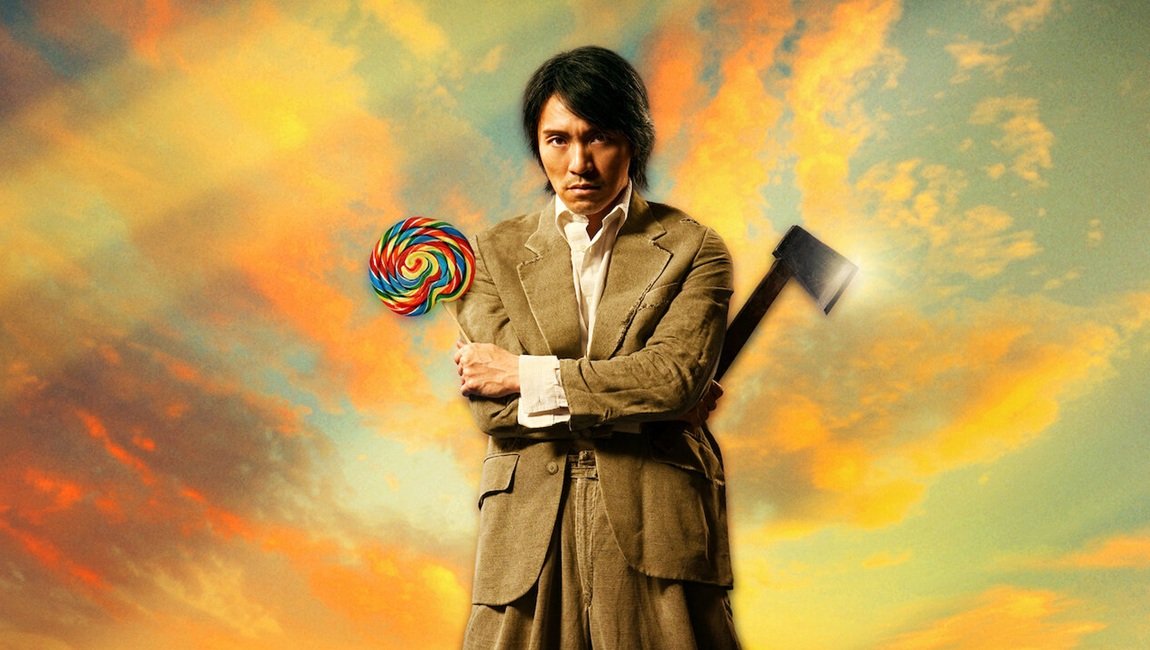
In 1940s Shanghai, street gangs run rampant above the law, with the largest and most ruthless of all being the Axe Gang. Run by the nefarious Brother Sum (Danny Chan, known for being a Bruce Lee lookalike), a figure so rotten his teeth are permanently etched in plaque, the Axe Gang rules with their steel-bladed namesake, sparing no lives and taking no prisoners. Largely ignored by gangs are the poorer regions on the outskirts of town, including Pigsty Alley, a slum consisting of vendors and tenement buildings, run by the irascible Landlady (Yuen Qiu) and salacious Landlord (Yuen Wah). Hoping to make names for themselves are Sing (Chow) and Bone (Lam Chi-chung), a pair of lowlife petty criminals with aspirations to become high-ranking Axe Gang members. But when an altercation with the denizens of Pigsty Alley unwittingly triggers a war with the Axe Gang, Sing finds himself caught in the middle of the chaos, which escalates to include the emergence of hidden heroes with incredible powers, deadly Chinese harp-playing assassins, a dangerous foe known as The Beast (Leung Siu-lung), and a mysterious lollipop girl from Sing’s past (Huang Shengyi).
Chow is quite adept with introductions, immediately establishing the threat of the Axe Gang as they slaughter the smaller, ill-equipped Crocodile Gang, with Brother Slum hacking the rival gang leader with abandon, before going on to shotgun an unarmed woman in the back. It’s a potential recipe for horror, but Chow never tips over into bad taste. Kung Fu Hustle instead operates as a delicate balancing act, though there’s never a doubt that Chow is primarily out to make you laugh, and thankfully the laughs arrive pretty much non-stop: Brother Sum’s post-killing ritual involves an elaborate dance routine with the members of his gang; Sing looking for an adequate challenger to fight, only to be met with increasingly physically imposing opponents, including an incredibly-ripped child; pretty much anything the Landlady says or does. Arguably the comedic highlight of Chow’s career is the botched assassination attempt of the Landlady at the hands of Sing, Bone, and a set of misthrown knives, a side-splittingly disastrous quest that somehow escalates to include poisonous snakes and a Wile E. Coyote/Roadrunner-esque chase sequence through the countryside. Chow is clearly having a ball playing the jester, but he’s wise enough to never wink to the camera, surrounding himself with a game ensemble with crack comedic timing (though Yuen’s Landlady handily steal the show).
But returning to the point about parody: perhaps more crucially, Chow never half-asses the martial arts in Kung Fu Hustle. Every fight is constructed with as much care as every joke, as Chow’s formal prowess holds his own against the likes of Bruce Lee, Lau Kar-leung, and Jackie Chan. Consider a stunning sequence where the three heroes of Pigsty Alley ward off the Axe Gang to defend their own people from harm. With a flurry of kicks, punches, and staff blows, Chow orchestrates a jaw-dropping display of honor, courage, and athleticism, and there’s nary a laugh to be found. Chow might juggle a bunch of hats here, but he looks great in all of them, keeping Kung Fu Hustle light on its feet and rich in affection for cinema. Chow has stepped away from the front of the camera and continued to helm films in the years since — including another blockbuster in his native country, 2016’s The Mermaid — but Kung Fu Hustle is almost certainly his crowning achievement as a filmmaker, a masterwork of parody, action, and comedy in one tidy, absurdist package.
Comments are closed.