
In This Dispatch
Heat
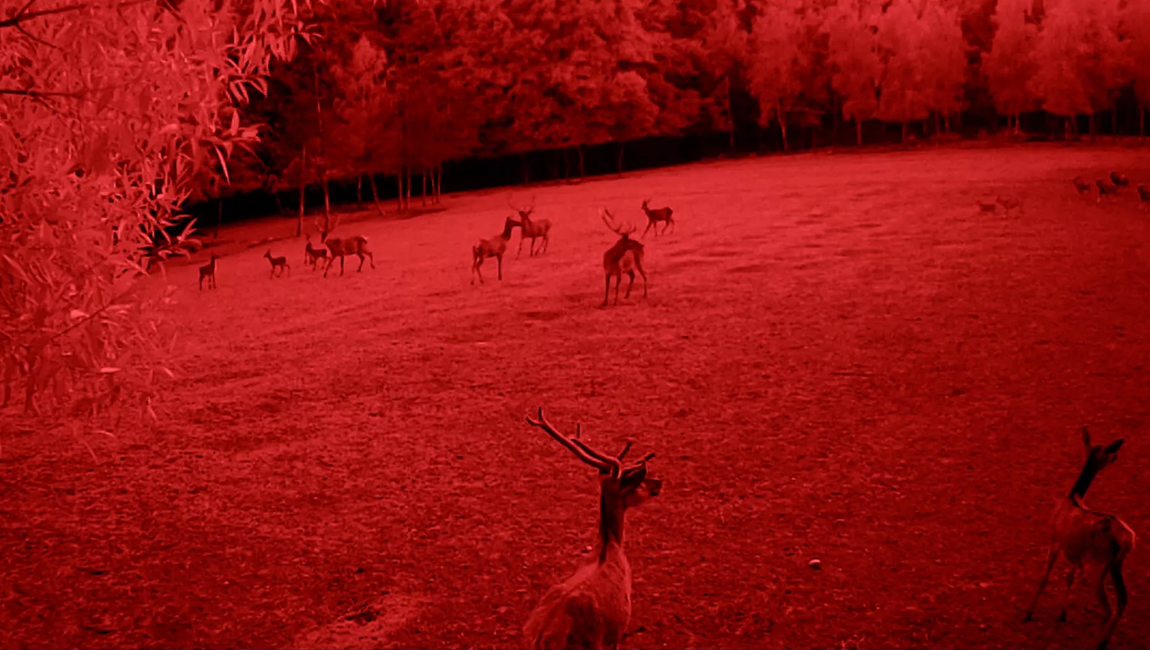
Jacqueline Zünd’s documentary Heat takes place across the Persian Gulf, one of the hottest spots on planet Earth today. Though not because of the ongoing war in Iran ignited by America, but quite literally: temperatures in these areas exceed 50° Celsius, and survival there is becoming increasingly unbearable under escalating global warming, already striking the people of these regions first. Swiss filmmakers certainly have an affinity for environmental docs, whether due to generous funding opportunities or a rather privileged geopolitical position in the absence of pressing crises. Yet in Heat, Zünd sidesteps the infamous risk of sententiousness within the subgenre, offering instead an exquisite and, to its benefit, alienated aesthetic excursion into the sensory experience of climate change.
Not much time has passed since the last edition of Locarno, where Zünd’s previous narrative film Don’t Let the Sun premiered, a futuristic drama about the crisis of interpersonal relationships under the climate collapse, whose landscapes are as sunburned as human faith in a better future. The director developed this film in parallel with Heat, and this reciprocity is quite vivid. Continuing her directorial dialogue in a dystopian tenor, here reality itself provides the accord. Heat emerges as a fictionalized 86-minute documentary that moves across the landscapes in the Gulf states, combining them into a kind of singular diegesis. It observes grandiose and deserted city sights, while abruptly registering the routines of several protagonists, and the way they desperately and inventively confront the temperature. The approach is visually immersive and structurally asynchronous, layering people’s off-screen factual testimonies and more anxious bordering-on-existential questions.
Among the most memorable figures is a woman introduced crying in her car, heartbroken over the suffering of stray cats. Upon learning about an emerging business that delivers big ice cubes to households, she manages to obtain some for the animals so they can enjoy cubes’ cooling vapor and drops of fresh water. The shot of nearly a dozen cats circling this melting cube is nothing if not bizarre, and the film’s nonfiction stance renders it harrowing. Moving across its protagonists of varying occupations, Heat unmistakably exposes class inequalities, now further intensified by something as basic — and yet increasingly luxurious — as air conditioning. Another protagonist, a delivery worker whose face remains defiantly obscured by his helmet, notes that restaurants are increasingly reluctant to let him enjoy air conditioning while he waits for orders. At some point, an off-screen voice asks: “What will happen if the electricity cuts off?” — a chilling inclusion that amplifies the tension of such suffocating panoramas.
It is arresting how a climate documentary can be so haptic, as Heat makes one genuinely feel its title. Zünd’s trusted collaborator, cinematographer Nicolai von Graevenitz, delivers expansive vistas filled with the toxic yellow layer of the Khamsin — the path of an extremely hot, sandy, dry wind — charging the shots with a phenomenological quality of heat radiating from the land and the incandescent surfaces of skyscrapers under blinding sunlight. The dystopian ambience, constructed through static wide shots — often psychotically symmetrical and eccentrically prolonged — productively evokes a disturbing sense of absence: of people in the streets, let alone hope for change. However, toward the end, as Heat returns to each protagonist, drawing closer to their homes and personal lives, it slightly loses this delicate balance of docufiction, ultimately relinquishing its earlier cynical restraint and yielding instead to a more humanistic proximity it had not initially promised.
Still, this sensorial approach at its essence leaves behind something enlightening. Returning to its Gulf setting as an overarching symbol, now overgrown with new connotations, the film suggests that, rather than presenting dry facts, the distribution of the sensible might be a better tactic for environmental documentaries competing for attention amid the urgency of war narratives on the festival circuit. Yet while the latter continue to multiply and escalate, the former are more often met with bitter unease than the sense of dire urgency required to provoke action. — SONYA VSELIUBSKA
The Illusion of a Quiet Night
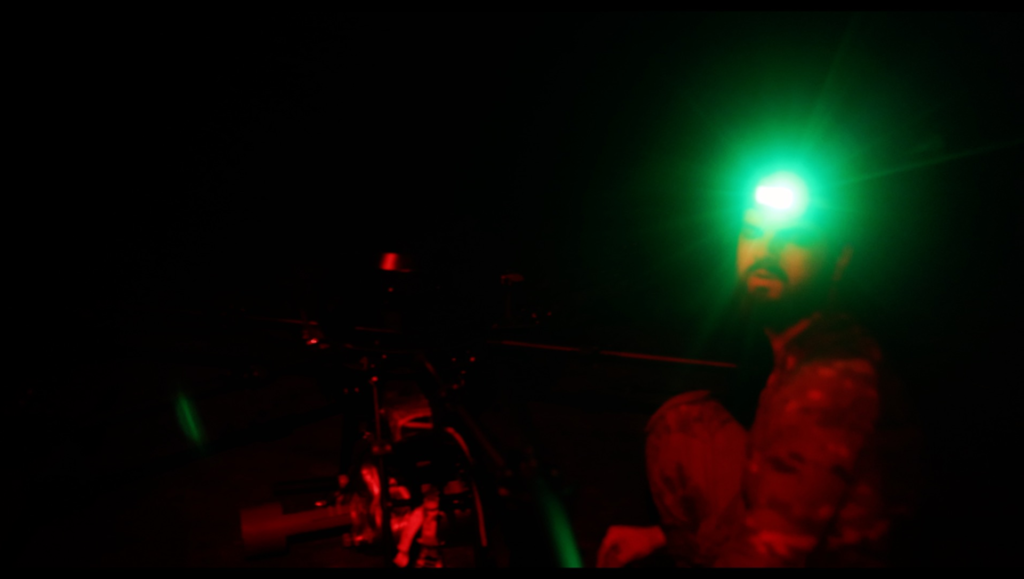
The redundant fatigue from the influx of Russo-Ukrainian war documentaries remedies itself if one begins to recognize their level of artistic excellence. One such effective cure is offered in The Illusion of a Quiet Night by Olga Chernykh, as she dared to embark on a rather ambitious task within the modes of nonfiction: to craft a crowdsourced documentary crammed into a strict temporal frame topped by an additional challenge of wartime routine. Shot during one summer night in late July 2025 by over 40 professional cinematographers alongside hundreds of civilians who submitted their clips via an open Google Form, this 70-minute documentary is a formally versatile and deeply humane voyage across Ukraine, which keeps screaming loudly against the illusions of quietness that the West has grown comfortable believing.
Russian attacks are notorious for mostly occurring in darkness — especially during the summer of the film’s shooting, when the aggressor perfected a ritual of launching at least three hundred drones per night. But the night has plans of its own, as do the civilians, who carry their stubborn adaptability for living out the mundane nonetheless. As the sun sets on panoramas of bustling city centers and rail stations where soldiers depart for the front, the film cuts to a feverish party in a busy club, with acid techno peaking at what would normally be played at 5 AM. A whole country’s worth of farewells, pleasures, and weirdly timed traffic bustles — it’s all crammed into whatever darkness falls before curfew sends everyone home at eleven. This emotional counterpoint — lurching between the melancholic, the frightened, and the festive — is the rhetorical register the film sets from the outset and dwells on throughout. It might be a formal necessity for any mosaic documentary at its core idea, but it is also exactly what life four years into a full-scale war looks like. The collective portrait here is about the rough coexistence of sentiments and events, bipolar in its vibe and seemingly uneven — and for precisely that reason so genuine.
Such lucidity owes much to the editing suite of Maryna Maikovska and Kasia Boniecka, who sew together this wildly disparate footage, including but not limited to digital cameras and phones, CCTVs, dashboard cameras, drones, and GoPros. This seamless flow owes much to their trust in associative editing — oftentimes amusing or surreal, if not outright psychoanalytic. Helmetcam footage of soldiers flushing enemies in the thick of combat roughly cuts to a retired veteran in bed, jolting from a PTSD-burdened dream. Thermal-vision footage of wild animals in the woods is cut against a close-up of a newborn’s eyes, equating each in their innocence. These sutures, however jarring, are ruthlessly honest in their revelation of tight unobvious bounds across destinies. The power of cinematic editing serves a larger metaphorical purpose, as by uniting those dimensions it proclaims Ukrainian sovereignty across the full extent of its constitutional borders. Illusion’s geography encompasses Crimea and Donbas, thanks to the bravery of volunteer contributors, risking their lives to provide such footage under occupation.
For Chernykh, the priceless quality of the poor image and the trust in filmic vigor to reach the unreachable grows out of something personal. Some may know her debut A Picture to Remember, which opened IDFA in 2023 and travelled on the festival circuit, collecting compliments for its slightly experimental, multimedial portrayal of feminine generations within her family — herself, her mother working in Kyiv’s morgue, and her beloved Donetsk-based grandmother, whom she sees through the pixelated video calls. An essay film in its optimal function to reflect on trauma and fading memory, A Picture to Remember culminated with Chernykh using a screen recording of Google Maps to virtually reach her grandmother’s doorstep when no physical path to the occupied city remained. The Illusions of a Quiet Night, then, an ever richer kaleidoscopic canvas, is a striking follow-up within her authorship that works as a political statement and aesthetic standout in equal power.
What also charms about the director’s latest is how it tries to resurrect the fragile intimacy of night, as something humanly universal, catching people at their most vulnerable and treating them with tenderness and hope in return. That veteran, first glimpsed waking from his nightmare, returns by the end of the film to step onto the balcony for a cigarette with the woman behind the camera — and as the sunrise fills the frame, she becomes the trusted company he can unburden himself to. What is more, the film dares to capture the simple nocturnal wonders. Early on, we see a woman preparing for labor while her husband paces the room in anxious excitement, and by the film’s end it circles back to celebrate the arrival of a new life. The elliptical tendency became one of the strongest structural signatures of Ukrainian war documentaries, devoted to exposing the renewal and acceptance as an inextricable choice but to push through. The country wakes up and returns to the routine, until the next night of miracles and horrors to come. — SONYA VSELIUBSKA
Also Playing
The History of Concrete
In 2020, HBO began airing one of the funniest and most significant docuseries in the history of the form, How To With John Wilson, in which a man named John Wilson attempted to give advice or illuminate a certain banal ubiquity of urban life with the help of his constantly roving video camera. In one episode, he describes both the utility and the menace of scaffolding, which seems to breed like a fungus infecting New York City’s buildings and intersections. In another, he investigates the best way to make risotto (while also attempting to purchase his building from his elderly landlord).
In 2023, How To With John Wilson ended. As Wilson’s feature debut The History of Concrete begins, then, he’s struggling to locate a creative — and psychic — way forward. Coincidentally, the foundation of his home is cracking and flooding, uprooting his tenants (who are also his friends) and leading to a crushing sense of futility and powerlessness. A botched DIY repair job subsequently leads to Wilson’s fascination with concrete. Unfortunately, nobody seems to want to pay for a documentary about it despite it being a literal foundational element of almost everything around us, so a mission to find financing leads him to the set of Marty Supreme (Josh Safdie is credited as a producer here) and to Rome, where once again nobody seems to know the secrets of this perhaps miraculous material (or if they do, they don’t want to share it).
Typical for Wilson’s projects, The History of Concrete dives down multiple simultaneous rabbit holes. A trip to the Hallmark movie studios leads to a digression about urban gentrification and ultimately about the rapper DMX. Concrete seems to last forever, leading to a thread about preservation, which brings us to the proprietor of a business that preserves the tattooed flesh of deceased loved ones, which winds up with the location of Chef Boyardee’s grave.
As in the series, Wilson’s camera — which behaves as much as a tool as it does a personal companion of sorts (an emotional support camera, if you will) — trains on anything and everything, whether it’s pertinent or not (spoiler alert: somehow everything is pertinent). Camera in hand, he diagrams the pervasive presence of concrete in our lives. He points out the five-by-five sidewalk grids, he blanches at the seemingly unending splotches of dried chewing gum all over the pavement “wherever people congregate.” He documents the literally crumbling infrastructure of the New York City traffic system, complete with rebar so corroded it leaves fossil-like imprints in stone and bridges secured by industrial tape, which he contrasts with such monuments as the Roman Parthenon, which has stood pristine for something like two millennia.
And yet, The History of Concrete is about so much more than just concrete. It might even be about everything. When it becomes clear that nobody will finance the movie if it’s inexplicably not attached to a rising musical act, Wilson finds himself in the company of Jack, a liquor sales rep who also fronts the Nebulas, a struggling rock band playing bar gigs in the sticks. There’s something sad but reaffirming about Jack’s perseverance in the face of incredible, likely impossible, odds, and Wilson becomes increasingly friendly with the guy. A late element of tragedy (too unusual to spoil here) throws the entire relationship into sharp relief within the context of the film.
For Wilson, concrete is a metaphor for the ultimate binder — the glue that secretly holds everything together and the fickle hand of fate, a manifestation of entropy and impermanence. It can last for thousands of years or a mere matter of months. It’s life and death at once. When it’s fresh, people carve their names into it in some sort of challenge to immortality. When it’s dry, it seals off trees from rainwater or entombs dead family members forever. But right as this characteristically sprawling, digressive, and endlessly curious thing is finally bearing narrative and thematic fruit, intercutting monks ritually smearing a Buddhist mandala with a ceremony celebrating the passage of a NYC affordable housing program, we also get Wilson giving Eric Adams the Headcrusher move through the camera. The History of Concrete is a tremendous ode to hope and kindness in the face of inevitable collapse. — MATT LYNCH
Club Heaven
The opening shot of Dutch director Jona Honer’s documentary Club Heaven plunges us into the heart of the “Playhouse” club in Chengdu. A perfectly symmetrical wide shot of the empty dancefloor resembles a kind of altar: a hefty circular lighting truss hangs above a cluster of glass-walled cubes, while dry ice billows upward in thick clouds. “Playhouse” is renowned as one of the world’s foremost EDM clubs, always primed for another night to ignite. But first things first: the briefing. As the general manager steps out in front of dozens of workers lined up like a military battalion, he launches into an uplifting-to-humiliating speech urging them to treat the job as sacred, while welcoming new team members who have only just turned 18. Club Heaven declares its focus from the outset on the nuances of labor, setting out to observe a nightclub in operation, from the highest chain of managers down to the girls whose job is simply to show up. From this flamboyant opening and the motionless shots of studious prep, a natural build-up toward some ecstatic release as the party time approaches is felt — only for the director to break those expectations, relentlessly yet ingeniously.
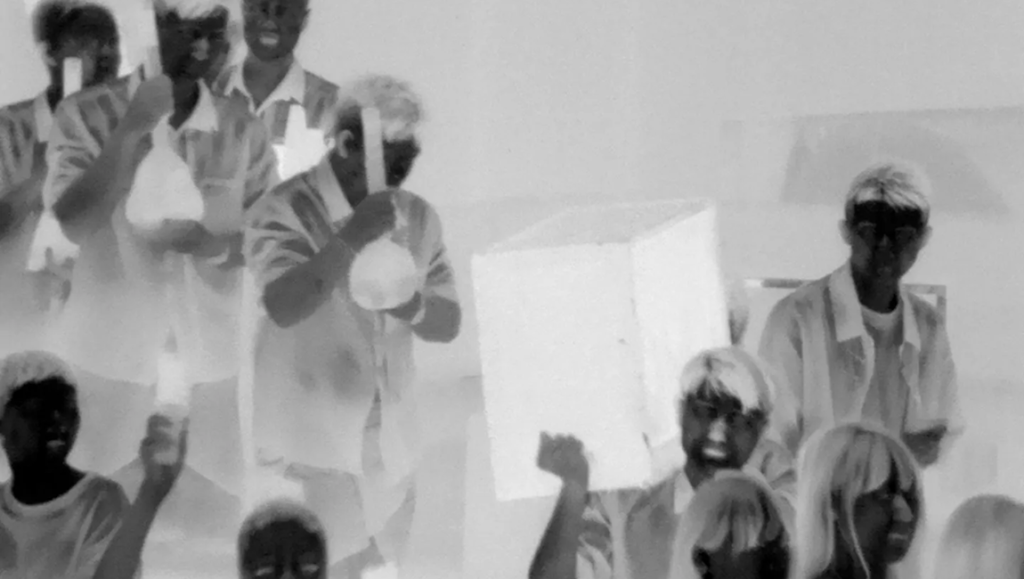
Once the film finally reaches the dancefloor, its camera switches to a thermal one, abandoning its rigid stasis for the freer movement of a handheld zoom that roams across the space. The inherent photonic specificity of the thermal optics, with its rough negative contrast, presents the dancers as a phantom, soulless throng moving in modest dance, while its focus stays with the very workers hyping sales. All this monitoring unfolds in dead silence, and the extended takes of several minutes imbue such scenes with ever-increasing disquiet. That is precisely the film’s strictly formalist and steadfastly devoted rhetorical stance: a leapfrog editing style that alternates between dancefloor and back-of-house, the latter dominating the runtime.
With the almost mathematical precision of roughly five-minute static long-distance shots, the camera observes the dark corridors, underwhelming lunch breaks, and eavesdrops on aggrieved conversations about miserable salaries, reaching for what might be called a bare-minimum Wiseman-esque quality of institutional portraiture. While the film’s synopsis promises that “the euphoria of some feeds on the fatigue of others,” it would be a stretch to define such a dynamic. The relation here is rather horizontal, the same moody register played at differing intensities across the entire club. It reads better as a rigorous attempt at a miniature metonymy of tough Chinese labor.
Club Heaven would make for an obliging programming company to Wang Bing’s Youth trilogy, devoted to the slow documentation of young migrant workers in Zhili. Here, too, some of the protagonists are migrants, and it comes as no surprise to hear Russian spoken in one scene. The Chinese nightlife industry is known to actively recruit white girls as dancers and party companions, both for the exoticism they bring and, primarily, to tap into the festive register of their Slavic origins. The film draws its best from its steady register in the scenes devoted to the female workers. It keeps returning to them being scolded for not looking cool or fun enough, then cuts to the thermal muteness of the dancefloor, where the fun feels a bit forced.
It is undoubtedly an original take on the club-set film, but as this alternating editing is so locked into its own rhythm, the film reaches its point too rapidly, while the thermal shots, however engrossing, grow predictable as the runtime wears on. There is something else Club Heaven‘s pedantry has to contend with by its very essence — namely, that it never lets us hear the music from the heart of the sound system. Honer’s assertiveness is here for a clear reason, yet the missing EDM bass drops and builds inevitably settle in as a stolen ecstasy. We do hear one song, though, and it arrives with bitter irony. At the film’s very end, a young female worker sits in the corner against LED projection walls of the sky and sings a tragically sentimental karaoke number, one which seems to exactly capture her mood after a long, overworked, underpaid night at the club. — SONYA VSELIUBSKA
Comments are closed.