
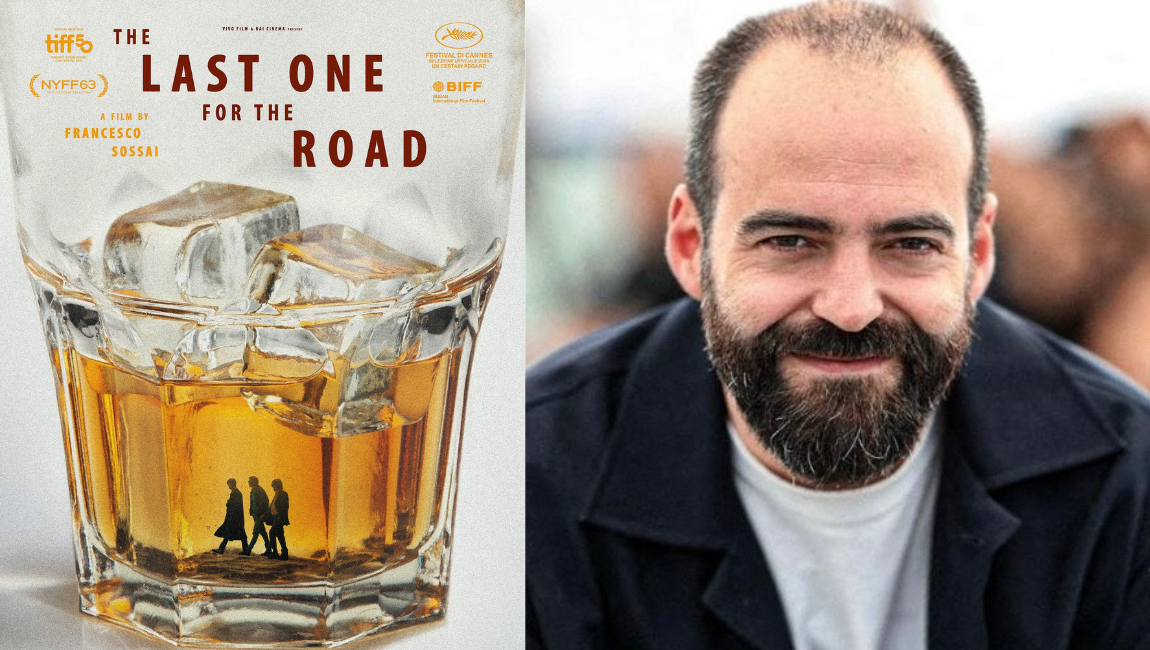
Early on in Francesco Sossai’s wistful, funny The Last One For The Road, a German tourist at a bar declares that he’s here to see Italy before it’s destroyed. “I think you’re too late,” shoots back 50-something Carlobianchi (Sergio Romano). There’s a despondent kernel of truth to the words of a man who, along with his best friend Doriano (Pierpaolo Capovilla), is confronted with the unfamiliar sights of a country he’s spent his whole life in, yet which now appears to have transformed overnight. Old haunts have been shuttered, new infrastructure projects are in the works, and a secret stashed in the floorboards of an abandoned house years ago has gone missing.
On a road trip that doubles as an endless drinking spree, the two men are in constant motion, and yet the stasis of middle age is catching up to them. They’re acutely aware of missed opportunities and elapsed time, and in Giulio (Filippo Scotti), the bookish architecture student they run into, they see a young man letting the moment pass him by too. As they rope him into their journey, they fill him in on their past while nudging him to seize his present.
For all the film’s atmosphere of loss, however, Sossai and his co-writer Adriano Candiago don’t let the melancholy linger for too long. In bars from northeastern Italy’s Veneto region to Venice, these men come alive — dancing with abandon or flirting with a bachelorette party. The city’s changing landscapes mirror their own shifting identities. In another life, these men made a small fortune with a racketeering scheme; now, they slip old habits with ease, successfully scamming a Count.
On the occasion of the film’s U.S. theatrical release, I spoke with Sossai about his decision to not shoot at any recognizable Italian landmarks, the appeal of overhearing bar conversations, and why some of the film’s most revelatory bits of dialogue are best left unheard.
Gayle Sequeira: Tell me about the capriccio, which Giulio explains is a type of painting that depicts a landscape which doesn’t exist. How did you settle on that as the guiding metaphor for this film about these two men who are holding on to a past vision of a landscape and are dismayed to discover how it’s changed?
Francesco Sossai: It’s exactly what you said. A capriccio is a type of Italian painting from the 16th or 17th century. The idea is that you take elements of different landscapes to create a new landscape, something that doesn’t exist in reality. It’s not that it no longer exists, it’s that it never did. It’s an imaginary scene. The classic image of Venice is that of the Piazza San Marco (St. Mark’s Square) with the Dolomites mountain range behind it — that’s a modern-day capriccio because it doesn’t show that between these two, there’s this huge plain with a lot of cities. There’s a form of life there. So my film is a counter-capriccio. I wanted to show what lay between these two well-known places.
GS: You don’t shoot at any of the landmarks or tourist spots one might associate with Venice. You set scenes in local hangouts instead.
FS: I didn’t want to make a film that would “sell” a place to tourists and make them want to visit. It was more important to make people see how those of us from the region perceive Venice. For us, it’s a place where you go to drink. [Laughs] There are no cars, and so you don’t have to drive home. It’s a university city, full of students, and so it’s a good place to party. We rarely go there to explore, or to see the landmarks. To reflect this insider perspective, I thought of this trick: I wouldn’t show audiences the canals of Venice until the night passed and it was the next day in the film. The characters have been in Venice for three to four scenes already, but it’s only when you see the water that you realize they’re there. It’s not the Venice you know from postcards or videos or from the times you might’ve visited. There’s something off and strange about the place.
GS: A recurring theme in the film is the transformation of physical and cultural spaces in Italy, whether an Americanized bar, a highway that’s about to be constructed though a 16th century garden, or a beloved restaurant that’s shut down.
FS: It’s a transformation I’ve been witnessing my whole life, and it’s very concerning. Our way of life has been transformed by ideas of infrastructure — by highways, by roads. We used to be a country of pedestrians and now we’re transforming into a car-oriented population. I asked myself why, and I began studying how cities in Italy developed. You see the influence of the great cities of the U.S. [on Italian infrastructure]. There was an American architect who visited my region 20 years ago and said that the development of small towns has created an “endless strip” that resembles Los Angeles. We Italians live in an imaginary landscape — the old Italy. We don’t acknowledge this change, but are instead always immersed in the picturesque nature of old cities and in our old cuisines even though that’s not the reality anymore. I didn’t want to be critical of this mindset, I just wanted to say that we need to acknowledge that things are different now.
GS: At the same time, you still emphasize the importance of local folklore and stories in keeping cultural artefacts alive. The film introduces this urban legend of a stash of cash dubbed “The Little Treasure” that’s buried in a small town.
FS: I spend a lot of time in bars, overhearing conversations. What’s interesting about the way people talk there is that their stories have this epic sheen to them, despite the topics being banal. They have a way of making their stories sound like legends, or like something extraordinary that happened in the past. We live in a time when you can’t really grasp onto legends or folklore, but there’s still a legendary aspect to the human condition, which is only conveyed in bars. This film was a way of visualizing that. I also asked myself if we’re still going to be telling stories in the same way in the future. And I tried to figure out the answer through this film. It struck me that Giulio is not the kind of guy who might be able to tell such stories, but once the film ends, he has this epic story to tell the next people he meets. The idea is that stories activate stories.
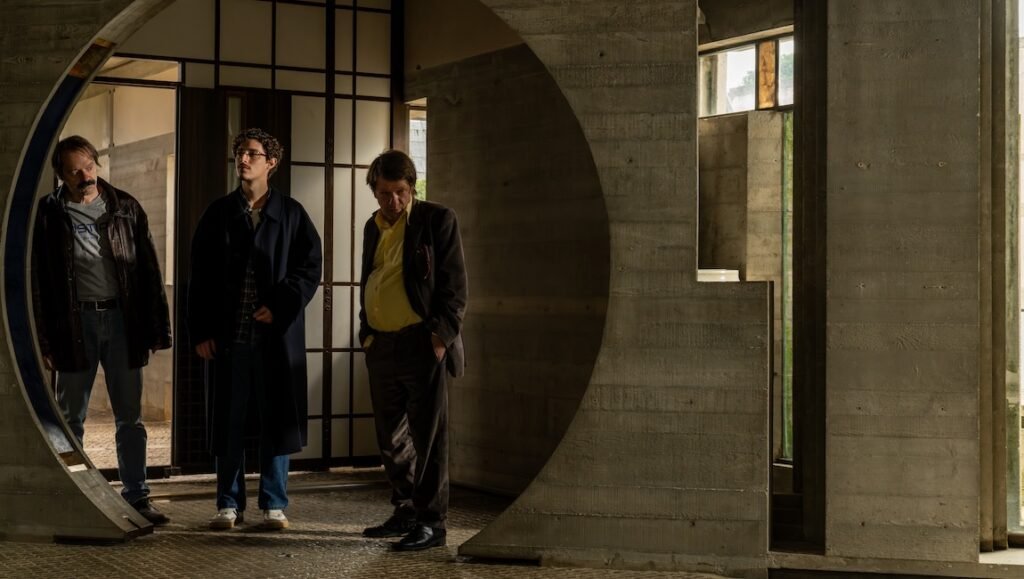
GS: Several times, however, there’s a focus on things being left unsaid. Early on in the film, an imparted secret is drowned out by the sound of a helicopter’s propellers. By the end, the life advice that these two men begin giving Giulio is cut off once his train doors shut.
FS: I think a lot about what the meaningful experiences of a person’s life are, and what really shapes them. Maybe these are little and banal things, but you remember them for life. You project a higher meaning onto situations like these. Those moments in the film, when you’re about to hear something about “the secret of the world” or an explanation of something, you’re close to the final word or sentence that’s supposed to make sense of it all. But you never get there. Which is also true of life — things are never complete. It’s okay, life goes on. I wanted to convey this feeling of trying to grasp a fleeting meaning.
GS: The film is shot on 35mm and Super 16. Was shooting on film part of this attempt to hold on to something physical and tangible?
FS: Yes, for sure. For me, the only way to make a film is to shoot on film. It’s not only physical and something you can preserve, but it’s the only way to bring a clear and meaningful handcraft to cinema. My cinematographer [Massimiliano Kuveiller] and I have a film-imposed rituality to shooting. I believe rituals are important to society; without them, you’re lost because you don’t have a structure. Shooting on film creates these rituals for me, my cinematographer, for the sound people, for the actors, for everyone working on set. With digital, you lose that. It’s like going to church while being an atheist — you’re praying just for the sake of it. The rituals of film are what make the magic of mise-en-scène and direction happen.
GS: You’ve spoken about drawing on Italian-style comedies from the ’50s and ’60s. What were your references and what specific aspects of those films did you want to bring to this?
FS: There’s this Italian film called Il Sorpasso [1962] or The Easy Life by Dino Risi, which stars Vittorio Gassman and Jean-Louis Trintignant. It’s a portrait of the Italian economic development of the ’50s and ’60s, and it portrays all the idiosyncrasies and miseries of a society that’s coming out of World War II, believing in new possibilities and looking at the future with optimism. I wanted to make a counter-portrait to that. I applied the idea of Risi’s film to today — we’ve been a nation in crisis, with an economy in crisis, since 2008.
I was also making a road movie so I watched a lot of road movies like Wim Wenders’ Kings of the Road [1976], Jacques Tati’s Trafic [1971], and Jean-Luc Godard’s Weekend [1967]. I kept going back to them to study how they worked.
GS: You balance out this lightness in the film with a deep melancholy, and these two contrasts really complement each other. At one point, Dori says, “We’re too old to grow up.” Brion tomb, where the three men end up, has been designed to evoke the gravity of death, but, as Giulio puts it, also an ethereal lightness.
FS: Mario Monicelli, who is the father of Italian comedies, said that the principle of this genre was to speak about heavy issues, but in a light way. And that’s how we approached the writing of the film. We didn’t want to make a stupid comedy just for the sake of making people laugh, but to reflect on issues we felt were important to our contemporary world. A light touch seduces the audience — you can bring them into your film with a laugh, you can make them comfortable and then they’ll realize midway through that they’re actually laughing at themselves. You allow for a form of self-criticism. We wanted to reach for a poetry of contrasts. Architecture is structured the same way: there’s a design but also a void.
GS: Since you brought up architecture, tell me about weaving a fascination with the subject into the film.
FS: I’m the son of an architect, and the brother of another architect. A lot of my friends are architects. At one point, I lived in a house with eight architects for many years. I didn’t study the subject, but I got exposed to a lot of its concepts this way. Carlobianchi and Dori think they know their hometown really well, but what they lack is form of criticism and the gaze of an alien — in this case, Giulio, who is very erudite and has studied architecture. He shows them how the landscape and the shape of their cities have influenced their lives and made them who they are. You’re always a product of the space you’ve lived in.
Comments are closed.