
Talk of generations forgotten is typically regarded as historical fact, whereas dreams about the desiccated self are frequently dismissed as melodramatic outings a dime a dozen. There is a truth to this distinction: when one speaks of history, one conjures material, collective evidence painstakingly lived and preserved through time. No such legacy awaits the average Joe, one out of a hundred billion souls in history whose place on earth mirrors earth’s place in the vast cosmos. Yet a curious phenomenon reveals itself at the crossroads of collective and personal memory: an amnesic doubling that throttles not just the air out of the past but also the very act and gesture of breathing. For the young protagonist of Zou Jing’s resplendent debut, A Girl Unknown, the lightness of being is a burden tacitly placed upon her shoulders, festering as time passes and eventually leaving her behind. Born Lin Juan (Cao Ruofan) in the thick of China’s reformist trajectory under Deng Xiaoping, she exists in pristine innocence for the first few years of life, brimming under the sun in a rural southern village with little to her name and little wanting.
The awakening of self-consciousness coincides with a traumatic upheaval; indeed, it may have resulted from it. As Lin Juan’s father dies from an unspecified illness elided by the obscurity of childhood memory, her only recollection of him — fastening and fixing a kite under the pouring rain — will soon disappear. Quickly shuttled away from the village by her mother to the city, she has no inkling of the magnitude or permanence of this move, nor the reasons why. Zou’s direction itself offers few explicit clues, hinting instead at the violence of the One Child Policy, which had, without the girl’s knowledge, made her secondary to a younger sibling and therefore expendable. At the unseen behest of her stepfather, her mother leaves her with another couple, Meishuang (Shen Jiani) and Weiqiang (Zu Feng), who have lost their own. Now surnamed Wang and struggling to fit in with a foster family to whom she serves as an always inadequate surrogate, the girl grows inward, a muted indifference quickly curdling into depression and dissociation.
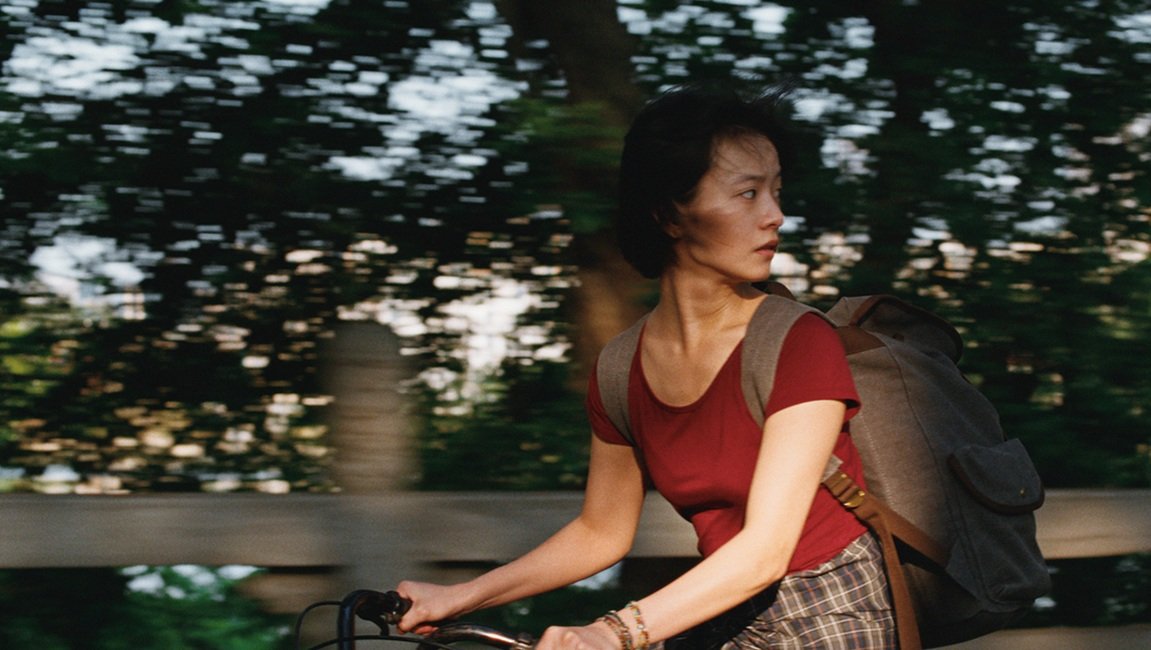
Among other things, A Girl Unknown’s tender beauty shines through its luminous compositions, lensed by DOP Liang Zhongqiang, enlivening the eighties and noughties alike as Juan transitions into adulthood. A jump cut from a monkey plushie to the counterculture of Western influence (Trainspotting) replaces the lithe physicality of a wide-eyed child with the weary melancholy of late adolescence, whose holder (Li Gengxi) is made to recoil from touch at most instances: the assault on her body by an older family friend, the incessant feeling of abandonment and betrayal no homecoming could fully fix. When such an opportunity does arise, it comes as a nasty shock for the girl, who bears a hidden third name and must, by a will not quite her own, respond to it. “What light doesn’t shine?” she asks, a riddle from her younger days metastasizing into a refrain life alone cannot hope to echo. Zou’s narrative, a mix of autobiography and sharp naturalism, does progressively venture into schematic territory, sometimes enveloping the film in a miasma of limp grief. Yet the hidden paroxysms — inexpressible, inconsolable — which come alive only in the purifying embrace of water are the same ones her protagonist plunges into, dissociating from all except the fragile recognition of her own being. If anything, the film’s title may be subtly read two ways: as a definitive ontological state of anonymity, and as the active and arguably more tragic process of unknowing and unbecoming oneself.
Comments are closed.