
It would be naïve to assume a documentary featuring a revolutionary subject would de facto pursue fidelity with the revolution. No artistic mandate exists requiring perspectives of filmmakers — or biographers, for that matter— and their subjects to align. The new French documentary, Che Guevara: The Last Companions, ends up on the most frustrating side of this equilibrium by posturing itself as being spiritually faithful to its revolutionary figures, the final three companions to the titular Commandant’s activities in Bolivia, despite first performing an ideological kenosis of their revolutionary politics.
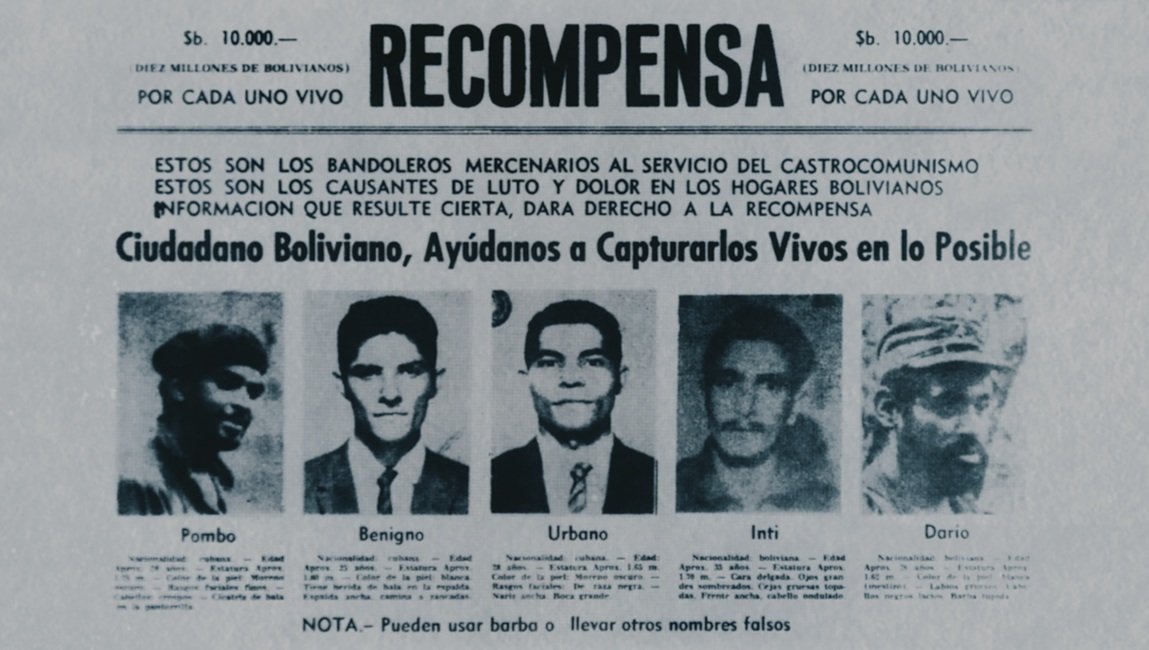
Acting coach-turned-director Christophe Dimitri Réveille blends archival footage, original interviews, and sparse animation into a film that details the events following the death of Che Guevara in Bolivia in 1967. Six comrades survived his death immediately, though three died quickly during the escape. The English title places somewhat more prominence on the famous fallen revolutionary than did the original French Les Survivants du Che, though both still capitalize on the marketability of Che Guevara — one of the world’s most (in)famous symbols of armed revolution. Indeed, the connection to Che sells the film, even though he has very little to do with what happens to Urbano (Leonardo Tamayo Núñez), Pombo (Harry Villegas), and Benigno (Daniel Alarcón Ramírez).
The Last Companions is, more than anything, an escape film. Réveille meticulously and procedurally pieces together the arduous story of these survivors avoiding capture by the Bolivian army as they journey more than 2,600 miles through dense jungles and rugged mountains back to the city where they hope to arrange travel back to Cuba. The director tells this story in incredible detail, including everything from a dog they save from the rightist army to the isolated rural farmer who houses them for a month so that they can gain their strength back and continue their journey. Structurally, this all resembles the foundation of a heist, where the details themselves are the appeal — and their escape is genuinely enthralling, even without an ideological substance to gird it. Their escape could come from anywhere, for any reason. We very briefly hear why each of them fights, though what they believe and, most importantly, the story’s relevance to the global struggle for liberation from oppression are decorative at best and forgotten at worst.
The famous Vincent Lindon narrates the film in a voice so deep and raspy as to be almost sultry. In the context of this world, then, Lindon’s voice is distracting. He narrates in French, of course — his own language, though it has squat to do with the story (beyond the accidental fact that Benigno eventually settled in France and became an anti-Castroist). It’s a similar casting logic that has recruited the beloved Morgan Freeman so many times: his voice is instantly recognizable, and his star power lends authority to the documentary, a genre often dictated by the negotiation of authority.
Elsewhere, Les Astronautes’ animation adds entertainment value in the sense that the sequences where it is used tend to be recreations of the most traditionally “cinematic” or violent elements of their escape, frozen, until now, in the memories of Urbano, Pombo, and Benigno. It doesn’t look too different from mainstream animation styles either, aesthetically tethering it to the capitalist world the revolutionaries were in live combat with. Animation’s rejection of verisimilitude is one of cinema’s oldest languages for fantasy — and though it can be, and has been, creatively and originally utilized in documentary, in this case, it ends up at almost total odds with its subjects, whom it otherwise genuinely empathizes with and even tries to side with.
“Recording events is one way to continue the struggle,” one of the subjects says about recollecting Che’s final moments and their escape to the Cuban authorities after returning. The line has an in-world function here to explain why Fidel and those close to him would care about what was, ultimately, the final moments of a failed insurgency in Bolivia, but it’s reasonable to assume the line also has a larger, more revolutionary purpose: to impose a (leftist) political vantage point onto the documentary. This preservation of memory serves a revolutionary end. And, of course, memory can function this way on film. Many of the most radical films from Palestine use memory to ideologically combat the erasure of Palestinian identity by their oppressors, for example. This is not what’s happening in Réveille’s first feature, however. The memory is disembodied from the mechanisms of oppression and centers Cuban rather than Bolivian voices.
The commercialization and heroification of Che’s and his comrades’ likeness is the ultimate ideological materialization of the anti-Marxist “Great Man of History” approach to historiography. At the end of the day, Che Guevara: The Last Companions isn’t too far removed from any soulless Che Guevara T-shirt that reduces revolutionary politics to marketable heroes of the past. And the right loves this because once you kill a superhero, their power dies with them.
Comments are closed.