
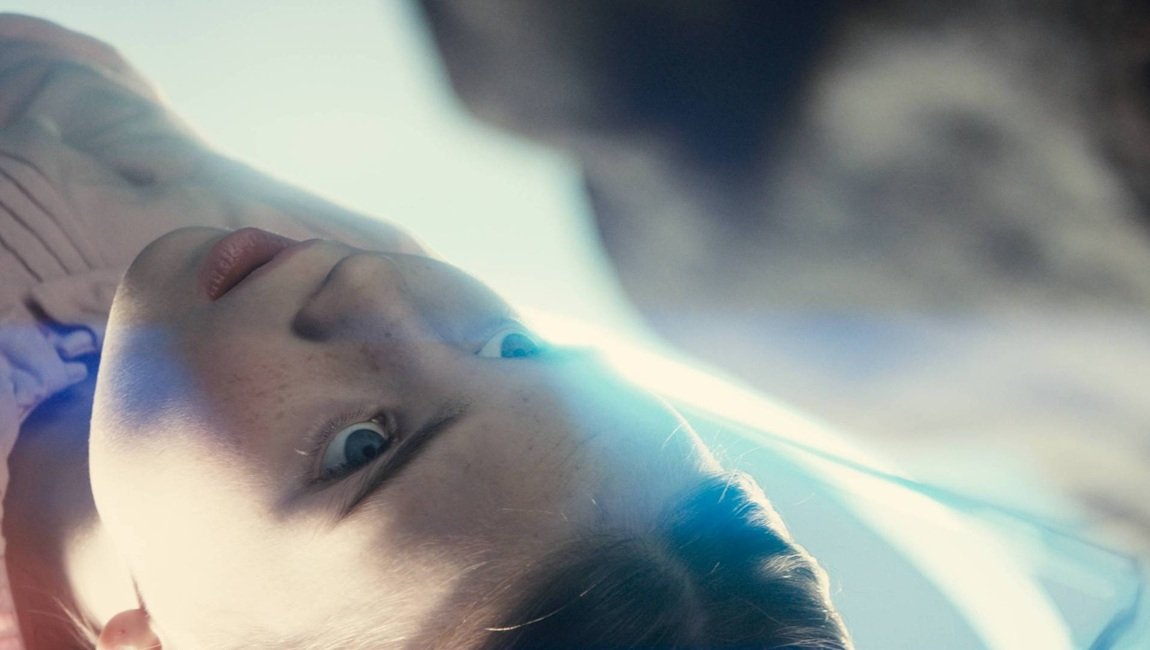
Steven Spielberg’s latest venture into science fiction is also perhaps his most extensive venture into examining the properties and powers of the cross-cut. Emily Blunt and Josh O’Connor play the protagonists of Disclosure Day, and a late-game revelation reveals that they were always bonded to one another in a certain sense, but it takes a while for them to meet: the separation-based formula of cross-cutting hasn’t changed much since the days of Griffith. O’Connor’s Daniel Kellner is a Julian Assange-style cybersecurity expert and whistleblower who’s fleeing a corporation, Wardex. Wardex has been working with the U.S. government in covering up the existence of aliens and their experiments on said aliens, after earthbound crash landings. Kellner has managed to swipe countless hard drives of evidence, and two out of three alien devices that allow for “diving” when directly touched — a potentially too-overpowering form of temporary psychic communication and invisibility. (They’re little rods that look a bit like the coffin-esque pods for the psychic triplets in Minority Report.) Wardex, led by the life-wearied Noah Scanlon (Colin Firth), still has the third diving device and is using it and all their resources to chase Daniel down, while the latter tries to reunite with his fellow whistleblowers, headed by Colman Domingo’s Hugo, so that they might leak the information to the world on a mass scale.
Meanwhile, Blunt’s Margaret Fairchild is a Kansas City TV meteorologist who wants to become a proper news anchor, but begins having a particularly unusual day that involves picking up new languages and the perfect things to say to total strangers after a cardinal flies in and out of her window. It’s a grand pursuit where everyone is trying to find everyone else, and there’s the added wrinkle of relationship troubles: Daniel is trying to keep his former nun girlfriend Jane (Eve Hewson) safe and answer her questions along the way, while Margaret’s boyfriend Jackson (Wyatt Russell) is unsure about what’s happening to her and doesn’t know how to feel about their recent move to the Kansas City area. To top it all off, there’s heavy background implications that war is on the horizon thanks to North Korea, although pretty much everyone more or less continues with business as usual — one of the film’s most true-to-life elements.
Spielberg’s setup and establishment of the chase are immediate and thrilling, with his commitment to putting on a show through dynamic visual exposition at its most carefully judged. Even something as simple as the film’s many frantic phone calls and other forms of communication tend to get transfigured into his characteristically roving shots of pure navigation through spaces. It’s Close Encounters of the Third Kind’s hunt for the higher mysteries filtered through the surveillance state paranoia of the director’s 2000s work, but the thematic undercurrents go to places that aren’t quite what you’d expect. Jane, being a former nun, raises serious consideration of how the Bible views the potential for extraterrestrial life in our universe, along with some heavy allusions to stigmata when Noah dives into her mind to track down Daniel. Said considerations of trying to overcome feeling alone in the universe, and the bombardment of images that can manipulate those same emotions, are also perhaps the main thematic justification for the cross-cutting.
The film opens with a POV shot from the perspective of a wrestler getting curbstomped, and Spielberg’s career-long fondness for shots of people looking in awe at something gets a self-reflexive workout — there’s as much investigation as to why people are drawn to seeking out images as there was in his roman á clef autobiography The Fabelmans, but through the lens of conspiracy and paranoia like those of his New Hollywood contemporaries. There are also numerous visual references to some of the most famous shots in Ingmar Bergman’s Persona — the duality of Daniel and Margaret’s bond with the aliens is explicitly part of the text, but Hewson’s faint physical resemblance to Blunt becomes noticeable in this context, despite the film not explicitly tackling romance beyond the broad strokes. It’s perhaps inevitable that the film takes a slight dip when the cast starts coming together and the set pieces about uniting in the service of a higher purpose turn into both trying to figure out what that higher purpose is and trying to stay away from Wardex long enough to get it across.
Still, despite some flagging momentum toward the end, Disclosure Day’s climax is original enough for Spielberg to keep his 2020s return to form ongoing, and the director’s latest will certainly go down as one of his most eccentric films as a result. Spielberg has always been a true believer, or at least someone who very much wants to be one, and that extends to all sorts of higher forces. Whether it’s a self-reflexive gesture about his own anxious childhood to set a significant portion of the climax in a recreation of young Margaret’s bedroom is hard to determine, but it certainly adds to the generally mystical qualities of said finale. Spielberg has always had his Freudian symbolist side, but a crown of thorns made up of the diving devices aimed at the eye of a child is a particularly potent example.
The director also remains a certain type of limousine liberal. Disclosure Day‘s third act is another of his sunlight-disinfectant climaxes, generally revolving around his recurring belief that, if presented with an undeniable image, the world will be changed for the better. (How this contradicts his liberal Zionism is left as an exercise for the reader.) There’s a brief “is this AI?” moment regarding the original footage of the aliens, but given that this is a Steven Spielberg movie, serious doubts about the power of images ultimately need to be dispelled in order for him to justify what he does. Disclosure Day’s slight naïvete is ultimately touching for its glimmers of self-awareness — much like every other Spielberg science fiction film, this one ends with a superficially happy sheen that disguises darker undercurrents. Here, it’s the possibility that uncovering these deeper revelations might not be enough, and we might not even be granted the chance to see them in this world. Now that’s a heavy disclosure.
DIRECTOR: Steven Spielberg; CAST: Emily Blunt, Josh O’Connor, Colin Firth, Colman Domingo, Eve Hewson; DISTRIBUTOR: Universal Pictures; IN THEATERS: June 12; RUNTIME: 2 hr. 25 min.
Comments are closed.