
Something I learned over many years working in restaurants is that there are no cooks that work in them, no servers, no bartenders, no hosts or bussers or runners. There are only performance artists, actors, poets, ballerinas, rappers, filmmakers, and writers. They pay the bills with restaurant work, but they know, and will tell anyone who will listen, it’s no representation of who they really are. It’s an idea that always caused mild offense. If you are being paid to do a job, you should take pride in it, and you should do it well. Until you’re actively doing something else, in America, it is in fact who you are. Have some dignity, work your shift start to finish, then write about rap music for free under a pen name drunk after a long night out with your co-workers like a normal person.
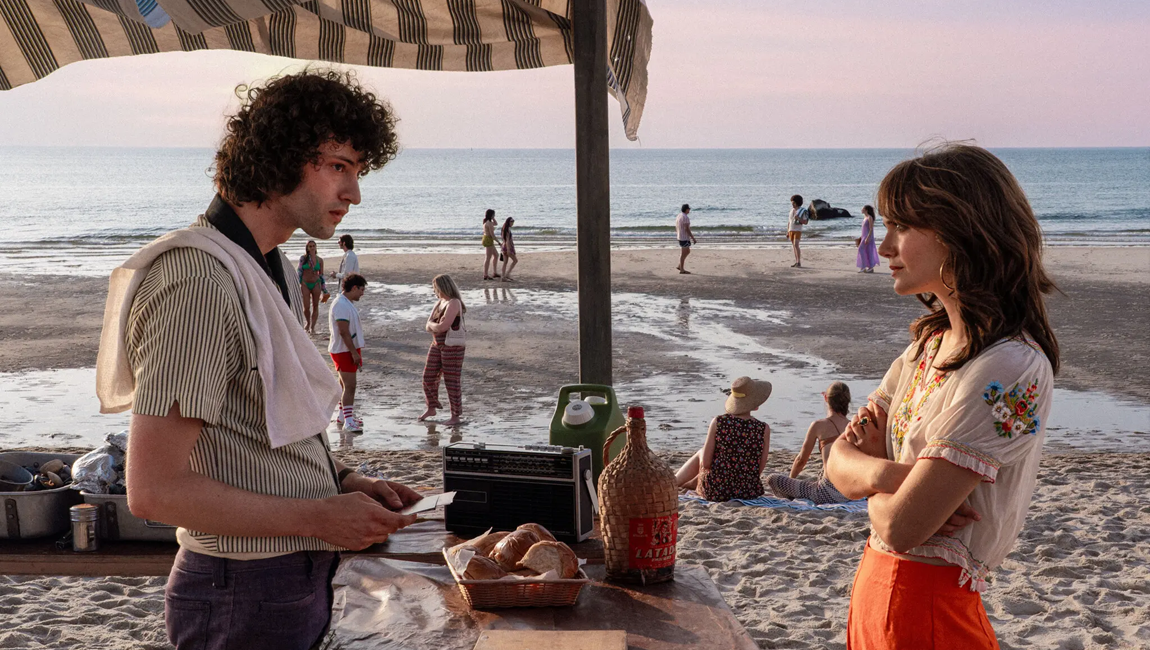
This tension — between what we do in our work, how we like to think of ourselves, and who we are — is the primary concern of Tony, Matt Johnson’s competent and occasionally soulful Anthony Bourdain bildungsroman depicting the artist as a young poser. The film is set over a summer in the mid ’70s in Provincetown, which at that point in history was an intimate seaside crab trap where you could get heaping $4 lobster rolls and trays of freshly shucked oysters at shacks a local might casually denigrate as “fast food.”
When we meet Tony — Anthony’s rigidly enforced sobriquet — he’s a fuck-you leather jacket, a bedhead of curls, and a cliche anti-authoritarian collection of references that range from Bruce Lee to the New York Dolls. He’s trying to lock down a writer’s fellowship that will jumpstart his career as the Orwellian teller of truths he’s trying to prove to his skeptical intellectual mother that he is. Whether in front of a fellowship committee, a woman he’s trying to sleep with, his parents, a prospective boss, or a mirror, his mantra is fake it until you make it, and the film is smart enough to keep him in that insufferable space for the entirety of its run.
This is how he lands in Provincetown, chasing a girl on little more than a whim, to avoid facing his rejection from the fellowship he already told his parents was in the bag. In short order, he’s down and out in Rhode Island: shut down by a bartender, his ass kicked and mugged, left to crash on an ocean-facing back porch hammock, washing dishes in what will become his Degobah Swamp, and all of this during a point in American life and culture when working in a kitchen was still understood as a menial job for misfits and fuck-ups.
Matt Johnson’s brief filmography is full of “Fuck yeah! Movies!” magic. He has faked a moon landing, a school shooting, the aughts tech boom, and a base jump off Toronto’s CN Tower, but Tony demands a restraint and grounded humanity we’ve never seen from him before. And he proves up to the task, mostly. The film’s period detail — from the soundtrack, to Jay McCarrol’s stirring score, to the mise-en-scène that captures everything from the beach to the unwashed whites in a greasy kitchen — is predictably spot-on. The more pleasant surprise is that the protagonist’s arc, from annoying dick to slightly less annoying dick, also successfully lands.
This is largely thanks to Cessa — who capably sells the slutty SAT word processor who has to comment on every fucking bite of food, which is who Bourdain is presented as — and a wonderful supporting cast in the kitchen: Antonio Banderas as the film’s Yoda, with a heart braised in cream and brandy; Leo Woodall (on a real run right now) as bad cop and bad seed Han Solo; and the great Stavros Halkias as… Matt Johnson. They are believable kitchen phenotypes, callouses with arms and legs bantering and pranking over flames in the kitchen and over squid stew family meals in the dining room. Johnson is working with a script nimble enough to deliver the reliable beats of a “finding your footing and maybe even yourself” in the kitchen (and crucially, in cookbooks) progression that still manages to keep even the food-literate viewer interested with scenarios and details we haven’t seen on screen before (when Cessa gets frustrated with his side towel and tries to shuck an oyster bare hand, my entire, hospitality industry-leaning theater in Union Square let out an audible groan befitting a final girl running up to the attic in a horror film). We are decades into this genre of movie, and so it matters deeply that this one passes the now crucial restaurant narrative smell test, with duct tape bandages and lived-in beats, like a special that is too ambitious for an undermanned and underskilled kitchen, as well as capturing the elation you get the first time you make something delicious for a beautiful woman.
Throughout Tony, the young Bourdain outlines his daily routine, a monastic writer’s life spent slaving over the blank page in a quiet room, as we watch his actual summer unfold, busting balls and having his balls bust, burning and cutting himself, drinking and smoking, connecting to the odd assemblage of life you can find in any kitchen, full of performance artists, actors, poets, rappers, filmmakers, and a kid who thinks he’s a writer but is slowly discovering he might be a cook — and that might not be so bad. It’s Bourdain connecting to people and food, the curiosities and passions that will go on to define his life and make his writing actually matter. If you find that point overbaked, you’ll probably walk out of Johnson’s film disappointed. If you are moved, whether you have found the same purpose in kitchens or not, it means that Matt Johnson himself that has come of age, pulling off one his most unlikely cinematic feats: proving he can follow an ancient, simple, lovely recipe.
DIRECTOR: Matt Johnson; CAST: Dominic Sessa, ddd; DISTRIBUTOR: A24; IN THEATERS: August 7; RUNTIME: 1 hr.
Comments are closed.