
In some remote village, at some time before electricity and machines, there are the men who have jobs and the women who wed them. The women are docile, anticipate little of sex, and are expected to mother hordes of children. The men are crass, womanizing, and put little effort into the relationship. No one in this village are rich, the doctors are poor in ability, and berry-picking is one of the few past times. The gender roles ruling Alex Huston Fischer and Eleanor Wilson’s Wicker are meant to be obvious — something the viewer immediately recognizes and knows as true to the world, even without the ability to discern an exact time or place. That foundation allows the real work can begin, and this sophomore feature reveals the filmmaking duo’s central preoccupation: relationships, and how they are shaped by and vulnerable to the outside world. The duo’s follow-up to 2020’s Save Yourselves! also confirms that their dark sense of humor and taste for the absurd isn’t something they’ll shy away from anytime soon. Wicker is, in a word, weird.
Weird doesn’t mean random, though. The strange premise of both the movie and the original short story, “The Wicker Husband” by Ursula Wills, is in concert with “The Search for the Lost Husband,” an academic folklorist classification within the Aarne-Thompson-Uther Index developed in the early 20th century. Also classified as “Animal as Bridegroom,” these folk and fairy tales generally depict a woman and her nonhuman love interest (the most famous example is all iterations of “The Beauty and the Beast”). They can be a metaphor for arranged marriage, where the woman is forced into a coupling against her wishes, but the husband’s condition can also be a trial for the protagonist, testing her vanity, trust, and willingness to sacrifice. Often, these stories are interpreted as depictions of a woman’s autonomy — either her rejection of the norms expected of her, or her dedication to love above all other obstacles.
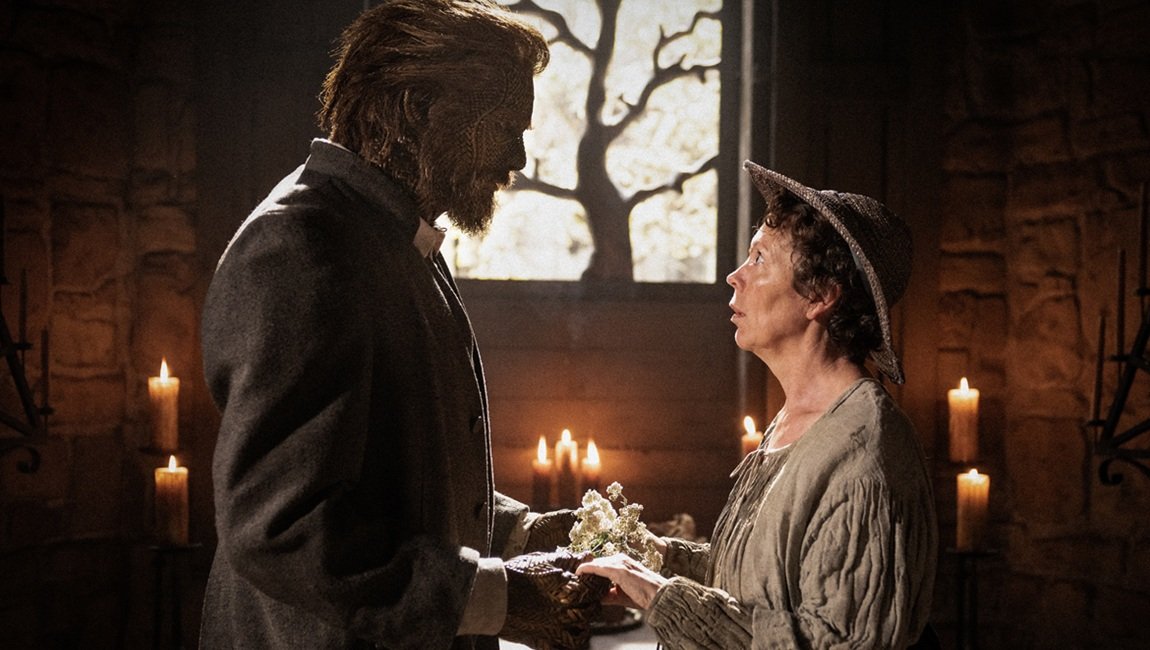
With Wicker, Fischer and Wilson embrace literary tradition and reference points. The Fisherwoman (Olivia Coleman) is an outcast in the village. She grew up an orphan, without the typical familial structure, and is the only woman in town with a job of her own. It’s a job that wears out any possibility of beauty or confidence. She is smelly. Her gait wobbles. Her hair is short and unkempt. Her frock is ill-fitting and filthy from wading through water. Her demeanor is brusk, and she occasionally leans into self-deprecation if it means she’s in on the joke. The Fisherwoman is clearly unhappy, but her dissatisfaction is not that she longs to be a wife. She longs instead to have a husband, and that distinction is the bedrock of how Fischer and Wilson explore the contradictions between her independence and her secret sensitivity. She goes to The Basket Weaver (Peter Dinklage) despite herself, and, as in many fables, makes a wish. She asks him to make her a Wicker Husband (Alexander Skarsgård). In a month’s time, they are wed. “I was made to be with you,” he soon tells her — both literally true, and the first time anyone has expressed to The Fisherwoman that she could be the light in their sky.
Wicker’s criticism of patriarchal social mores are as plain to see as The Fisherwoman’s unibrow, but like Save Yourselves!’s handwringing about phone addiction, Fischer and Wilson aren’t interested in giving the audience a lecture. Yes, The Wicker Husband causes a stir in the village, particularly infuriating the gossipy, ostentatious Tailor’s Wife (Elizabeth Debicki) for illuminating the romance and care that is lacking in their own marriages. The Fisherwoman, though, is the carrier of the film, and its themes lie in how her insecurities reveal themselves now that there is a (wicker)person she wants to keep in her life. The Wicker Husband is content to serve while The Fisherwoman continues as the central breadwinner and decision-maker in the relationship — but The Fisherwoman has difficulty trusting that any man, even one tailor-made for her, would be satisfied by that role. Even though she knows not to trust The Tailor’s Wife’s condescending tone, her suggestions that The Wicker Husband may be in high demand tap into an insecurity. Wicker touches upon the insidious nature of an oppressive system like the patriarchy, where even those who stand against it can find its whispers ingrained in the back of their head.
Fischer and Huston also ensure that The Wicker Husband is more than a plot device. The Fisherwoman’s Orphean doubt effects him, having never known the strictures of the world he’s suddenly entered. Because his expectations and desires within their relationship live outside of the norms established by the rest of the village, there’s no where for The Fisherwoman to hide in her vulnerability. She must be honest with him — and herself — if she wants to be with him.
Wicker is a tonal mish-mash by design, and it is a testament to the performances that the movie can include broad comedy and stock characters while still evoking delicate, grounded feelings. Even on a technical level, Fischer and Wilson are loyal to traditional folklorist reference points, focused on clever reinventions rather than madcap absurdity. Cinematographer Lol Crawley (The Brutalist) was instructed to emulate a 17th century Dutch painting, and costume designers András Dániel Tóth and Attila Godena-Juhász utilize English, Flemish, and Hungarian references from the medieval period all the way through the late 19th century. The effect is a story that feels both ancient and fantastical without being easy to pin down.
That’s not to deny the film’s flaws. Its humor does occasionally overwhelm the good intentions, and some of the ensemble scenes could be pulled from Drunk History or the medieval second season of Miracle Workers. It also directs the audience too far away from our central romance for stretches that are too long, which can halt momentum and allow tedium to trickle in. Still, fairy tale warts and all, Wicker is a bold new entry under “The Search for the Lost Husband;” a genuinely romantic and longing film tenderly anchored by Coleman’s distinguished performance.
DIRECTOR: Alex Huston Fischer & Eleanor Wilson; CAST: Olvia Colman, Alexander Skarsgård, Elizabeth Debicki, Peter Dinklage, Richard E. Grant; DISTRIBUTOR: Black Bear; IN THEATERS: October 23; RUNTIME: 1 hr. 45 min.
Comments are closed.