
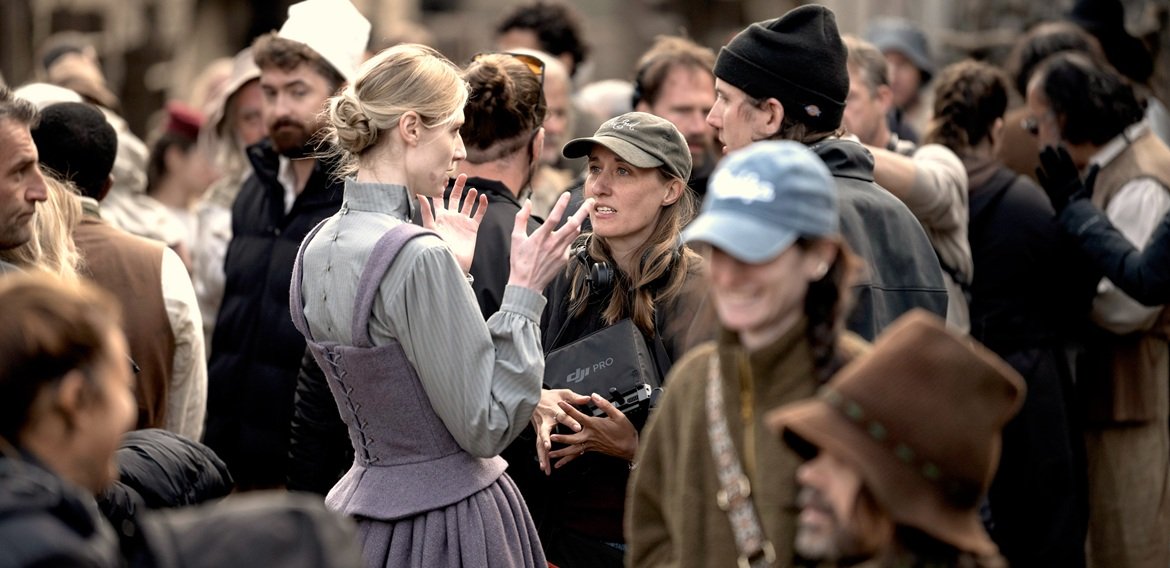
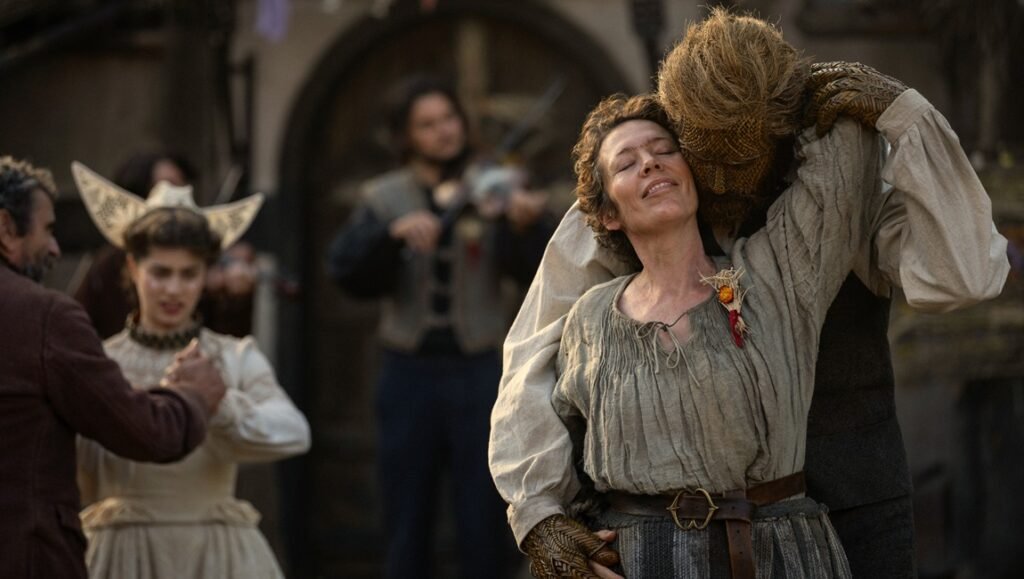
Wicker, the latest film from Save Yourselves! directors Alex Huston Fischer and Eleanor Wilson, is a film both steeped in the romantic fantasies of old that are rooted in the folklore tradition, and an answer to “romantasy,” the portmanteau of “romance” and “fantasy” that was coined within the last decade as a quickly produced, easily consumed iteration of the literary subgenre that has emerged within millennial audiences. It’s the latter sensibility that keeps Wicker in line with Fischer and Wilson’s interests, despite initially reading as a drastic departure from the up-to-the-minute modernity of Save Yourselves! Gas-guzzling aliens are exchanged for eldritch magic; the existential threat of technology becomes the age-old pressures of social castes; and instead of the younger, Brooklynite faces of Sunita Mani and John Reynolds, the audience primarily follows seasoned British actress Olivia Coleman as the haggard Fisherwoman. In true fable fashion, every character in Wicker is reduced in name to their occupation (or in many cases, their husband’s occupation). The Fisherwoman is, in fact, the sole woman living in this medieval village who works for herself, and her spinster status, orphaned background, and general funk from working with fish all day have made her the target of mockery from The Tailor’s Wife, The Baker’s Wife, The Innkeeper’s Wife, The Tailor’s Wife’s Sister, and all the gossipy women about town. That is, until The Fisherwoman makes a husband — or rather, The Basket Weaver makes her a husband — out of wicker.
On the occasion of its U.S. theatrical release, I spoke with Fischer and Wilson about choosing Wicker as their follow-up film, what it says about modern relationships, and why wicker is the perfect husband material.
This interview has been edited for clarity and flow.
Daniella Mazzio: I’m a big fan of your previous film, Save Yourselves! I’m interested in going from Save Yourselves! — a film so modern that it feels like it could be response to the COVID pandemic despite premiering beforehand — to Wicker, which feels on its face is a total opposite movie in time setting and in going from following these American Millennials to an older woman in pre-industrial times. What drew you to Wicker as your follow-up project?
Eleanor Wilson: That it was so different was a big part of it. We’re always seeking out what we can do that would be different.
Alex Huston Fischer: This felt like not only a movie that we hadn’t done before, but something that we may never have done. If the short story wasn’t sent to us, we wouldn’t have sought out a period fable.
EW: It’s not what we were looking for, but when the short story came along, it was sort of undeniable. There’s a couple of throughlines. One, we love practical effects, and this was a step up from our pouffes. It was a practical effects challenge that was like, “Hell yeah, this is why we make movies, this is so exciting.” But it’s a relationship comedy as well, of sorts. Both films are dressed up in different ways, but they are examining the ways in which we relate to each other. That was fun for us to pull that thread in a bit more of a grown-up way.
AHF: And we have an extremely easy time writing relationships. We have a fun, nice time writing them.
DM: In both films, you’re exploring how the outside world shapes and can even impede upon an interpersonal relationship. In Wicker, you have this very patriarchal environment in the village. How do you see those expectations shaping The Fisherwoman’s self-image and relationship to herself?
AHF: Just entering a new relationship — we talk about this a lot — you’re making yourself very vulnerable. It’s not something that anybody’s comfortable with, let alone The Fisherwoman, who has been living alone her whole life and has this very hard shell. Then you add to it the whole village, especially The Tailor’s Wife, implanting seeds of doubt. The whole movie is about jealousy and envy corrupting a great love.
EW: That was the really fun part of it for us and the thing that made it feel personal. It does feel so relatable to choose to enter into a relationship. The Fisherwoman is a sort of modern character, because she is a woman who has her own job, her own money, her own hut, and she doesn’t need a man. I think that’s what a lot of modern women feel like right now — that we are fine by ourselves. What is the point of entering into this kind of thing? It was really fun to get into her psyche. When love is presented to her, it’s all about how can she accept that she’s worthy of that. And when there are external forces all around us — I mean, it’s different in modern times, but even now, you meet someone that you like, and the world is telling you that men are horrible and you shouldn’t trust them. It’s very hard to not listen to the echoes of society, and also your own past relationships and the baggage that you bring to a new relationship. It’s very difficult to ignore all of that noise and just sit with the person who’s in front of you. It felt very modern to be discussing that in a film, even though it was a period fable.
 DM: You introduce the motif and symbol of the mirror at the beginning of the movie. Can you talk about The Fisherwoman’s role as a mirror to the rest of the village, especially the rest of the women in the village?
EW: That’s an interesting point too, I hadn’t really thought about that, but yeah, all these people are mirrors to each other. For the rest of the village women, seeing someone who has her own agency — It’s all fine, because she’s stinky and an outcast.
AHF: Right, she has her place.
EW: She can be that; she can have her own job, because she doesn’t have anything else that they would want. But when she does have something that all of a sudden seems desirable to them, it’s like, “How can you be The Fisherwoman and be having the best sex in town and having an equal respectful relationship — and keep your job?” Those things are not allowed.
AHF: It doesn’t feel like it should be able to happen. So then the other characters see what they don’t have and they start to wonder why. And they wonder, “Do I want that? Or should I think that’s disgusting and awful and that should stop?”
EW: For some of them, it is more straightforward. They see this, and they’re like, “There is romance lacking in my life, and I want to seek that out. There is sex lacking in my life, I want to seek that out.” But for characters like The Tailor’s Wife, it’s a little harder for her to really get at or understand why she feels so bothered by this. I think for us, and talking about this with Elizabeth [Debicki], it was that The Fisherwoman has freedom, and seeing freedom reflects back her lack of it.
AHF: What an impossible place to be.
DM: I mean this as a compliment: You both make very weird movies, and I love the balance in tones. I’m curious: when you’re directing these performances, how do you strike a balance when you’re morphing between parody, folk influences, and a very recognizable reality?
AHF: I think most of it is casting. You just find people with the same sense of humor as you, and if they’re also an incredible actor — maybe, the best actor there is — it’s helpful. Sometimes on set we’ll say, “Go for it this time, really go for it. Even bigger than you think.” But most of the time you’re just going for honesty. So even if Peter Dinklage is yelling, “Mummy, mummy!” into a fire, he’s really transported to his inner child, he’s really believing that. I feel like you just fully commit to whatever it is. You fully commit to the absurdity, and you fully commit to the authenticity of the romance.
EW: Then, it’s all in the edit. I mean, it’s all fairly planned. It’s not like we do an enormous amount of different takes and then try and figure it out. There were certain things that dropped off in the edit because we were like, “We don’t need that description here because it’s all in her face,” and then there were certain times where we were like, “That was too silly, let’s take that moment out,” and then it will be like, “Oh, now we’ve earned a silly moment so we can have it in. You just calibrate it.
AHF: You just follow your internal meter, which is the same thing you do when writing. “This doesn’t quite feel right,” or “How do we make this funnier?” Usually it’s just thinking about how to make it more truthful in some way.
DM: Last, I know wicker is intrinsic to the source material, but from your vantage point: What makes wicker the right constructive material for a husband?
AHF: This is a great question for Ursula [Wills], too.
EW: I think it is interesting that the construction of a basket, and especially the traditional construction with wicker, is made to be very sturdy and last a long time.
AHF: Even though it’s very lightweight. It’s very fragile.
EW: Right, so there’s something intrinsic to The Wicker Husband that both has this fragility, which you could then describe as vulnerability that is just a part of who he is and can’t hide, but he’s also got a great strength.
AHF: It’s pure and it’s of the land. The only time we show him naked in the movie is as part of the landscape. He’s the natural fibers. It’s an ancient technique. There’s a purity to something that’s that ancient. Wicker is from all over the world and thousands of years old. Maybe the perfection of humanity comes from… Well, I don’t know how to finish that.
EW: I know what you mean, though.
AHF: It’s the best of all of us. He is the best of all of us that we can ever achieve.
Comments are closed.