
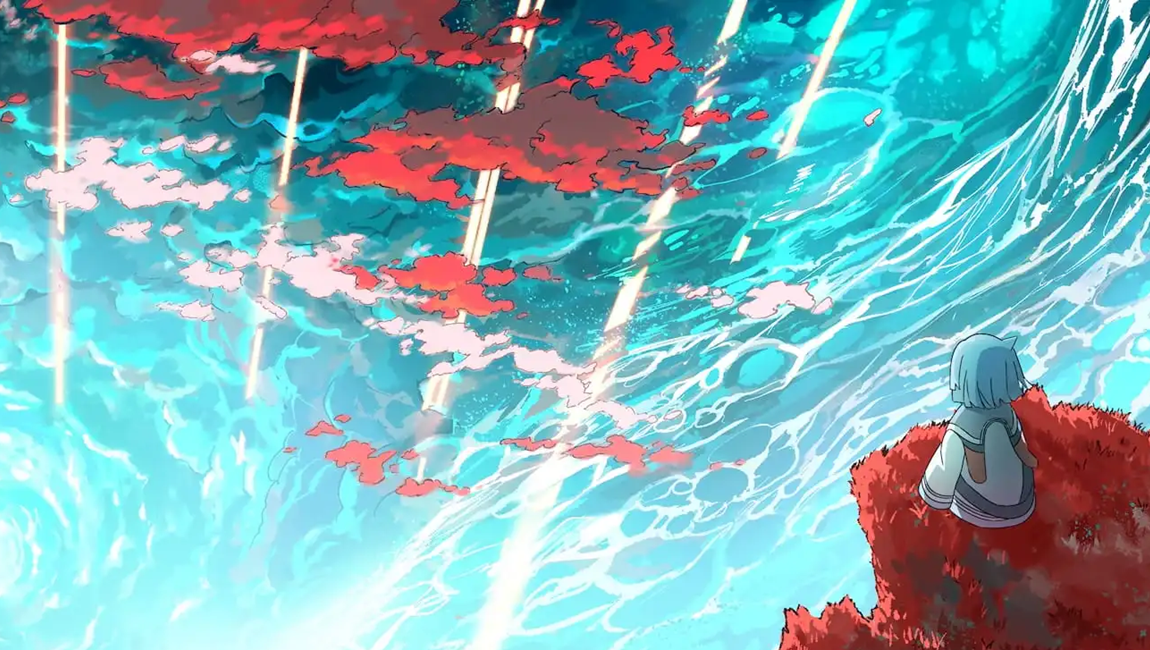
Another World offers a reprieve from Western visions of a dreary, Catholic purgatory. “Another World” — both the film’s title and its proper name for the place we go between death and reincarnation — is something of a psychedelic Eden. As dead souls wander its lush, red grasses toward the next life, they might see waterfalls cascading from ice mountains, trees that blush like giant roses, spiraling structures that spread into the sky like DNA helices. Those sleepwalking ghosts are also likely to cross paths with Soul Keepers, impishly aloof specters who usher the dead into their new paths back down on earth. Another World can often feel like a beatific twist on Tibetan theology, a vision of a liminal afterlife that almost reaches nirvana in its own right. Or it would be if it weren’t for the evils lurking in the world below.
It’s a high-concept, endlessly complicated premise that has already paid off in spades. Tommy Ng Kai Cheung’s anime, an adaptation of Naka Saijō’s novel Thousand Year Ghost, was both the highest-grossing movie out of Hong Kong in 2025 and the highest-grossing Hong Kong animated feature of all time. That’s impressive in a vacuum; even more so considering Another World’s asynchronous, thousand-armed plot, a ruleset that demands a pad and pen to keep up, and acute splashes of gore that betray its otherwise Studio Ghibli–friendly sensibilities.
As Another World prepares for global distribution, it’s tempting to wonder whether Western audiences will share the appetite and patience of its hometown audience. They’d do well to give it a shot: under a web of diversions and contradictions, Another World offers a touching examination of generational abuse and redemption, resentments kept and released, the cyclical evils of man, and the duties of those that keep after our souls.
Among those Soul Keepers is Gudo (Chung Suet Ying), a tiny, porcelain-masked being who processes the dead as if they were Excel sheets at a temp job. Another World’s story and execution can be dizzyingly complex, but Gudo’s job is simple enough. He works under the benevolent Goddess Mira (Kay Tse), who works with other goddesses to untangle knots in the ropelike remnants of souls left behind by ghosts as they enter their next lives. Those knots are formed by unresolved resentments from the last life; too many knots, and a seed of evil will form and be carried into the reincarnated body. If that seed blooms, the human will turn into a Wrath: a horned monster who wreaks death in our world and the next. Simple, right?
Another World’s plot is as knotty as an unresolved resentment, and even at 112 minutes, Cheung’s film can feel dense enough to require another installment. Gudo’s impassivity toward life and death is challenged by Yuri (Choi Hiu Tung), a young girl who enters Another World after dying in poverty. Yuri wanders the utopic Bardo in a daze, calling out in search of her brother, who’s either passed on to the next side or remains among the living. Gudo’s mask functions as a preinstalled poker face, but it seems he takes up Yuri’s cause under a compulsion somewhere between idle curiosity and civic duty. Spending time with Yuri unlocks a deep, sprawling connection between Gudo and the land of the living, a thousand-year journey that spans 10th-century China to World War I Germany.
Gudo’s emotional tabula rasa allows Another World to focus on the humans he follows in the living world, as well as their heartbreaks, tragedies, and subsequent downfalls. Gudo watches as a princess falls into bitterness after her father is usurped and killed; hundreds of years later, a villager turns violent after that spoiled kingdom hoards food from its peoples. Later still, hungry children tear each other apart in between grueling shifts in an Industrial Age factory. Another World careens in and out of these worlds with little warning or context, and the transitions can be jarring — especially while still trying to parse how many knots of resentment add up to a seed of evil.
It’s a calculated risk. Cheung’s refusal to hold hands can feel alienating, but as Another World reveals itself, it also reveals a careful study of the ways abuse and resentment coil and cycle through centuries of generations. The movie is rooted in Buddhist theology, but you don’t need to subscribe to a particular dogma to appreciate its vantage. Here, pain and forgiveness have immense political fallout, but their seeds are buried in the personal: a missing brother, a hungry child, a father scorned.
Another World is so serenely rendered that its moments of violence — explosions of blood and gore with barely a whisper of a warning — are as painful as if they were inflicted upon a family member. Cheung scored funding for his feature with an innovative 2019 short that animated hand-drawn watercolors using a 3D skeletal system; Another World pulls the same levers to dazzling results. Worlds both living and dead are as lush as a cherished picture book, but it’s in the character design that the film’s handcrafted valor hits its mark (even when those characters meet their tragic fates). Yuri’s eyes — two scribbled dots with the grain and texture of a colored pencil — blink with enough affection to convert the most cynical viewer into their very own Gudo. To see those eyes manifest in a princess, a villager, a factory urchin, all with Gudo’s hungry ghost in the wings, is to see Another World spread itself into the heavens.
DIRECTOR: Tommy Ng Kai Cheung; CAST: Chung Suet-Ying, Christy Choi Hiu-Tung, Louis Cheung, Kay Tse On-Kei; DISTRIBUTOR: GKIDS; IN THEATERS: June 5; RUNTIME: 1 hr. 52 min.
Comments are closed.