
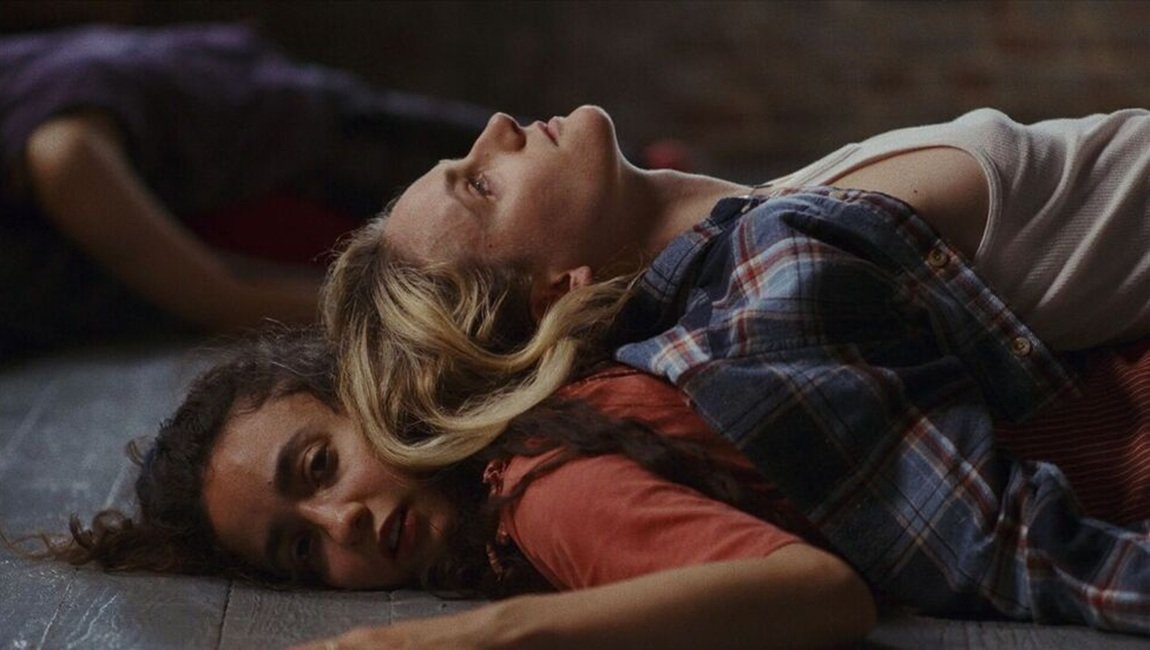
There is a small but fascinating subset of filmmaking that we could call the “intentional community movie.” These films involve a small cadre of performers who are isolated from the larger world in order to intensively explore some niche interest, and part of the works’ dramatic organization relies on the fact that the ordinary rules of social behavior are temporarily suspended and a new, usually quite explicit set of rules is adopted. This offers the characters an unusual permission structure, wherein some very specific element of human activity — art, sex, trauma — becomes the primary focus of nearly all the action.
Most such films occupy a Venn diagram intersection between the cult film (e.g., Sean Durkin’s Martha Marcy May Marlene, or the second part of Louise Weard’s Castration Movie) and the traditional sleepaway-camp horror film. Violence is usually restricted to the emotional level, and the participants, despite their fragile psychologies, are not under duress and can leave the scenario behind at any time they choose. Some clear examples of the intentional community film include Josephine Decker’s Madeline’s Madeline, Nathan Silver’s Stinking Heaven, and Denis Côté’s That Kind of Summer. The most extreme example of this tendency may be Leigh Ledare’s The Task, in which a group of participants spends two hours of screen time articulating the conditions under which they are able to make verbal interventions into the community itself.
But of the granddaddy of this type of filmmaking is Jacques Rivette, whose career-long fascination with closed theatrical experiments achieved its pinnacle with the legendary Out 1. The structure of rehearsal and performance in these films could be said to reflect an attempt to enact the traditional notion of aesthetic creation within a sociological collective. This produces complications, since the aesthetic act, conceived from Kant and Burke up through Adorno, entails a mental and even physical separation from the concerns of the everyday world. This retreat is typically solitary, and so the collectivity of art camps is in part intended to disrupt that creative isolation and instead make it the basis for shared experience. The fundamental contradiction of all this is precisely the point, a way to turn creation outward and open the psyche to the desires and demands of the other.
Tori Lancaster’s debut film Mother Future Self takes place at an intensive dance/movement seminar situated in a remote corner of rural Maine. We see numerous classes and exercises conducted by Colleen, who is played by K.J. Holmes, an actual movement artist and teacher. An acolyte of experimental dance pioneers Steve Paxton and Simone Forti, Holmes treats bodies as both extensions of and disruptions of space, encouraging her students to become attuned to themselves and one another as embodied beings, using that practical research as the basis for further creative expression.
Prior to writing and directing Mother Future Self, Lancaster has worked as an art director and production designer on such films as Exhibiting Forgiveness, The Miseducation of Cameron Post, and the notorious Dimes Square farce Actors, directed by Mother cast member Betsey Brown. The essential subject matter of Mother Future Self seems to be a logical extension of Lancaster’s previous film work in that it is object-centered, concerned with the distribution of bodies and matter arranged in space before a camera. At the start of Holmes’ first meeting of the seminar participants, she refers to having asked them to bring a “seed,” some object or concept that will serve as the starting point for their movement composition, and this shows an intellectual continuity with the likes of Paxton, Forti, Tricia Brown, Yvonne Rainer, and other dance artists who aimed to replace virtuosity with a more mindful form of vernacular, task-based movement.
While all of this could be seen as merely the backdrop for Mother Future Self’s dramatic action, it makes more sense to see it as that action’s container, establishing a set of alternative practices that allow certain dramatic actions to come forth. The two main characters of the film are Sofi (Imani Jade Powers) and Jordan (Brown), former best friends from college who have not been in contact for eight years. Sofi is a coordinator for the seminar, Jordan a participant, and neither knew the other would be there. Much of Mother’s tension emerges from the unusual circumstances of this reunion: the fact that Sofi and Jordan cannot simply have a chat to make up for lost time, but instead are thrust into various situations of physical intimacy — exploring each other’s feet, moving their backs against each other in tandem, mirroring movements — that transpire in a semi-public arena.
The conditions within the seminar retreat are both heightened and relaxed. The focus on mindfulness and the intricacies of proprioception lends itself to a somewhat different set of social rules. Jordan casually reveals secrets of Sofi’s past, having to do with her mental and physical health, in group settings. Jordan asks after the fact if the disclosure was okay, and Sofi, attempting to maintain the spirit of openness, waves these disclosures away as being no big deal.
Above all, Mother Future Self explores the thin line between self and performance, the way that our identities shift and mutate to accommodate the rules, explicit or otherwise, that govern interaction within a particular social space. Lancaster seems to adopt an uncertain attitude toward the crucible of the creative seminar, since the breaking down of traditional boundaries is presumably what the participants signed on for. Should the ego dissolve completely, this may indeed loosen one’s inhibitions and establish the ground for radical creation. What happens after the final performance is another matter entirely.
Comments are closed.