
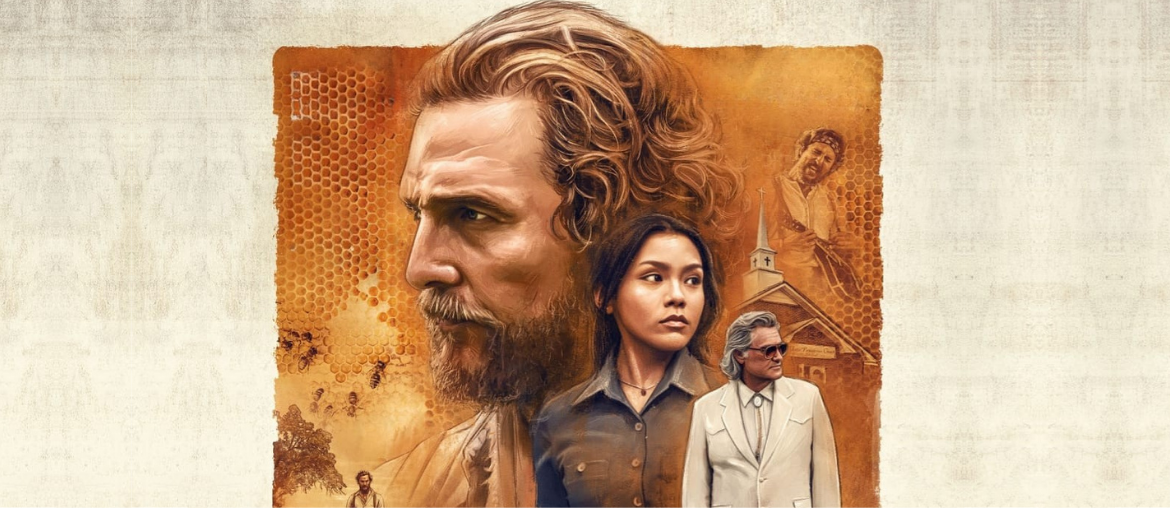
Flitting across genres from musical to beekeeping drama to heist movie to revenge thriller, yet rooted in the culture, ways of life, and eccentricities of rural Oklahoma — director Andrew Patterson’s home territory — The Rivals of Amziah King emerges as one of this year’s most original and inventive films. Its amber tones not only evoke the honey processing plant at the center of its narrative, its operations filmed in intricate, well-researched detail, but also the warmth of close-knit community life. When beekeeper and bluegrass musician Amziah King (a charming Matthew McConaughey) is roped into investigating a major honey-thieving racket, he ends up reconnecting with his former foster daughter Kateri (Angelina LookingGlass). Soon, Amziah’s own hives are plundered, and the young Kateri’s plan to rescue the business begins to double as an unnerving plot to exact revenge.
In The Rivals of Amziah King, moments of jolting violence co-exist alongside those of great tenderness. Patterson exhibits a clear affection for the people whose oddities are on display, and an empathy for the hardships they endure. Ahead of the film’s release, we spoke about shaping the character of Amziah with McConaughey, thematic similarities to his breakout debut feature The Vast of Night (2019), and how stand-up comedy influenced the film’s tonal shifts.
Gayle Sequeira: I’d read that you originally planned to make this as a miniseries. What made you realize it was better suited to the feature film format, and what was the process of reshaping it like?
Andrew Patterson: Let me get the record straight on that and tell you how it played out. I’d written a script in 2018 called The Rivals of Amziah King, which was 110 pages long. I was ready to make that as a feature. But then the film I’d shot before that, The Vast of Night, started getting into festivals, and that very quickly became my full-time job — taking that movie around the world and planning to put it into cinemas. Then COVID hit, and the film was put on streaming. I didn’t want to shoot another movie during the pandemic because production spaces are sanctuaries to me, and getting close to the people I work with is important. So social distancing wasn’t going to work. Instead, I wrote a lot and I wanted to see where I could go with The Rivals Of Amziah King, if I just let my imagination loose. The first version was written before I had any introduction into the film industry. For the second, I ended up writing seven chapters, or 360 pages. So it looked exactly like what you’re describing — a miniseries — which only existed in that format for a few months before I went, “I’m not making TV out of this.” So I truncated that down to 220 pages and then 140 pages before taking it to my producer and telling him I was going to make this movie. Amziah’s third iteration felt like adapting my own novel into a film.
That whole process was the greatest thing that could’ve happened to this movie because things that were never in the first version came through in the second and third. What you got in Amziah the Second that wasn’t in the first were characters like Remmick (Jake Horowitz) and Colmar (Tony Revolori). You get the swarming operation at the school. You get a sequence in which Kateri and Remmick have to steal back the honey and float it down the river. But there was never a point where it was going to be put together to end up on a streamer. That would’ve been the wrong place for it.
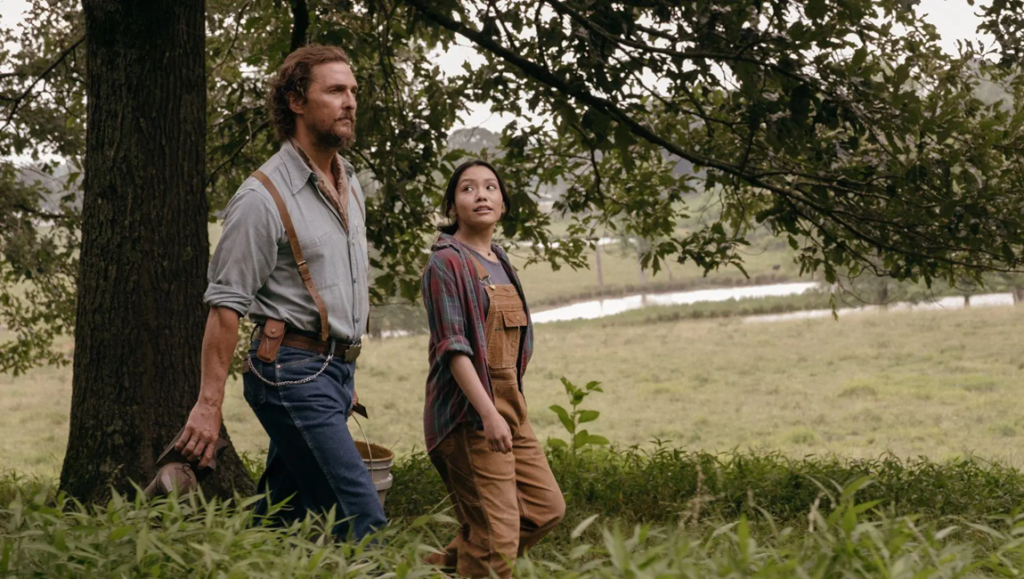
GS: The film is very much its own thing — I can’t think of the last movie I saw that goes from a tender film about family and community to a thoroughly researched depiction of the beekeeping industry to a heist movie to an agricultural revenge plot by the end. But were there any films you drew on as a reference?
AP: The more specific a movie is, the more oddly universal it becomes in a way. You still have to know how to tell a story that’s unique and to build protagonists that have human qualities. There were movies [I drew on], but it was more stories and things I’d seen work in the past. I don’t just study film — I’ve watched stand-up comedians change tones within three minutes and go from uproarious laughter to devastating narratives to personal confessions back to uproarious laughter. I’ve been at concerts where 20,000 people have gone from pumping their fists and yelling the same song to the entire stadium just going quiet when the performer starts talking about loss or a political issue. It’s a whole tonal shift. I’ve been to funerals where people have been memorialized with laughter, tears, pain, and joy. So when I write a script, I try to look for the honesty of all of those things, and I then try to interplay them with each other in a way that will work for my intended audience. I don’t expect it to work for everybody. If it did, I would know I failed as a creative because I would’ve made something too palatable, and my instincts about storytelling, the characters’ irreverence, their personalities, the things I like to have them say — all these would’ve been suppressed.
I’m hoping certain people adore the movie. I’m positive that a lot of people will have issues with it. That’s cool, because now I’ve created a debate. The movies that I’ve gone back and watched the most are those that a lot of people have loved, but that just didn’t work for me — I try to figure out what the creative did that was so special to millions of people and why I, someone who walked out of the same theatre, didn’t have the same experience they did. With Amziah, I wasn’t really thinking of jumping tones all the time or taking wild, crazy swings with the narrative. I just wanted to make something humane, something universal, and something new to cinema in terms of the location. And then I had to narratively thread all the feelings that I’ve experienced in different parts of life.
GS: Amziah is tonally different from your previous film, The Vast of Night, which is a sci-fi mystery, though I do see similarities between them. They’re both about characters up against something so much larger than they are — in this case, Kateri attempting to take down a powerful and corrupt businessman — by initiating an investigation and connecting the dots themselves. They’re also both films about storytelling.
AP: There’s always going to be themes and things that a creator will chase after, and similarities in terms of how they direct. I’ve noticed that a lot of the time, my dialogue has the same rhythms. I hadn’t picked up on the theme you pointed out — that both my movies are about people up against things way bigger than themselves. I’m surprised that I hadn’t realized that about my own work. The thing that I can see is that they’re both about communities of people. I don’t know that I ever set out to explore the same themes. I hope that you get into a parallel existence that’s nothing like yours and you’re connecting to a truth within that feels similar or at least relatable to your part of the world or your upbringing. It’s about protecting that honesty, whether in a performance or in the edit. If you have a wrong music cue under a scene, you can ruin the scene. If you linger on somebody’s performance too long, you can lose interest.
GS: This is Matthew McConaughey’s first film in six years. What were your initial conversations about the film like, and what did he bring to the character that wasn’t in the script?
AP: It wasn’t so much a pitch because he ended up reading a finished script. A lot of what he responded to was the language of the character and the irreverence that Amziah embodied. He joked with me that there was preaching in the script that didn’t look like preaching. And what he meant was that there were themes, ideas, and points of view about the world that Amziah shared that were essentially his beliefs about life and culture. He loved the moments in which Amizah describes how important a community is, and how important it is to rebuild. He also responded to how Amziah teases certain characters — and almost lambasts them in some scenes — but then also turns right on a dime and talks about why they matter to the community. The process was then making sure he understood how I was going to direct it, and I got him to understand what I expected from the role. We wanted to ensure we were all making the same movie. It was a six-month-long process — from the time he read the script to the time he got off set — that got us the result you’re seeing.
GS: How do you prepare him and your other actors for working with and handling bees?
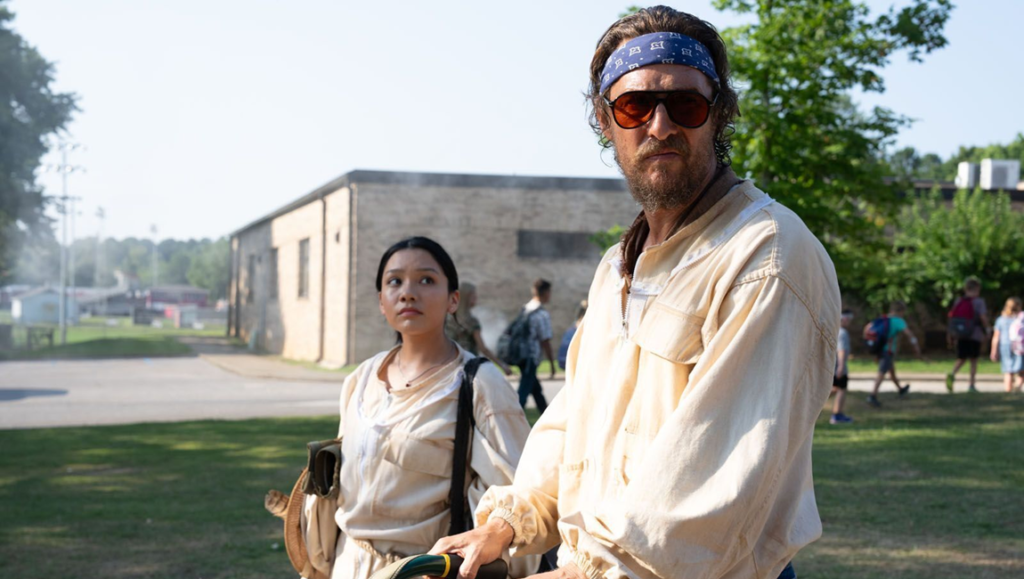
AP: You just throw ’em in there [Laughs]. No, I’m serious. They’re not beekeepers. You tell them the truth, which is, “The bees aren’t going to sting you; they’re not going to come after you. They don’t care about you. We have about 40 minutes to get the shot, so let’s get the hive open and let’s pull a queen out and see if we can get the other bees to follow her.” But the actors knew what the film involved going into it. It’s not like I cast either Matthew or Angelina without knowing they were willing to be in front of, around, and in the middle of those hives.
GS: There are two scenes I’d like to talk to you about specifically. The first is when Kateri makes the split-second decision to cause a fraudster’s death by trapping him in a high-temperature room. She even turns up the heat. You cut from his frantic banging on the door to her outside, almost stoic. As she’s steadily losing her humanity, you later include a scene that humanizes Dob McCoy (Kurt Russell) — a cruel industrialist who’s destroyed several local businesses — by showing him caring for his sick wife.
AP: Kateri’s a pretty unsuspecting antihero in this movie. Anybody that knows almost anything about American history knows that first, we had a slave trade that went on for far too long, and second, that we were not good to the Natives. But what you see in a lot of stories are antiheroes who look nothing like the Indigenous young woman that Kateri is. Those protagonists — who are badass or who pass off as people allowed to engage in righteous retribution — are White men. I was interested in writing and directing a movie about somebody on the warpath, but I always knew the protagonist was going to be a young woman who would use her intellect and her knowledge of the agrarian world to exact her revenge. I wanted her to be able to do those things in ways such that nobody would suspect her, almost to the point where she becomes, if not cocky, then confident about not getting caught. She knows that even if law enforcement knows what she’s doing, they’ll still be like, “Okay, young lady, you cleaned out my town. Now don’t do it again.”
With McCoy, there’s a line Amziah says about the bees: “They’re not all bad or all good. It depends on a lot of things — if they’re hot, hungry, cold, young, old.” Even in my writing of the antagonist, I still wanted there to be parts of him that were good. Audiences can handle a character who is evil to one group and then compassionate to another. So rather than just make him a caricature of evil and someone who only preys on the community, he gets a moment where you can see that at least in this one specific context, he’s not the worst person. In that same scene, you start to see that if his wife’s not around forever, that might actually be a merciful thing.
GS: There are several sequences in which Amizah and his musician friends just sit around playing bluegrass songs that are so joyous and rousing. What went into crafting those?
AP: Even when I was writing the script, there was a musical element as early as page five. I ended up finding the character through music, because Amziah is someone who wants to share his love of music with his community. I usually write with music playing, headphones in. I block out the world. I’m not a fan of musicals or song-and-dance, though. If a musical is the goal of a movie, there’s a terrible script underneath that. So I was trying to infuse a proper script — this narrative that had developed characters and strong dialogue and unique turns — with music that would help change directions or convey a sense of irreverence. There’s a whole song that starts by talking about how an investigation to find a marking inside a barrel has led to nothing — sung in a tone that makes fun of the situation — and it ends with Amziah reconnecting with his foster daughter after years, all within a minute-and-a-half. These are things the music let me do that I wouldn’t have been able to otherwise, and it ended up becoming a defining feature of the script.
[Spoilers ahead.]
GS: Tell me about conceptualizing the accident sequence at the end, when McCoy attempts to evade the police and winds up driving right into the path of an incoming train. It doesn’t end there — he escapes unharmed, but steals a truck so he can get away. A second chase sequence ensues, with him eventually being shot dead by that vehicle’s furious owner.
AP: That came to me when I realized that rather than account for his sins, McCoy would rather do anything else. He’d rather evade the cops and move on with his life in another country, just as long as he doesn’t have to pay for anything he’s done. There’s a motif that runs throughout the film — whenever McCoy’s on screen, there’s a train sound in the background. It’s like he’s on a trajectory to be hit by a train.
We were able to take a real train and run it a mile up and down a track. Through movie magic, we were able to smash a truck with a giant piece of concrete several times, destroy it, and flip it over. And we then married the two sequences together. It takes some real ingenuity to do that because you can’t do anything that will actually damage a train track. So it was a lot of prep, a really good crew, and a strong VFX team. And at the end, when McCoy gets shot by the locals — that’s what the world is like where I live. There’s a certain code out there. Good luck if you try to steal something out from under hardworking individuals. He might’ve gotten away with stealing bees and preying on the community. He might’ve even gotten away with getting on a plane and flying off to another country. But he wasn’t going to get away with stealing a man’s truck.
Comments are closed.