
In a video doing the rounds from the red carpet premiere of Klara and the Sun, an interviewer asks director Taika Waititi what it’s like bringing a movie about artificial intelligence into today’s world. Waititi, entirely against character, adopts the considered demeanor of a politician delivering a carefully rehearsed denial. The film, he explains, was conceived and shot years ago, before AI was even part of the conversation. “So this was never a film about AI or about the threat of AI. It was always a film about an outsider coming into a broken family and trying to put them together again. And, um…” Waititi trails off, pauses, before falling back on an inevitable what-can-you-do-about-it smirk. “Kind of like E.T.”
There’s something a little tragic here. Waititi, having followed his Oscar-winning Jojo Rabbit with two megaflops, has seen his former king-of-quirk status curdle into universal cringe at his brand of twee irreverence. Now he finds himself forced into the humiliation ritual of reciting lines about how his AI film is, in fact, not about AI, because in the years since it was greenlit the ground has shifted so seismically that the premise “E.T. with robots” is dead on arrival. Then again, it’s hard to feel too sorry for Waititi, who has spent his last pennies of goodwill (and $20 million) on a pile of crap.
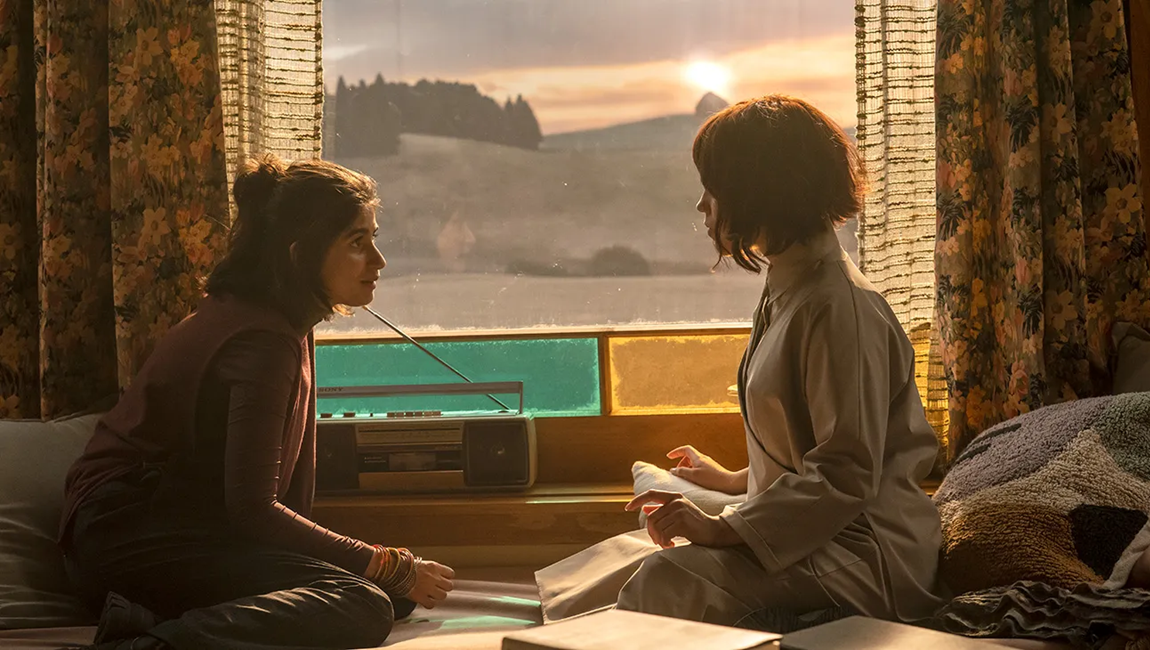
The film is adapted from Kazuo Ishiguro’s lauded 2021 novel, and the setup remains mostly the same. Klara (Jenna Ortega) is a solar-powered android, designed to serve as an Artificial Friend to the children of wealthy parents. She is chosen by teenaged Josie (Mia Tharia), who, on account of her privileged upbringing, has recently been genetically modified to vastly improve her cognitive abilities. At first, the naïve Klara seems to have found her dream home, but cracks soon begin to show. Josie’s mother, Chrissie (Amy Adams), is distant, still mourning the death of her other daughter. And Josie herself is unwell, prone to fits and long periods confined to bed.
Where the film diverges most significantly from the novel is in its decision to undercut almost everything with Waititi’s blunt comedy. Ishiguro’s novel is told from Klara’s perspective, offering all the strangeness of seeing the world through an android’s eyes. At one point, Klara becomes fixated on what she calls the Cootings Machine, an industrial contraption whose thick fumes obscure the light of her beloved Sun. In the novel, it becomes a genuine source of anxiety, filtered through Klara’s coolly detached but charmingly idiosyncratic understanding of the world. Waititi, by contrast, can only approach it with ironic distance, honing in on the absurdity of Klara’s combination of limited perspective and enlarged empathy.
And so the film lurches between tonal registers, filtering grim subject matter — its dystopian-lite setting, Josie’s illness, Chrissie’s depression, Klara’s subjugation — through the child-friendly comic sensibility of Waititi’s earlier features, then abruptly swinging toward the seriousness of an adult domestic drama, before snapping back into demented whimsy. The effect becomes harder and harder to take as the film piles on increasingly insistent appeals to sentiment.
Klara and the Sun is at its most interesting when it draws a connection between artificial intelligence and the art of acting and impersonation. Klara is an extraordinarily capable mimic, able to synthesize the voices and reproduce the mannerisms of those she meets with uncanny accuracy. In one scene, Josie’s mother, acutely aware that she may be about to lose another daughter to illness, demands of Klara an impersonation of Josie — an impersonation that enchants and then repulses her. It’s one of the few moments in which Waititi makes genuinely effective use of Ortega’s acting ability, rather than reducing her to the cartoonish mugging that dominates the rest of the film.
If Ortega’s facial gymnastics are in one sense merely the default acting style of a Waititi film, they also serve to show that Klara is, to borrow a phrase from Blade Runner, “more human than human.” (Amy Adams, by contrast, is barely trying.) The sympathetic, marginalized AI has become a staple of modern science fiction, with its apparent humanity often used to probe the limits of our own empathy. Waititi, however, is less interested in the philosophical ramifications of artificial intelligence than in exploiting Ortega’s alt-girl icon status to exalt the figure of the quirky outsider. “People don’t want different, they want normal,” a fellow robot scolds Klara toward the beginning of the film, and you can already see the sort of pat messaging we’re heading toward.
A few decades ago, a film like Spielberg’s A.I. Artificial Intelligence could treat its robo-boy as a fairy-tale figure: a Pinocchio for the age of machines, whose longing to become human remained safely within the realm of fantasy. In the years since Ishiguro’s novel, however, the proliferation of “real” AI in our everyday lives — and the accompanying backlash, not least within the film industry — has given this sort of story a very different feel. Waititi can protest all he likes that this isn’t a film about AI, but that is inevitably how it will be received. And in that context, the cozy reassurances offered by the end of Klara and the Sun feel woefully ill-equipped to address the anxieties that now surround the technology. Can this once-reliable sci-fi figure survive the arrival of the real thing?
CREDIT: Taika Waititi; CAST: Jenna Ortega, Mia Tharia, Amy Adams, Natasha Lyonne, Rachel House; DISTRIBUTOR: Sony Pictures Releasing; IN THEATERS: October 23; RUNTIME: 1 hr. 56 min.
Comments are closed.