
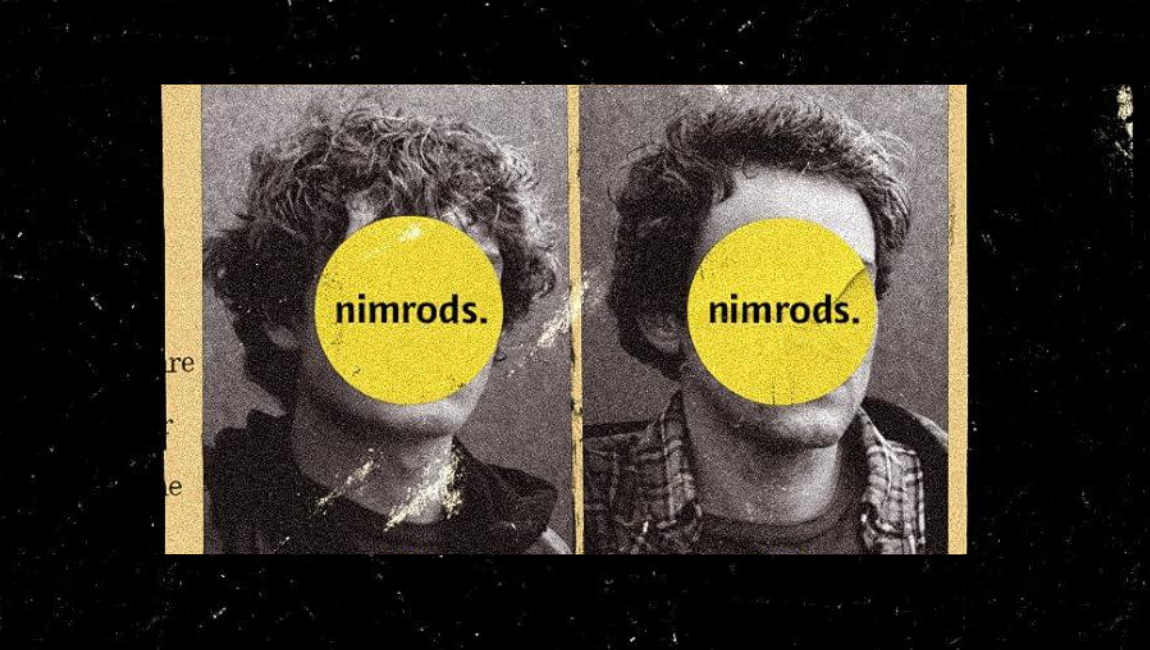
Marketed as “a Green Day comedy,” Lee Kirk’s newest film, Nimrods, could more fittingly be described as specious or surprisingly inept. Or, it could be called intriguing, but only because of how idiosyncratic its surface appears relative to the shallowness of its waters. As promised, the film pays its due to Green Day, though the punk power trio is hardly in it. They did, however, produce the film and devise the story from which Kirk’s screenplay originates, which substitutes Billie Joe, Mike, and Tré for an adolescent rock band named “The Analog Dogs,” following them during a cross-country journey. Among the band members are lead singer Tommy (Mason Thames), guitarist Fred (Kylr Coffman), and drummer Chad (Ryan Foust). The impetus for the trip: a record store Green Day meet-and-greet and ensuing phone call from Tré Cool, who invites the impish teenagers to open for Green Day on New Year’s Eve in Los Angeles. The trick is, though, that the phone call is merely a prank played by Tommy’s older brother, portrayed by newcomer and son of Mark Ruffalo, Keen Ruffalo.
This premise — or more pointedly, how distinct it is from the contemporary formula for films based on culturally renowned musicians — is perhaps why Nimrods is so superficially captivating. On one hand, Kirk’s iconoclastic attempt to sidestep the hackneyed musical biopic of today by forcing his chosen showmen to the periphery is commendable, with the director instead turning his focus to a group of starry-eyed youngsters. At the very least, this approach seems a more organic use of Green Day’s discography and assumes less responsibility for cinema being used as a record advertisement. But on the other hand, what remains front and center in Nimrods is just as derivative as any biopic made in the last decade.
The title sequence itself suggests something out of a 2000s teen comedy: the camera pans down a bustling high school hallway and halts at the word “Nimrods” scribbled onto the wall atop a locker. The following scenes — those preceding the road trip — are more or less complete cinematic tedium. Kirk valiantly attempts to give his main character and band leader, Tommy, some emotional backbone by composing a few schmaltzy moments with his mother — played by The Office alum Jenna Fischer, in a particularly kitschy performance — in which the pair bond over their shared grief regarding the recent loss of Tommy’s father, but little genuine emotion comes to pass.
What follows during their journey to L.A., as one could imagine based on the description thus far, is an overstuffed mélange of road-movie signifiers, including but not limited to: the band’s car breaking down because of a mixup between regular and diesel gas; a free replacement vehicle that happens to be a battered ice cream truck; a psychedelic trip; a stop in a small town to party and meet a girl (played by McKenna Grace, in her second role opposite Thames); an escape from a creepy motel manager (played nicely by Fred Armisen); a band break-up; a band reunion. Kirk takes an idealistic approach to transposing the slackerism of a ‘90s Linklater film to modern times, but his indolent teens are such incredible posers that the entire ordeal seems a naive undertaking for its director. Take, for example, a shortage of cash early on in the trip, from which a thousand or so interesting narrative avenues could spring. But no, these boys have a credit card for “emergencies,” and the fear — and ultimately, the potential for more — is short-lived. In a particularly obvious moment, Tommy scolds the dorkish member of the band, Chad, for arriving early to rehearsal, proclaiming that to be punk, one must break every rule in the book. Even their name — the Analog Dogs (which is a victim of a tired gag wherein the band is referred to as the “Anal Dogs” or “Anal OG Dogs”) — assumes a certain adolescent nostalgia for another time, a time that, more often than not, Kirk seems to misremember.
One supposes such is the point: these young rockstars are not actually slackers or punks, but then again, they are not exactly the opposite either. With that integrative approach of dual philosophies, Kirk places so much weight upon his three stars that they crumble under it by the end, leaving them stuck between two sides of a performance spectrum: to be (trite and monotonous) or not to be (genuine and eccentric). If nothing else, Kirk’s images land somewhere between humdrum and quite interesting, utilizing camcorder footage for portions of the road trip scenes, which adds a nice flavor and texture to what is otherwise fairly routine. But the compositions — and really, the film as a whole — take a dive during the finale at Green Day’s New Year’s Eve show, which is nothing short of a scintillating concert commercial. If Nimrods’ conclusion points to anything, it’s a myriad of successes and failures that define the film, with Kirk managing to sidestep his film’s commercial pitfalls early, only to fall face-first into them later on. Of all the pedestrian concert films and biopics, it would be inaccurate to say that Nimrods is the worst, and it certainly won’t be the last. With regret, the show must go on.
DIRECTOR: Lee Kirk; CAST: Mason Thames, Ryan Foust, Kylr Coffman, McKenna Grace, Jenna Fischer; DISTRIBUTOR: Inaugural Entertainment; IN THEATERS: August 14; RUNTIME: 1 hr. 43 min.
Comments are closed.