
A nasty, ruthlessly streamlined throwback to the sleepover staples of the Reagan administration, David Robert Mitchell’s The End of Oak Street (unofficially) brings the curtain down on the summer of 2026 with a flourish. Like a feature-length episode of The Outer Limits by way of a pulpy beach read, the film starts off as one of J.J. Abrams’ famed “Mystery Box” films — Abrams’ Bad Robot produced the film — teasing out a fantastical scenario that seemingly defies all logic, only to get down to business with a premise too irresistible to get terribly hung up on. In short, what happens when a small Michigan enclave is teleported to the prehistoric era and is overrun by ferocious dinosaurs? Questions of “why” and “how” fall by the wayside in the face of the film’s primal immediacy, as the project amounts to little more than 100 minutes of “run, hide, fight” in which a fractured family must pull together simply to survive. Winningly unpretentious, the film is a pure thrill ride in the best sense; it aspires to little more than shredding your nerves and having you alternating between gasps and horrified laughter.
Set in the summer of 1982 (a halcyon time for genre films) in a suburb outside of Detroit, we meet the Pratt family as they strenuously try to enjoy themselves at a block party — but there are unmissable signs of trouble. Dad Greg (Ewan McGregor), stubbornly insists on delivering pizzas for tip money even though he claims he was recently hired back by Chrysler and hides a bottle of whisky in the garage. Meanwhile, mom Denise (Anne Hathaway, appearing in already her fourth film of the year) throws herself into the novel she’s secretly writing, which tellingly is about an unhappy woman who contemplates abandoning her family. Their teen daughter Audrey (Maisy Stella) dreams of attending Cornell to study astronomy under Carl Sagan, but knows her parents can’t afford the tuition, while her younger brother Brian (Christian Convery) is trying to avoid getting his face caved in by a local bully, though he isn’t so preoccupied that he hasn’t noticed how frequently Mom and Dad argue. Still, it’s a precious, sleepy community (wooden dog houses in the backyard, kids zipping around on bikes, accessible terraces perfect for gazing up at the stars, etc.) of the sort that harkens back to Amblin Entertainment films of yore. It’s also the perfect setting for something wondrous and terrifying to happen.
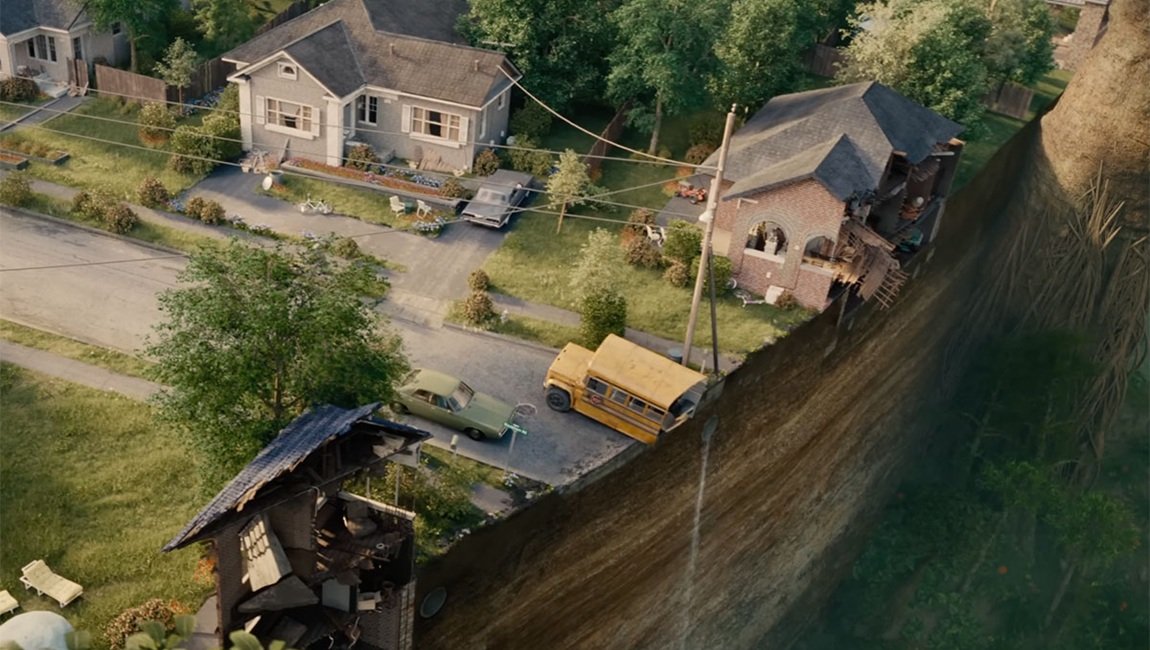
Things start small at first, relatively speaking. An inexplicable plant that we’re told went extinct millions of years ago starts growing in someone’s garden. A giant pile of excrement — one of several overt references to the Jurassic Park films — is deposited in a cranky neighbor’s backyard. But then one night, there’s a gust of wind, a blinding light, and a weird sound that makes everyone’s ears pop from the pressure change. Then the power and water go out; not just on Oak Street, but across the entire town. The Pratts can hear screams in the distance, but they tell themselves that if they lock the doors and hunker down for the evening, then everything will be back to normal in the morning. But it’s in the light of day when things start to get really strange: cars and houses are seen sliced perfectly in half (the whereabouts of their missing halves unknown), steam vents rise up from the cement, dense vegetation blocks off streets and cuts off escape, and an active volcano looms in the distance. It isn’t long before Greg, while out searching for the family dog, stumbles across a bipedal, bird-like creature — the film adheres to the current science which has argued dinosaurs may have had feathers — with razor-sharp teeth and standing taller than he is, rooting around in some trash cans. Chased through the neighborhood in his tiny shorts and mid-calf white socks (the film has fun with the leisurewear of the ’80s without overdoing it), Greg reconnects with Denise, who herself has just stumbled across the sweet old woman from the neighborhood who has had her throat torn out in her kitchen.
This stretch really does reflect Mitchell’s grand design for the film: nightmare imagery transpiring in broad daylight and indiscriminate violence visited upon nice people of the sort who don’t typically see die in these kinds of movies. Mitchell, whose 2014 breakthrough film It Follows was built out of the philosophy that a monster slowly, determinedly advancing in the distance is more unsettling than what might unexpectedly jump out at you, retains that sensibility here. Shot in scope with an emphasis on panoramic shots that allow us to survey everything happening on the street at a given time, the film plays like a perverse game of Where’s Waldo? We’re encouraged to scan the frame for some creature dragging a day player into the bushes, human corpses littering the streets being treated like carrion, or a housecat being snacked on, all while our main characters stream by in a mad dash. Death is so pervasive that it all sails past numbing and takes on a darkly comedic quality. It really does become one thing after another.
There’s an almost adolescent quality to the way The End of Oak Street carries itself, recalling the impish malevolence of Gremlins and Poltergeist. Mitchell’s personal imprint may be limited to the film’s Michigan setting and a fondness for the ephemera and latchkey insouciance of Gen X, but he demonstrates a real knack for staging set pieces that blend practical and visual effects. The film creates the appearance of reasonably convincing dinosaurs — especially considering how the film often declines to hide them in shadows — interacting with his actors, exploiting the disconnect of, say, a T-Rex in a small garage, to superlative effect. Scenes are designed to emphasize something moving from the background to the foreground, often with our characters utterly oblivious to the creature about to pounce upon them (a scene where a giant predator tries to sneak up behind the Pratts recalls a popular internet meme involving Jason Momoa tackling Henry Cavill at a film premiere). Using what one assumes is a lot of smart greenscreen and composite work, Mitchell stages action scenes on a 360° axis where our characters run from a giant dinosaur galloping after them, only for the camera to stop on a dime and chase the actors going in the opposite direction within what appears to be the same shot. It’s an anticipatory approach to horror, with the audience usually a few seconds ahead of the characters, encouraging viewers to squirm in their seats while stifling the urge to yell out “look behind you!”
As to be expected from all this description, the influence of Steven Spielberg is all over the film; however, it’s the sadistic version of the filmmaker who would revel in building out elaborate set pieces that seem to exist solely to traumatize small children (more Temple of Doom than E.T.). A scene where we track a dinosaur concealed behind a tall fence, with a laundry line being yanked to the ground serving as a marker of its advances, feels especially indebted to the filmmaker’s visual sensibilities and innate showmanship. But whereas Spielberg could often be counted on to pull up just before things get too unpleasant, Mitchell has no such compunction. The End of Oak Street marvelously shifts tones on a dime, segueing from elation to crushing despair in the blink of an eye (or the snapping of a powerful jaw). The film will likely test some viewers’ capacity for maliciousness as Mitchell has devised sequences in the film which exist almost solely to torment the characters and see them suffer (a scene where Convery’s character needs to jump from a rooftop to a tree below for a plot-specific reason is teased out like a live-action version of Lucy holding the football for Charlie Brown). It’s the sort of film where one of the kids pisses their pants after barely surviving a dinosaur encounter, and Mitchell doesn’t feel compelled to call attention to it via the dialogue or a reaction shot. It’s just treated as a completely natural response to living through this hellscape.
And yet, the film never feels oppressively dark. Mitchell recognizes the value of incorporating levity and undermining the seriousness of the situation to allow the audience a chance to laugh or catch its breath. In one example, an instance of spousal bonding and tentative reconciliation is set against a backdrop of two several-story-tall dinosaurs having sex with one another against the side of a house. Elsewhere, an especially intense scene involves a snake the width of a car and the length of a football field silently slithering from one floor of a house to another. The film even invites the viewer to contemplate the question “What is the best way to drive around dozens of giant prehistoric turtles?” And then there’s Mitchell’s extensive use of split-diopter shots (functioning here the way lens flares do in Abrams’ films), which literally flatten out the film’s more intimate scenes. That even extends to a burgeoning sapphic romance that finds Audrey tending to the superficial injuries of the homeschooled girl on the block in almost leering extreme close-up.
But the savviest thing about The End of Oak Street is that it doesn’t overstay its welcome or become mired in the need to explain itself more than it absolutely has to. There is somewhat of an explanation for what’s going on here — there are offhand allusions to solar anomalies, and all those initial mentions of Carl Sagan aren’t a coincidence — but the characters themselves barely care beyond the immediacy of the moment — and frankly, neither should the viewer. One can infer where pages of scientific gobbledygook may have been viciously excised from the film, sacrificing clarity for expedience, and it’s all the better for it. The audience is more or less in the same position as the characters, constantly guessing where the story will take us next and keeping our focus where it belongs. Scary dinosaurs rampaging across suburbia; what do you need, a roadmap?
DIRECTOR: David Robert Mitchell; CAST: Anne Hathaway, Ewan McGregor, Christian Convery, Maisy Stella, Chris Coy; DISTRIBUTOR: Warner Bros. Pictures; IN THEATERS: August 14; RUNTIME: 1 hr. 39 min.
Comments are closed.