
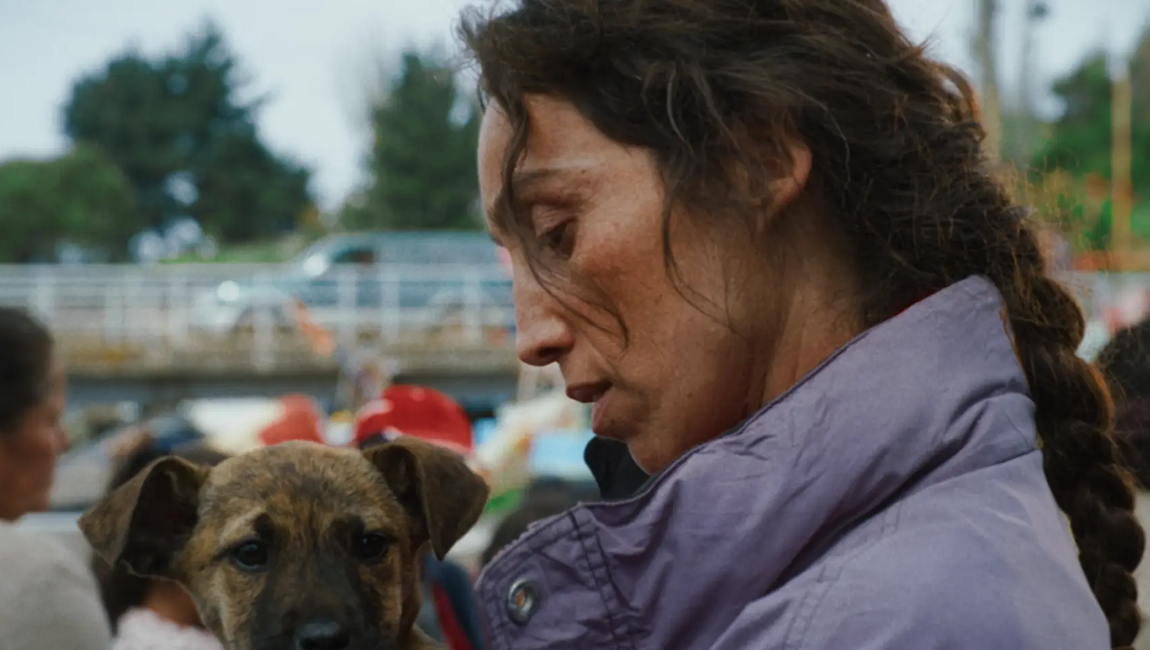
Watching La Perra, the new film from Dominga Sotomayor, one may be reminded of those pet adoption bumper stickers that read “who rescued who?” In the case of Silvia (Manuela Oyarzún) and her dog Yuri (playing herself), the answer is a bit of a wash. No one saved anyone here, but then again, that would have been a very tall order under the circumstances. La Perra is a story about trauma and control, and Sotomayor explores these issues within a rather Freudian frame. In the psychoanalytic analysis of trauma, the injured party often unconsciously creates the opportunity to restage their primal hurt, in the hopes of making it better the next time. As La Perra demonstrates quite frankly, this seldom works out.
Silvia is a middle-aged woman with a severe demeanor. She harvests kelp for a living, wading out to sea and pulling in the seaweed to dry and sell. She has a boyfriend of sorts, but she seems to keep him at arm’s length. In the film’s first scene, we see a young dog being pulled out of the ocean by fishermen, and before too long, Silvia has adopted the pup. We can witness Yuri softening Silvia’s hard edges in almost real time, and things seem to be going great — until Yuri goes missing during a storm. Silvia is understandably distraught, but when Yuri suddenly reappears, it is not the joyous reunion a viewer might expect.
Another Freudian concept becomes useful here. Freud described the “fort/da” game as a way that an infant enacts minimal control over their existence. The baby throws a toy on a string, then drags it back, in order to master the pain of absence. The toy is a stand-in for the mother, who scares the child because she has the ability to leave, something the baby cannot control. Silvia, too, is trying to overcome her own childhood trauma through her relationship with Yuri, but it doesn’t work the way she wants it to. So she locks Yuri up; the dog tunnels out of the house, and at that point, Silvia appears to give up on the dog completely. Silvia, you see, wants to do the leaving, not be the one who’s left.
This film is quite a bit darker than the films that put Sotomayor on the map. Where Thursday Till Sunday (2012) and Too Late to Die Young (2018) were driven by familial complications, La Perra is essentially a one-and-a-half-hander, with all of Silvia’s human relationships taking a backseat to her neurotic embrasure and rejection of the dog. The film is irritating in an almost admirable way. It focuses on a rather unlikeable protagonist and has long, glowering, mostly silent interludes. The director might be attempting to work within the so-called “slow cinema” world, but she undercuts this approach with a fidgety impatience. She lacks the intuitive interest in bodies and landscapes that would permit the film to operate on that level.
Instead, Sotomayor provides a flashback interlude that depicts Silvia’s primary childhood trauma, which is meant to explain (if not excuse) her bitterness. Doing that kind of thing is always tricky, because it implicitly asks the viewer to decide whether the main character has somehow earned her dyspeptic outlook. What we find is that Silvia needed help and never received it, and so, like many people who bear a defining psychological scar, she demands loyalty and reassurance from others who are never really equipped to give the narcissist what she wants.
To its credit, La Perra goes out of its way to provide Yuri’s point of view. When the dog gets away from Silvia, she is a blissed-out free agent, barking at horses and chasing shorebirds, running around and playing on the beach as dogs do, with no self-consciousness or goal. It’s a very different cinematic depiction of dogs than we are used to, since Yuri doesn’t subsume her sense of self in pleasing her master. In fact, Yuri behaves much more like a stray cat, going where she pleases and refusing to allow Silvia’s needs to define her.
While this aspect isn’t enough to redeem La Perra, it does raise compelling questions about what we expect of our animal companions. The cats vs. dogs debate is as old as the hills, but when Vice President JD Vance made fun of “childless cat ladies,” it clarified some of the cultural terms of this nonissue. Narcissists often glom onto dogs because they tend to provide endless affirmation, whereas cats can be a bit high-handed with their human friends. But there’s a good chance those “childless cat ladies” have been to therapy and aren’t expecting a pet to serve their damaged egos. Ironically, La Perra is a sort of secret cat movie, in the sense that Yuri lets Silvia down simply by having her own wants and needs. A dog with healthy boundaries? It’s wonderful to see.
Comments are closed.